An asphalt shingle roof replacement in Atlantic County, NJ is only as wind-rated as its installation. High-wind performance depends on the shingle's tested wind class, a six-nail enhanced fastening pattern in the correct nailing zone, full ice-and-water shield at eaves, valleys and penetrations, a bare-deck inspection, and balanced ridge-and-soffit ventilation. A complete asphalt replacement in this market typically runs $9,000–$25,000.
This guide is for an Atlantic County homeowner who is not deciding whether to replace a roof in the abstract, but whether a coastal roof needs a higher wind-rated shingle, the enhanced nailing pattern that makes that rating real, and full ice-and-water underlayment. It assumes you will read a written proposal and want to know which lines in it protect you and which ones are filler.
Three ways to spec a coastal asphalt roof in Atlantic County
Most Atlantic County homes are reroofed in architectural asphalt shingles for a simple reason: the price-to-performance ratio is hard to beat, and the wind-rated lines are built for coastal exposure. The real decision is not shingle versus metal or membrane. It is which of three specification levels your street actually needs, and how much of the typical replacement range goes into layers you will never see after the crew leaves.
| Spec tier | Wind class to request | Fastening | Underlayment | Ventilation | Tear-off | Wrong for |
|---|---|---|---|---|---|---|
| Minimum reroof or overlay | Whatever the stock shingle carries | Four nails, standard placement | Felt or minimal synthetic | Leave existing | Overlay where the code allows one layer | Open coastal streets, two-layer roofs, long-term owners |
| Wind-rated reroof | A wind-rated class matched to exposure | Six nails in the manufacturer's nailing zone | Synthetic over the full deck | Ridge exhaust only | Full tear-off to bare deck | Homes with blocked soffit intake or skipped deck inspection |
| Full coastal spec | Highest tested class plus enhanced fastening | Six nails, correct depth, no overdriving | Synthetic plus ice-and-water shield at eaves, valleys, and penetrations | Balanced ridge and soffit intake | Full tear-off with a written per-sheet deck rate | Buyers who cannot fund hidden deck replacement |
The minimum reroof
This is the roof that gets the job done on paper. It uses the stock shingle, the standard four-nail pattern, minimal underlayment, and, where the municipality allows it and the existing roof is a single layer, an overlay that leaves the old shingles in place. It suits a sheltered, tree-lined street with a dry deck and a short ownership horizon.
It is wrong for an open coastal street, a house near the bay, any roof that already has two layers, and any owner who plans to stay through the next nor'easter season. The limitation is structural: the tested wind rating never gets a chance to perform because the installation was not built to the conditions the street actually delivers.
The wind-rated reroof
This tier takes the shingle's wind class seriously. It starts with a full tear-off, installs a wind-rated architectural shingle with the manufacturer's enhanced fastening pattern, and runs synthetic underlayment over the entire deck. It suits most Atlantic County homes that catch open wind, including the suburban streets that feel calm until a coastal storm channels gusts between houses.
The honest limitation is that a wind-rated shingle and six nails still leave two failure points: water entry at eaves, valleys, and penetrations, and an attic that cannot move air. Those are the next tier, not optional extras.
The full coastal spec
This is the specification for a bayfront house in Margate, a high-exposure street in Brigantine, or any roof where a leak is expensive to fix and a lifted shingle becomes an insurance event. It combines the highest tested wind class, six-nail enhanced fastening, full synthetic underlayment, self-adhered ice-and-water shield at every critical junction, all new flashing, balanced ridge-and-soffit ventilation, and a bare-deck inspection with a per-sheet replacement rate agreed before work starts.
The limitation is cost and honesty. It is the most expensive option, and it is the option most likely to reveal deck work that nobody, including the contractor, could see until the old shingles came off. That is not a reason to skip it. It is a reason to price the unknown in writing.
What the typical Atlantic County replacement costs, and what moves the number
For an average Atlantic County home, most homeowners pay somewhere between $9,000 and $25,000 for a complete asphalt replacement. The spread is that wide because it tracks square footage, roof pitch, the number of stories, how many valleys and penetrations exist, how much decking needs replacing, and whether the old roof is one layer or two.
The parts that move a quote the most are also the parts you cannot see from the curb: deck replacement, underlayment, ice-and-water shield, and the fastening pattern. A lower number is not automatically a better deal if it buys four nails instead of six, felt instead of synthetic, or a vague "ice and water shield included" line with no locations attached. A written, itemized price that separates labor, materials, disposal, and the per-sheet rate for decking is the only version you can compare honestly. For the full breakdown by material, roof size, and pitch, see the 2026 New Jersey roof cost guide.
How to choose an asphalt shingle roof replacement in Atlantic County, NJ
The wrong choice usually comes from making one decision in isolation. If you are still deciding between repair and replacement, see the roof repair vs. replacement guide first. The five calls below determine whether the roof performs for two decades or becomes a lesson in coastal roofing.
Exposure of your street, not the county average
Atlantic County is not one wind zone. An inland subdivision in Egg Harbor Township, a wooded lot in Galloway, and an open bayfront block in Margate see different uplift. A roof specified for a central New Jersey subdivision is not specified for a bayfront house, and the difference is in the fastening and underlayment, not just the shingle wrapper.
Have the contractor explain the exposure of your specific street before you accept a wind class. The cost of guessing wrong runs both directions: you either pay for a high-wind class you do not need, or you install a standard class that lifts at the first strong gust and turns a routine storm into a claim.
One layer or two under the shingles
New Jersey's adopted building code limits a roof to two layers of covering. An overlay is cheaper because nobody has to remove and haul away the old roof, and some contractors push it hard for exactly that reason. But an overlay does not avoid the cost of removal. It defers it and adds the weight of an extra layer to the bill.
Once a second layer is on, the next roof has to be a full tear-off no matter what. If the roof already has two layers, there is no overlay question at all; it is a tear-off by code. This single fact should be settled before you compare any two quotes, because a bid that assumes an overlay and a bid that assumes a tear-off are not pricing the same roof.
What the deck is likely to hide
Nobody can see the condition of the sheathing until the old shingles come off. That is a physical fact, not a sales tactic, and it is why an honest proposal includes a per-sheet price for decking replacement instead of pretending the number is zero.
In Atlantic County, deck rot clusters in predictable places: along the eaves where ice dams and wind-driven rain have backed water up under the shingles, around chimneys and skylights where old flashing leaked slowly for years, in valleys, and on shaded north slopes that never fully dry between storms. Choose a scope that includes inspection to the bare deck and a written per-sheet rate, so the discovery is a known cost rather than a negotiation.
Whether the attic actually breathes
A ridge vent is only half of a ventilation system. It exhausts warm, moist air at the peak, and it can only do that if replacement air can enter low at the soffits or eaves. If the soffits are blocked by insulation, painted shut, or undersized, a new ridge vent pulls against a closed box.
The result is a hotter, wetter attic and a shingle that ages faster than the warranty assumes. Before you buy a roof described as "vented," ask whether the intake side was measured and what will be done if it is inadequate. Ventilation is a system, not a ridge product.
Installation discipline that keeps the rating real
Shingle wind ratings are conditional. The lab test assumes the manufacturer's fastening schedule, not whatever the crew happened to do with a nail gun on a Friday afternoon. The written scope should name the nailing pattern, the nailing zone, the underlayment locations, and the flashing scope.
Manufacturer-certified installation is the phrase that matters here, because it means the material warranty you are paying for stays valid. If a proposal will not put those items in writing, the shingle on the wrapper is not the shingle you are actually buying.
What a shingle wind rating actually tells you
A shingle wind rating is a laboratory number, and it is only meaningful when you know what installation conditions the manufacturer attached to it. A shingle rated for high wind speeds only achieves that rating when it is installed with the manufacturer's enhanced fastening pattern — typically six nails per shingle instead of four, driven in the specified nailing zone, not high, not low, and not overdriven through the mat. Get the nail placement wrong and the tested rating is void as a practical matter, whatever the wrapper says.
That is why the wind class belongs in the same conversation as the fastening schedule. A roof that is labeled high-wind on paper and four-nailed in reality is not a high-wind roof. It is a standard roof wearing a high-wind label.
The coastal roof nailing pattern: why six nails change the rating
Standard installation is four nails per shingle. Enhanced high-wind installation is typically six. The extra two nails are not cosmetic. They change how the shingle transfers uplift into the deck, and they are the difference between a shingle that stays sealed and one that peels off the windward slope.
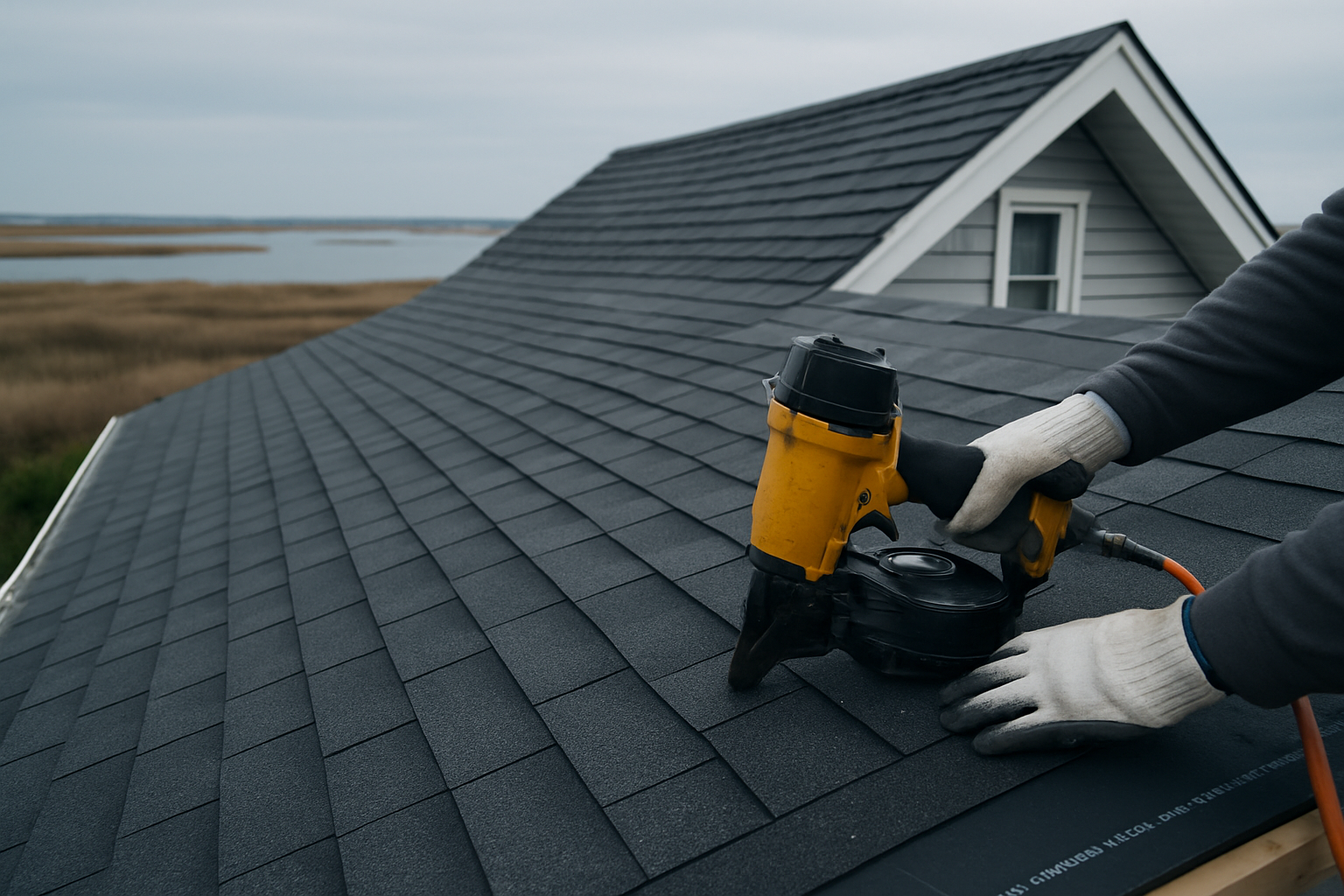
The nailing zone is the strip the manufacturer designates for fasteners. Driving nails above it leaves too little shingle above the fastener to resist the wind. Driving below it puts the fastener outside the reinforced area of the shingle. Driving through the mat, whether by overdriving or by using the wrong pressure on a pneumatic nailer, cuts the shingle's grip and creates a path for water. Any one of these errors is enough to erase the tested rating even when the right shingle and the right nail count are on the job.
For a coastal roof, the nailing pattern should be written, not assumed. The scope should state six nails per shingle, the nailing zone, and the expectation that fasteners sit flush rather than buried. The same discipline applies to the starter course at the eaves and rake, which is where wind gets its first purchase on the roof edge. A high-wind shingle that starts with a poorly fastened edge course has already lost the first battle before the field shingles go on.
Ice and water shield coverage for Atlantic County roofs
Shingles are not waterproof by themselves. They are a wind- and impact-resistant outer skin that sheds the vast majority of water, and the underlayment beneath them is the secondary barrier that handles what gets through. On a coastal Atlantic County roof, that secondary barrier has to do more work than it does inland, because wind-driven rain and ice dams push water sideways and uphill.
Synthetic underlayment has largely replaced felt on quality installations because it does not wrinkle when it gets damp, holds fasteners better, and stays intact if a storm arrives before the shingles do. It runs over the entire deck, lapped so water always flows over a seam rather than into it.
Ice-and-water shield is a different product with a different job. It is a self-adhered membrane that seals around the fasteners that penetrate it, and it belongs at the three places water concentrates on a coastal roof:
- Eaves, where ice dams and wind-driven rain back water up under the shingles.
- Valleys, where two roof planes funnel water into a single channel.
- Penetrations, including chimneys, skylights, and pipe boots, where flashing is the first line of defense but never the only one.
A written proposal should say exactly where the membrane starts and stops, not just that ice-and-water shield is included. Ask the question the way a contractor should be able to answer it: where exactly does ice-and-water shield go? If the answer is vague, the coverage will be vague, and the places that need the membrane most will be the places it does not reach.
The roof tear-off checklist for an NJ reroof
Before you sign a replacement contract, work through this checklist. Every item is a question an Atlantic County homeowner should be able to get answered in writing, and the answers belong in the scope, not in a phone call.
- How many layers are coming off, and is this a full tear-off to the bare deck?
- What underlayment is specified, and where exactly does ice-and-water shield run?
- Is every piece of flashing new, including step, counter, chimney, and pipe boots?
- What is the per-sheet price if decking has to be replaced?
- What wind class is specified, and what nailing pattern is attached to it?
- What ventilation is being added or corrected, and is intake included?
- Who pulls the municipal permit and who schedules the township inspection?
- What does cleanup include, and is there a magnet sweep for nails?
A proposal that answers all of these is a scope. A proposal that answers none of them is a price on a truck. The difference is what protects you when the roof is opened and the conditions on your deck turn out to be worse than the estimate assumed.
Roof deck inspection before new shingles go down
The deck is the plywood or OSB layer the shingles are nailed to. It is the part of the roof you cannot evaluate from the ground, and it is the part that determines whether the new roof stays attached and stays dry.
Three signs say the deck needs attention before it is covered again:
- A sagging or wavy roof line, or decking that flexes when walked.
- Daylight visible through the roof deck when you look up from the attic.
- Rot at the predictable Atlantic County locations: eaves, valleys, chimneys and skylights, and shaded north slopes.
A full tear-off is the only way every square foot of sheathing gets inspected before new material goes down. That is why the tear-off is not an upsell; it is the inspection step. When rot is found, the right response is a written per-sheet replacement rate that was already in the proposal, not a surprise change order negotiated in the driveway after the old roof is already in the dumpster.
Ridge ventilation and attic intake: keeping the warranty valid
A properly vented roof moves air in at the low edge and out at the high edge. The ridge vent is the exhaust. The soffit or eave intake is the inlet. They are one system, and a roof that is vented at the ridge but starved at the soffit is not vented at all.
The reason this matters to a coastal asphalt roof is heat and moisture. A hot, humid attic shortens shingle life, encourages ice dams at the eaves, and can rot the deck from the underside. Manufacturer warranty language and the applicable building code both assume the roof is ventilated. A shingle that fails early on an unvented attic is a fight you do not want to have with a warranty department.
Before the shingles go on, ask the contractor to state the exhaust area and the intake area, and to confirm the intake is actually open. If the soffits are blocked, correcting that is part of a competent reroof, not an optional line item. Ridge ventilation only keeps the warranty valid when the attic can actually draw air in from below.
Municipal permit and inspection sequence in Atlantic County
Permit requirements and the inspection sequence vary by township, so they belong in the written scope rather than assumed. Before work starts, confirm with the contractor who pulls the permit and who schedules the inspection, and get that in writing.
The sequence should be straightforward. The contractor pulls the municipal permit if one is required. The old roof comes off and the deck is inspected before it is covered again. The underlayment, ice-and-water shield, flashing, and shingles go on. The township inspector then checks the stages the municipality requires, and the job closes out when the inspection passes.
Hold any bidder to that standard. A contractor who suggests skipping a required permit to save time or money is not saving you anything — you may be left with an unpermitted roof and a disclosure problem when you sell. Confirm the permit and inspection details in writing before the tear-off begins.
Common mistakes that void a good shingle choice
- Buying the rating, not the installation. A high-wind-rated shingle with four misplaced nails is not a high-wind roof. Fix: get the fastening pattern in writing with the shingle class.
- Accepting an overlay to save the tear-off cost. The code's two-layer limit means the removal cost is deferred, not avoided, and the extra layer adds weight. Fix: if the roof already has one layer and you plan to stay, do the full tear-off now.
- Letting ice-and-water shield stay vague. The product only works where it is installed. Fix: require the proposal to name eaves, valleys, and penetrations and the coverage at each.
- Agreeing to a price before the deck is known. Deck rot is invisible until tear-off, and Atlantic County rot clusters in known places. Fix: insist on a per-sheet replacement rate before work starts.
- Venting the ridge and starving the soffit. A ridge vent without intake moves almost no air. Fix: confirm the intake area was measured and any blocked soffit will be opened.
Questions to get in writing before you sign
The five questions below are the ones a homeowner should ask, and the answers belong in the contract, not in a phone call.
- Is this a full tear-off, and how many layers are coming off?
- What underlayment is specified, and where exactly does ice-and-water shield go?
- Is every piece of flashing new, including step, chimney, and pipe boots?
- What is the per-sheet price if decking has to be replaced?
- What wind class and nailing pattern are specified for my street's exposure?
If a contractor cannot answer these in writing and leave the proposal with you to read overnight, that is the answer. A written, itemized scope is the only version of a roof quote you can compare, hold, and enforce. HappyRoof's Atlantic County roofing team writes every estimate fixed in writing before a single shingle comes off.
Frequently asked questions
Does my Atlantic County roof need a high-wind shingle, or is a standard shingle enough?
It depends on exposure, not on the county line. A sheltered inland street may be fine with a standard class and four nails; an open bayfront or high-exposure street needs a higher tested wind class and the enhanced fastening pattern that goes with it. Have the contractor explain the exposure of your specific street before you accept a shingle class.
What does a shingle wind rating actually guarantee?
A wind rating is a laboratory number, and it is conditional. A shingle rated for high wind speeds only achieves that rating when it is installed with the manufacturer's enhanced fastening pattern — typically six nails per shingle instead of four, driven in the specified nailing zone, not high, not low, and not overdriven through the mat. Get the nail placement wrong and the tested rating is void as a practical matter, whatever the wrapper says.
Is six nails per shingle really necessary, or is four enough?
For high-wind and coastal exposure, the enhanced six-nail pattern is what the tested rating assumes. Four nails are standard for ordinary conditions. The nail count matters less than placement: six nails driven outside the nailing zone or overdriven through the mat are worse than four correct nails.
Where should ice-and-water shield go on a coastal New Jersey roof?
At the eaves, in valleys, and around penetrations such as chimneys, skylights, and pipe boots. These are the places where ice dams, wind-driven rain, and funneled runoff concentrate. A written proposal should state the exact locations and coverage, not just include the phrase.
Why do I need a full tear-off instead of an overlay?
New Jersey's adopted building code limits a roof to two layers of covering. An overlay defers the removal cost, adds the weight of another layer, and hides the deck from inspection. Once a second layer is on, the next roof is a full tear-off no matter what.
What happens if the contractor finds rotten decking after tear-off?
Deck rot is invisible until the old shingles come off, and it clusters at eaves, valleys, chimneys and skylights, and shaded north slopes. The fix is a per-sheet replacement rate agreed in writing before work starts, so the discovery becomes a known line item rather than a surprise.