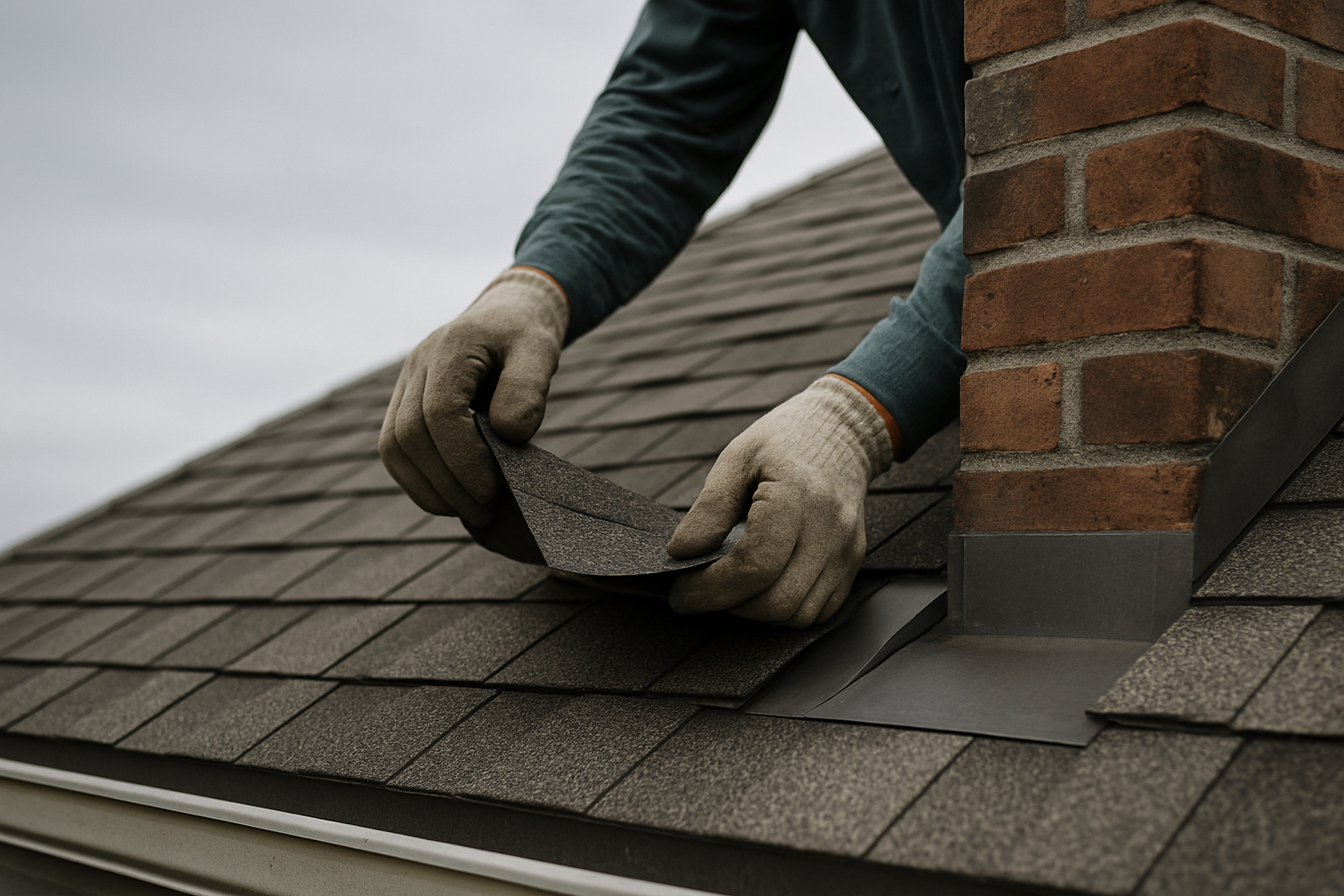
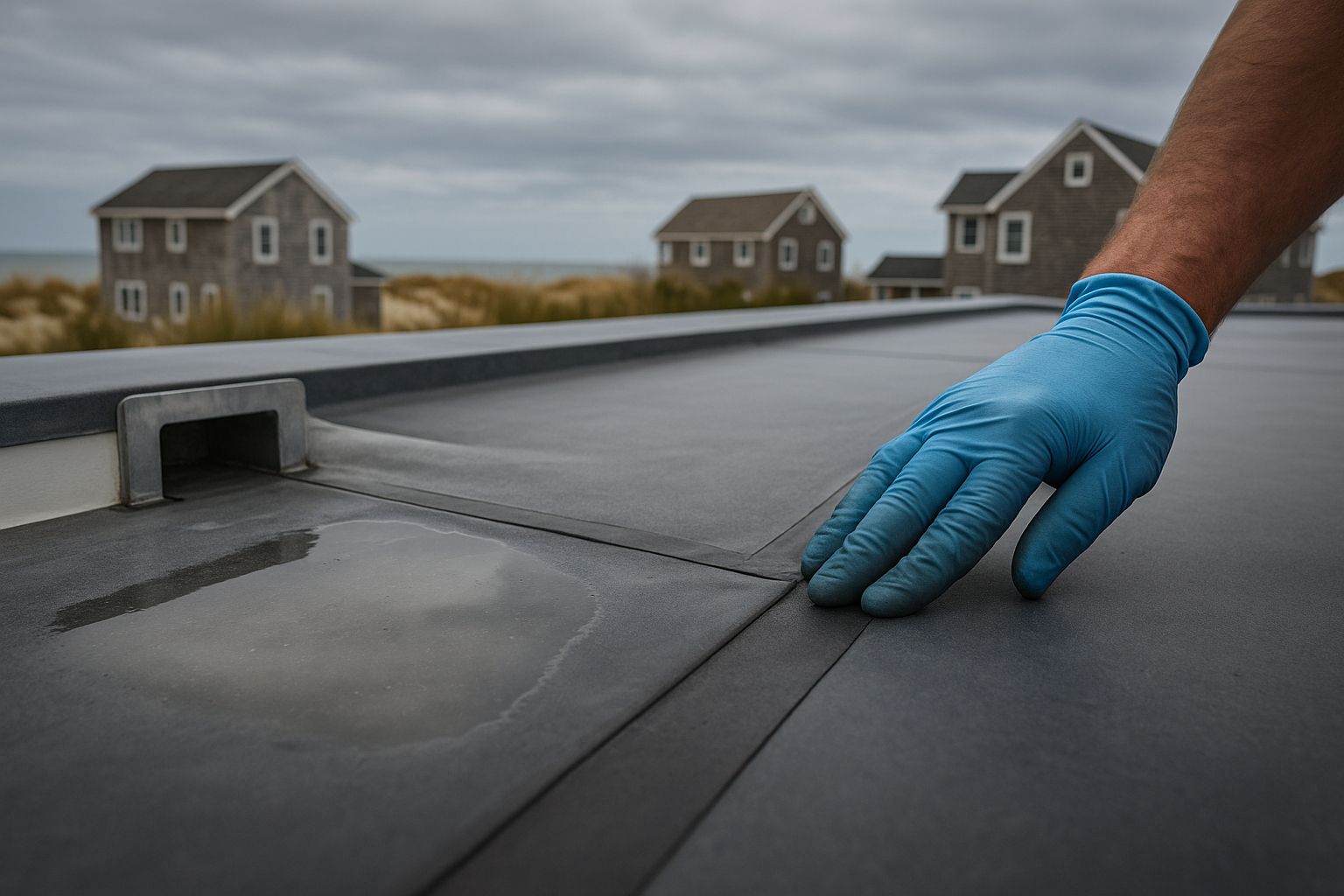
Flat roof repair in Atlantic County, NJ means finding where water actually enters a low-slope membrane — at a seam, flashing detail, drain, or scupper — rather than patching the stain inside. We repair flat membrane roofs on shore homes and additions, address ponding and wind-driven-rain failures, and give you photo documentation plus a written price before work starts.
Flat roof repair in Atlantic County, NJ: what it actually means
When a homeowner says "flat roof," they usually mean one of two things: a porch or rear addition on an older shore house that was built nearly dead level, or a low-slope section of a main roof where shingles cannot shed water fast enough. In Atlantic County, those roofs are everywhere: over the rear and porch roofs in the older neighborhoods of Atlantic City and Pleasantville, over the additions in Egg Harbor Township and Galloway, and on the low-pitch sections that connect an original house to a newer wing.
The repair discipline is different from shingle work. A shingle roof is a system of overlapping, water-shedding units. A low-slope membrane is a continuous waterproofing layer, and it is only as good as its weakest detail. Most roof leaks are not the roof failing; they are one detail failing. That single sentence is the entire logic of flat roof repair, and it is why a low-slope roof leak in NJ is almost always a detail problem rather than a membrane problem. The membrane in the middle of the roof almost never leaks. Water gets in where the membrane stops, changes direction, is penetrated by a pipe, or meets a wall, a drain, or an edge.
The economics work the same way. Most roof repairs in Atlantic County fall between $400 and $1,800: the low end for a single accessible detail, the high end for multiple details or difficult staging. Flat and low-slope roofs are a different material and a different repair entirely. When the membrane itself is at the end of its life, full replacement with a flat membrane is a separate job, priced after inspection based on area and how much of the substrate needs rebuilding.
What matters on a low-slope roof is not how many years it is old but what condition the details are in. Two roofs of the same age can be in completely different states: one with clean seams and dry insulation, one with open laps and a saturated deck. The inspection is what tells you which one you own.
How low-slope roofs fail on shore homes and additions
Low-slope roofs do not fail randomly. They fail in patterns, and after enough service calls the pattern becomes obvious: the open field of a roof almost never leaks. The membrane in the middle of a low-slope surface is doing the simplest job on the whole roof, which is holding water back until it drains. Leaks happen at transitions, interruptions, and fasteners. Most low-slope leaks fall into a short list of recurring defects.
The Atlantic County environment accelerates those defects. Wind-driven rain from a nor'easter finds every loose lap and lifts every weak flashing. Salt air from the barrier islands corrodes the metal details and fasteners that hold terminations down. The Pine Barrens leaf load plugs scuppers and drain strainers in the fall, and when a drain is plugged, water that was supposed to leave the roof in minutes sits there instead. Freeze-thaw cycles work on any sealant that has begun to pull away.
The recurring defects break into four families, and each has a different fix:
- Membrane failures — open laps, blisters, splits, or punctures in the membrane itself.
- Flashing failures — water getting behind the membrane or metal at walls, curbs, parapets, and penetrations.
- Drainage failures — ponding caused by a clogged scupper or drain, insufficient slope, or a sagging deck.
- Edge and corner failures — wind uplift pulling the membrane loose at the perimeter and at corners.
The rest of this page walks through each family the way an inspection does: what you have, what fails, what the fix looks like, and when the fix is no longer worth doing.
EPDM, TPO, and modified bitumen: know which membrane you have
Before you can talk about repairing a low-slope roof, you need to know which membrane is up there. The three families behave differently, fail differently, and are repaired differently.
EPDM
EPDM is a synthetic rubber membrane, a thermoset that is cured during manufacture and will not re-melt when heated. It is installed in wide sheets, which keeps field seams to a minimum, and those sheets are joined with adhesive or seam tape. EPDM is almost always black, stays flexible in cold weather, and handles the temperature swings of a coastal winter well. Its failure mode tends to be at the laps: adhesive seams can open over years, and the sheet can shrink slightly, pulling at terminations and edge details. A repair on EPDM is usually a seam clean-and-rebond, a patch over a puncture, or a re-secured termination.
TPO
TPO is a thermoplastic polyolefin, usually white or light-colored, and its seams are joined by hot-air welding rather than adhesive. A correctly welded TPO seam becomes one piece of material, which is why TPO is popular for low-slope work. The reflective surface also reduces heat gain in summer. TPO's failure mode is typically a weak or open weld, a puncture, or a failed patch from a previous repair. Repairs are done by cleaning the surface and re-welding or patching with compatible material. The catch is that welding requires clean, dry conditions and the right equipment; it is not a caulk-and-go job.
Modified bitumen
Modified bitumen is asphalt-based and reinforced, applied in rolls with torch, cold adhesive, or a self-adhered backing. Many older porches and additions in Atlantic County were built with it. It often has a granulated surface that looks like shingle granules, or a smooth surface that may be coated. Modified bitumen fails by blistering, splitting, or developing alligator cracking as the asphalt ages, and its roll overlaps can open. It can be repaired by cleaning and re-adhering laps or applying compatible patches, but a roof that is cracking across the field is telling you it is done.
If you do not know what you have, look at three things. A black, rubbery sheet with wide panels and taped or glued laps is usually EPDM. A white or light sheet with visible welded seams is usually TPO. A granulated or asphalt-looking surface in rolls is usually modified bitumen. None of this is a substitute for an inspection, but it helps you describe the roof accurately over the phone.
Here is the comparison in one place:
| Membrane family | Material type | Seam method | Typical surface | Common failure mode |
|---|---|---|---|---|
| EPDM | Thermoset synthetic rubber | Adhesive or tape laps | Black, flexible | Open laps, shrinkage at terminations, punctures |
| TPO | Thermoplastic polyolefin | Hot-air welded seams | White or light, reflective | Weak welds, open seams, punctures, failed patches |
| Modified bitumen | Reinforced asphalt rolls | Torch, cold adhesive, or self-adhered | Granulated or smooth | Blisters, splits, alligator cracking, open roll laps |
One thing to be clear about: when a flat or low-slope roof in this area is replaced, the replacement is a flat membrane sized and flashed correctly for a coastal climate. We do not claim a particular brand, and we do not need to. What matters is that the material is right for the exposure, the details are built for wind-driven rain, and the installation is manufacturer-certified.
Ponding, drains, and scuppers: how much water is too much
Flat roof ponding is the most common low-slope complaint on a shore home, and it is also the most misunderstood. A low-slope roof is expected to get wet during a storm. The question is not whether water stands while it is raining; the question is whether it is still standing well after the rain has stopped.
The practical field test is simple. If the water drains away after the storm passes, the roof is doing its job. If it is still sitting there day after day, that is ponding, and it is doing damage. Manufacturers publish the ponding depth and duration their membranes will tolerate, and those published details govern whether a repair passes muster. The general rule is easier to state: standing water should be the exception, not the steady state.
Ponding matters for three reasons. First, standing water keeps the membrane wet and accelerates aging at exactly the spot where it sits. Second, it collects debris, and the Pine Barrens leaf load here is real; that debris holds moisture and blocks drainage further. Third, it is a symptom. Water ponds because something is wrong: the slope is too shallow, the deck has settled or sagged, or a drain or scupper is not moving water off the roof. Left alone, the ponding works down through the membrane over time, and the first place you find out is often a wet ceiling below a spot that looked fine from outside.
The drainage path on a low-slope roof is one of three things:
- Roof drains — internal drains that carry water down through the building. The failure points are the strainer, clogged with leaves; the drain bowl seal, where the membrane ties into the drain; and the drain flashing itself.
- Scuppers — openings through a parapet or low wall that let water spill off the roof. A scupper can be blocked, undersized, or poorly flashed where it passes through the wall.
- Edge drainage — where the membrane slopes to a gutter or drip edge at the low side.
A roof scupper drain repair is usually one of a few jobs: clearing the opening, re-flashing the scupper to the membrane, replacing a rusted scupper liner, or adding a leaf guard where debris keeps plugging it. A roof drain repair is usually a strainer cleanup, a failed sealant joint at the drain bowl, or a loose sump clamp. Those are detail repairs, not roof replacements, when the rest of the membrane is sound.
The harder ponding case is a roof that has always been too flat. If a porch or addition was framed with almost no pitch, no amount of drain cleaning will fix it. The repair then becomes a question of adding slope, typically with tapered insulation or a re-framed deck, and that crosses into replacement territory. That is the honest conversation we have during an inspection, and it is why a ponding roof cannot be quoted over the phone.
Seam and flashing failures: where water actually gets in
If you remember one sentence from this page, it should be this one: leaks happen at transitions, interruptions, and fasteners. The open field of a membrane almost never leaks. Water gets in where the membrane ends, turns, or is punctured.
Seams
Every low-slope membrane has seams, and every seam is a potential entry point. EPDM has lap seams joined with adhesive or tape. TPO has heat-welded seams. Modified bitumen has roll laps. The failure looks the same from inside: a stain on the ceiling or a damp spot in the insulation, often far from where the water actually entered.
An open lap is usually repairable if the surrounding membrane is still pliable. The repair is to clean the lap, re-bond or re-weld it, and sometimes cover it with a compatible patch. The key word is compatible: you cannot patch TPO with EPDM, and you cannot caulk a weld. A repair that mixes materials is the next leak waiting to happen.
Flashing
Flashing is where the membrane meets something else: a wall, a chimney, a parapet, a pipe, a curb, a skylight, a hatch. These are the highest-failure details on any low-slope roof because they concentrate movement, wind, and water all in one place.
The common flashing failures on low-slope roofs are:
- Roof-to-wall transitions, where the membrane runs up a vertical surface and terminates under a counterflashing. If the termination is loose or the counterflashing has pulled away, wind-driven rain gets behind it.
- Pipe penetrations, where a pipe boot or pitch pocket has dried and cracked. A cracked pipe boot is one of the least expensive repairs on the roof and one of the most common sources of a persistent leak.
- Curbs and parapets, where the membrane turns up and over. A parapet is a long, exposed seam with a termination on top; every foot of it is a potential opening.
- Edge metal and drip edge, where the membrane ends at the roof perimeter. Lifted or corroded edge metal lets wind get under the membrane and starts the peel.
The repair is usually to remove the failed material, install new flashing in the correct sequence, and re-secure the termination so water sheds over it instead of behind it. This is detail work, and it is exactly where craftsmanship shows: the flashing has to lap in the right order, and the fasteners have to be in the right place and sealed.
Wind uplift at edges and corners
Wind is the reason a low-slope roof on a barrier island is not the same job as a low-slope roof inland. Wind moving over a building creates negative pressure, suction, on the roof surface, and that suction is not uniform. It is highest at the corners, strong along the edges, and lower in the field. A gust that skims across a porch roof can lift the membrane at a corner, peel it back from the edge, and turn a small loose detail into a torn roof in one storm.
That is what wind-driven rain does here. A nor'easter does not just drop rain straight down; it drives it sideways and uphill, under loose flashings, through open laps, and behind terminations that looked fine on a dry afternoon. A roof specified for an inland subdivision is not specified for a bayfront house in Margate, and we build accordingly.
The failure sequence at the perimeter usually goes like this: a termination loosens, wind gets under the membrane and works it loose in pulses, the membrane balloons and flexes at the edge, and eventually the edge metal lifts or the membrane tears at a corner. The repair is to re-secure the termination, replace any lifted or corroded edge metal, repair the torn membrane with compatible material, and, where the manufacturer's details call for it, add the securement the roof should have had in the first place. Corners get special attention because they take the most suction on the whole roof.
Salt air makes the metal side of this worse. Fasteners and edge metal near the ocean corrode faster than inland, and a corroded fastener is a loose termination waiting to fail. That is one reason edge and corner repairs on the barrier islands so often include replacing the metal, not just re-securing it.
For storm events, the sequence is different: emergency tarping first to stop further water entry, then documentation for the insurance claim, then the permanent repair once the weather allows. We tarp first and talk about the rest second.
Repair or replace: the threshold for low-slope membranes
The hardest question on a low-slope roof is not "what is wrong" but "should I keep patching this." The answer comes down to defect spread and substrate condition, not age alone.
Repairs make sense when the failure is a detail. One open seam, one failed flashing, one cracked pipe boot, one clogged scupper: these are single-visit fixes, and the math favors repairing them. Most roof repairs in Atlantic County fall between $400 and $1,800 for exactly this kind of work.
Replacement makes sense when the failure is the membrane or the deck. If the membrane is brittle and cracking across the field, if multiple seams have failed, if the insulation underneath is wet, or if the roof has always ponded because the slope is wrong, then another patch is delaying the inevitable. A flat membrane roof replacement is a separate job, and the price depends on area and how much of the substrate needs rebuilding.
Wet insulation is the hidden half of this decision. A membrane can look repairable from above while the insulation below it is saturated. Saturated insulation stops insulating, holds moisture against the deck, and turns a small repair into a bigger problem the longer it waits. That is why the inspection looks at the substrate, not just the surface, and why a patch is only as good as what it is patching onto.
Here is the threshold in plain terms:
- Repair the detail when one transition, penetration, or seam is failing and the surrounding membrane is still pliable.
- Replace the membrane when the field is failing, the membrane has lost flexibility, or the deck is saturated.
- Fix the drainage when the only problem is a clogged scupper, a failed drain seal, or debris, and the slope is otherwise adequate.
- Rebuild the slope when the roof has always ponded because it was framed too flat.
We show you the evidence either way. The inspection includes photos of what we actually find, an honest remaining-life assessment, and a clear statement of what a repair does and does not address. If you have ten good years left, you will hear that too.
What a flat roof repair includes — and what it does not
A flat roof repair is a defined scope of work, and the useful half of this page is the exclusions.
A repair includes:
- Finding the actual source of the water entry, not the stain.
- Before and after photographs of the actual defect.
- A clear statement of what the repair does and does not address.
- Itemized written pricing before work starts.
- Manufacturer-certified installation.
- Full cleanup, including a magnet sweep for nails.
- Proof of current New Jersey licensing and insurance on request.
A repair does not include:
- A new membrane where the old one is still serviceable. We will not sell a replacement for a roof with years left.
- A warranty that covers unrelated parts of the roof. The repair addresses the defect named in the written scope.
- Acting as your public adjuster or legal advisor. We document storm damage and can meet your adjuster, but the claim is yours.
- Absorbing or waiving your insurance deductible. We do not do that; we document the damage and the repair scope.
- A binding price for a roof we have not inspected. Price ranges are general guidance; a quote requires the inspection.
The exclusion list protects you as much as the inclusion list. A roofer who will not show you the defect, will not put the scope in writing, or will not tell you what the repair does not cover is selling something other than a repair.
The repair process, step by step
Here is what a low-slope roof repair looks like from first call to finished job.
- Book the free inspection. Call (609) 525-4521. We schedule a time to get on the roof and look at the membrane, the details, and the drainage.
- Find the source. We trace the water from the stain back to where it enters. On a low-slope roof, that means checking seams, flashings, drains, scuppers, and edges in the order the water would find them.
- Show you the evidence. You get photos of the actual defect, not a verbal summary. If the roof does not need work, you get that answer instead.
- Get the written price. The scope and price are itemized and in writing before anything starts. No open-ended "we will see what we find."
- Do the repair. The same people who inspected the roof do the work. Membrane repairs are made with compatible material; flashings are removed and reinstalled in the correct sequence; drains and scuppers are cleared, re-flashed, or replaced.
- Document the result. You get after photos to match the before photos, so you can see what changed.
- Clean up. Full cleanup, including a magnet sweep so no fastener ends up in a tire or a bare foot.
- For storm damage: emergency tarping first, then photos and documentation for the insurance claim, then the permanent repair once the weather allows.
The one thing that changes the order is weather. A repair on a wet, windy day is not the same job, and some membrane work, heat-welded TPO above all, needs a dry surface. We schedule around that rather than pretend it does not matter.
What to have ready before you call
The more you can tell us before we arrive, the faster the inspection goes.
- Where you see water inside. The room, the ceiling or wall location, and whether it appears during the rain or hours later. That timing is a clue about where the entry is.
- What type of roof it is. Porch, rear addition, or low-slope section of the main roof. If you know the membrane, EPDM, TPO, or modified bitumen, say so.
- Where the roof drains. Does it have a scupper through a parapet, a roof drain, or a gutter at the edge? Is any of it clogged with leaves?
- Photos you have already taken. Water stains, ponding after rain, lifted flashing, or anything that looked wrong from a window.
- Any past repairs. Invoices, receipts, or a memory of who did what and when. The previous repair is often the new leak.
- Insurance information if it is storm-related. The policy and any claim number, plus the date of the storm that did the damage.
- Access notes. For island towns especially: whether there is a shared driveway, a narrow lot, or a parking restriction we need to plan around.
None of this is required before we come out, but each item shortens the visit and gets you to a written price sooner.
Inspection intervals for a coastal low-slope roof
A low-slope roof in Atlantic County should not wait for a stain to get looked at. The practical minimum is a look at least once a year, plus a check after any storm that produced real wind-driven rain. The reason is that most low-slope failures are slow. An open seam or a failing drain seal usually leaks for months before the water shows up on a ceiling, and by then the insulation underneath may already be wet.
The inspection is free, and it is not a sales call. You get photos of what we actually find and an honest answer on whether the roof needs work, including when it needs nothing. If you are buying or selling a home, the same inspection answers the question a home inspector cannot: how much life is actually left in the membrane and what a repair or replacement will cost.
The fall is a particularly good time for a low-slope inspection here, before the Pine Barrens leaf load and the nor'easter season arrive together. A scupper that is clear in September may be a pond by November.
Where we repair low-slope and flat roofs in Atlantic County
We run low-slope and flat roof repair calls across all of Atlantic County, New Jersey, and the logistics differ more than people expect.
On the barrier islands, Atlantic City, Ventnor City, Margate City, Longport, and Brigantine, staging is the challenge. Narrow lots, shared driveways, and summer parking restrictions mean we plan access before we plan the repair. A membrane tear on a bayfront house in Margate is a different job than the same tear inland, because the wind exposure and the access are both different.
In the older neighborhoods of Atlantic City and Pleasantville, we frequently encounter low-slope rear and porch roofs that need membrane work rather than shingle work. These are often the original flat roofs over porches, and the repair is a different material and a different discipline.
Across the mainland, Egg Harbor Township, Galloway, Northfield, Linwood, Somers Point, Absecon, Hammonton, Mays Landing, Egg Harbor City, and the surrounding townships of Mullica, Hamilton, Buena, Folsom, Port Republic, Estell Manor, and Weymouth, the same membrane work applies to the low-slope additions and porch roofs that are common on older homes.
We serve every town in Atlantic County.
Scheduling, tarping, and next steps
Regular repair calls are scheduled with same-day service available. Storm response is different: emergency tarping is available when a storm hits, because the point of a tarp is to stop water entry before the next tide cycle or the next band of rain, not after business hours resume.
The next step is the free inspection. Call HappyRoof Roofing & Exteriors at (609) 525-4521, tell us whether it is a porch roof, an addition, or a low-slope section of the main roof, and we will get on the roof, find the actual source, and show you the photos. You get a written price before anything starts, or an honest answer that you do not need the work at all.
Frequently asked questions
How much does flat roof repair cost in Atlantic County, NJ?
Most roof repairs in Atlantic County fall between $400 and $1,800 for accessible, single-visit detail work. A full low-slope membrane replacement is a different job, and its price depends on area and substrate condition. A specific flat roof repair is priced after inspection, in itemized writing, before any work starts.
Why does water pond on my porch roof, and is it a sign the roof is failing?
Ponding means water remains standing after the rain has stopped. It is caused by too little slope, a sagging deck, or a clogged drain or scupper. Persistent ponding is not automatically a failed roof, but it shortens membrane life and is a warning. The fix may be as simple as clearing a scupper or as involved as rebuilding slope.
Can a low-slope membrane leak be repaired without replacing the roof?
Usually, yes. Most low-slope leaks are detail failures — an open seam, a loose flashing, a failed drain seal — not a failing membrane across the whole roof. If the membrane itself is brittle, cracked, or the deck is saturated, replacement becomes the honest answer.
How do I know whether to repair or replace my flat roof?
The test is defect spread and substrate condition. One failed detail points to repair; multiple open seams, a brittle or shrinking membrane, or wet insulation underneath points to replacement. We show you photos of the actual roof and give an honest remaining-life assessment, including when you have good years left and need nothing.
Will my homeowners insurance cover flat roof storm damage?
If wind-driven rain opened a seam, lifted flashing, or tore a membrane, the loss may be covered. We document the damage with photos and can meet your adjuster, and we provide emergency tarping to stop further entry. We are not a public adjuster and cannot advise on your policy; we document what happened and the repair scope.
Do you repair modified bitumen roofs or only EPDM and TPO?
Many older porches and additions in Atlantic County were built with modified bitumen, and we assess those membranes the same way we assess any flat membrane. If the roof is repairable, the detail determines the repair. For full replacement on flat and low-slope sections, we install a flat membrane sized and flashed for a coastal climate.