Roofing Margate NJ bayfront homes means starting with the parts you cannot see: salt air corrodes fastener heads, drip edge, flashing, vent hoods, and gutter hangers before the shingle field fails. Salt aerosol corrodes fasteners years ahead of mainland schedules, so moderate wind can lift shingles. The fix is corrosion-resistant metal, enhanced fastening, and wind-driven-rain underlayment as a system.
Why roofing Margate NJ bayfront homes need a different salt-air specification
Atlantic County runs three different roofing environments under one county name. On the barrier islands — Atlantic City, Ventnor City, Margate City, Longport, and Brigantine — the governing loads are sustained ocean wind, salt aerosol, and a housing stock of narrow attached and semi-attached buildings with low-slope rear sections. Inland toward the Pinelands, the same county means tree cover, limb strikes, shaded slopes that grow moss, and gutters that pack with pine needles each autumn.
A roof specified for a subdivision in central Jersey is not specified for a bayfront house in Margate. That sentence is the whole job. On the islands, the failures to watch are fastener, flashing, and underlayment failures at the perimeter, where wind and salt work for years before a leak ever shows on a ceiling.
Salt air roof corrosion is cumulative and quiet. It does not appear in a single storm report. It settles, wets, dries, and repeats, until the small metal parts that hold a roof together lose their grip. The practical difference between a mainland roof and a barrier-island roof comes down to four specification decisions: corrosion-resistant metal on every exposed component, enhanced fastening that holds under uplift, underlayment that stops wind-driven rain, and perimeter detailing for the way ocean wind wraps around eaves and rakes.
| Exposure factor | Mainland Atlantic County | Margate, Longport, Ventnor City, Brigantine barrier islands |
|---|---|---|
| Dominant weather load | Tree cover, Pine Barrens leaf load, limb strikes | Sustained ocean wind, salt aerosol, wind-driven rain |
| Fastener aging | Normal weathering | Salt corrosion years ahead of schedule |
| Typical housing stock | Detached homes, varied styles | Narrow attached and semi-attached buildings with low-slope rear sections |
| Site staging | Driveway staging is common | Often no driveway to stage from |
What does salt air corrode first on a barrier-island roof?
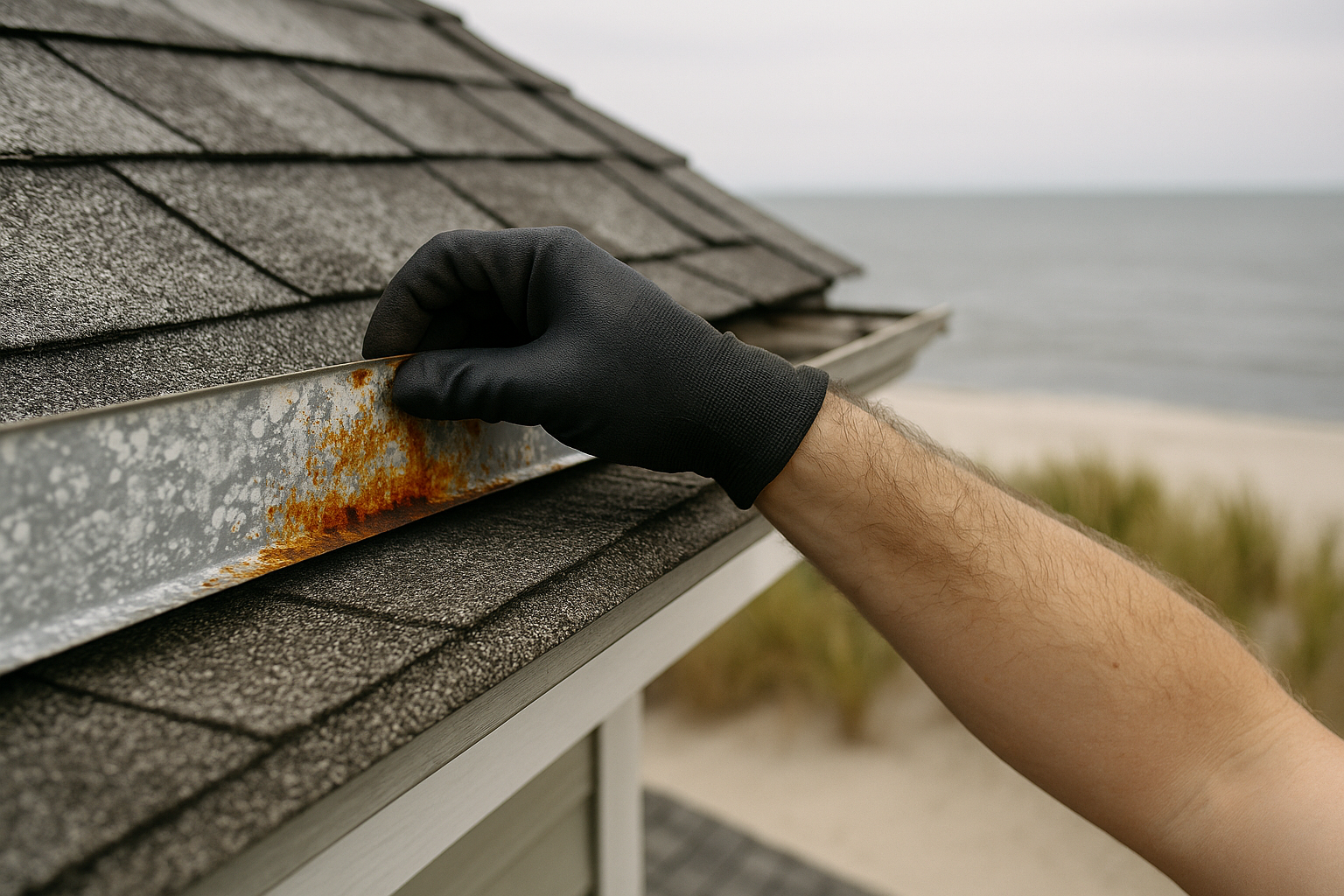
Salt corrosion on a barrier-island roof is not one dramatic event. Salt aerosol carried inland from the surf settles on every exposed metal surface, and it attacks fastener heads, drip edge, vent hoods, gutter hangers, and flashing.
The sequence matters. Fastener heads go first because they are small, numerous, and constantly wetted and dried by salt-laden air. A corroded fastener loses holding power, and the result is that the same wind event a mainland roof shrugs off can lift shingles on an island roof of identical age and specification. The shingle did not fail; the fastener did.
After fasteners, the perimeter metals go: drip edge and rake metal at the eaves, then vent hoods, then gutter hangers. Flashing at walls, valleys, and pipe boots pits and leaks on a longer clock. None of this is visible from the street, which is why a drive-by quote under-reads an island roof.
| Roof component | What salt air does | What the specification should address |
|---|---|---|
| Fastener heads | Corrode and lose holding power | Corrosion-resistant fasteners with enhanced fastening |
| Drip edge and rake metal | Rust at the perimeter | Corrosion-resistant metal at eaves and rakes |
| Vent hoods | Corrode and crack | Salt-tolerant vent hoods inspected with the roof |
| Gutter hangers | Corrode and let gutters pull away | Corrosion-resistant hangers checked with the roof |
| Flashing | Pits and leaks at walls, valleys, pipe boots | Corrosion-resistant step and counter flashing, valley metal, pipe boots |
Corrosion-resistant metal is a specification, not an upsell
A bayfront roof is only as salt-tolerant as its least-resistant component. Corrosion-resistant metal and enhanced fastening earn their keep here, but the phrase only helps if it is itemized. When a proposal says "corrosion-resistant metal," ask which parts it covers: fasteners, drip edge, flashing, vent hoods, and gutter hangers all need to be selected for salt exposure, not just the field of the roof. A roof with quality shingles and cheap fasteners is a mainland roof wearing a coastal costume.
Gutter hangers and vent hoods are the parts homeowners rarely think about until they corrode. On an island home they should be checked with the roof, because a failed gutter hanger lets a seamless gutter pull away from the fascia and pour water against the wall, and a cracked vent hood lets wind-driven rain straight into the attic.
The material conversation on a bayfront home should start with the components that fail first, not the one that looks best from the street. A shingle can be wind-rated and still fail early if the fasteners holding it are corroding.
Fastener selection and the load path that usually fails
The load path on a shingle roof runs from the shingle, through the fastener, into the deck. Most coastal roofing conversations start and end at the shingle, which is the wrong end of the chain. The fastener is the component salt attacks first, and it is the component whose failure turns a rated shingle into a loose one.
Enhanced fastening is not a single number. It is a pattern: more fasteners in the high-load zones, the right fastener length for the deck, and a corrosion-resistant material that does not sacrifice holding power after seasons of salt wetting and drying. The most heavily loaded zones are the eaves, rakes, ridges, and corners. Adding fasteners uniformly across the field matters less than getting the perimeter right, because uplift concentrates at edges.
A proposal that says "wind-rated shingles" but does not describe the fastening and perimeter detail is incomplete. The wind rating describes what the tested assembly can withstand; the field installation determines whether the roof on the house actually does. On a barrier island, the fastener schedule and the fastener material are part of the specification, not an afterthought.
Why wind-driven rain makes underlayment the waterproofing layer
Wind-driven rain is the leak mechanism that separates island roofs from mainland roofs. On a calm day, a shingle roof sheds water by gravity. In a nor'easter, rain does not fall on a roof; it is driven sideways into it, and it will find any lap that faces the wrong way. The shingle field is not the waterproofing in that moment; the underlayment is.
That is why ice-and-water shield matters on Margate and Brigantine homes. Its job in this environment is not only ice damming at the eaves. It is a membrane that seals around fasteners and stays watertight where wind-driven rain gets under the shingle course. The vulnerable zones are the same on nearly every island house: eaves, rakes, valleys, and every penetration — pipe boots, vent pipes, and the low-slope rear sections that so many older shore homes carry.
Wider membrane coverage in valleys and at wall intersections is cheap insurance on an oceanfront exposure, and it is one of the specific items worth comparing line by line between bids. If the underlayment stops short of the edge or is not lapped correctly, the deck gets wet long before the shingle shows visible damage. An inspection that only looks at shingles from the street will miss exactly this.
Coastal wind rating in New Jersey: a system attribute, not a sticker
Uplift is the force that peels a roof off, not the force that blows it over. Sustained ocean wind lifts shingle edges and, over enough cycles, works fasteners loose. On a bayfront home the governing questions are not just "which shingle" but how many fasteners, where, and in what pattern.
Coastal construction in New Jersey is built to wind provisions that differ from inland exposure. The practical answer on a roof is enhanced fastening and wind-rated shingle lines. Architectural asphalt shingles are a common choice for these roofs, and wind-rated lines are worth specifying for coastal exposure. But a wind rating is only delivered if the fastener schedule is correct and the fasteners themselves are corrosion-resistant. Salt corrosion losses in holding power undo the rating the shingle was tested to.
The uplift conversation should also cover the perimeter. The most heavily loaded zones on any roof are the eaves, rakes, ridges, and corners. Enhanced fastening in those zones matters more than adding fasteners uniformly across the field. Homeowners should treat a coastal roof wind rating as a system attribute, not a shingle sticker.
Bayfront, beach block, and a few blocks inland: the gradient matters
Within the barrier islands, exposure is a gradient, not a switch. A bayfront house in Margate takes the full marine load: salt aerosol on every metal surface, sustained wind off the water, and wind-driven rain against the windward elevations. A house a few blocks inland sees less direct spray but still lives in the same salt-laden air mass, and the same corrosion sequence runs on a longer clock.
The specification does not change wholesale from block to block; the inspection does. Two houses on the same street can have different answers depending on how the wind wraps the roof, whether the rear section is low-slope, and how much of the metal is sheltered by the building next door. A bayfront specification is not about over-building every house the same way; it is about matching the detailing to the exposure the house actually sits in.
That is why the free inspection starts with photos of the actual roof rather than a template. A roof that looks like the neighbor's may have a completely different remaining life once the fasteners, flashing, and low-slope sections are documented.
Material tiers for a salt-air exposure
Architectural asphalt shingles are a common choice for Atlantic County homes, and for good reason: the price-to-performance balance is strong, and wind-rated lines are worth specifying for coastal exposure. The shingle is only one layer of the system, but it is the layer homeowners see, and the coastal conversation should never stop at color.
Metal roofing is the durability tier for a salt-air exposure. Standing-seam metal sheds wind-driven rain and resists the salt corrosion that eats fasteners on the barrier islands. The reference range on the HappyRoof site puts standing-seam metal at roughly $18,000 to $45,000 installed. It makes the most sense on homes where the owner intends to stay, on low-slope sections where shingles struggle, and on architectural styles that suit it.
Flat and low-slope roofs — the porch and addition roofs so common on older shore houses — take EPDM or TPO membrane instead, generally $8,000 to $18,000 depending on area and how much of the substrate needs rebuilding. Those numbers are general guidance, not a contract: the quote for a specific home requires an inspection, and the tear-off is what turns an estimate into an honest number.
Whatever the material, the installation is manufacturer-certified, and the material conversation happens around exposure, fastening, and installation rather than a logo. The honest question for each tier is the same: what holds it down, what seals the laps, and what happens at the perimeter. Answer those three and the material choice becomes secondary to the detailing.
| Material | Where it fits on a barrier-island home | Reference cost guidance |
|---|---|---|
| Architectural asphalt shingles | Pitched main roofs; wind-rated lines specified | Priced after inspection; no per-home range published here |
| Standing-seam metal | Longer-lived surface; low-slope sections; salt exposure | $18,000–$45,000 installed |
| EPDM/TPO membrane | Low-slope rear sections, porches, additions | $8,000–$18,000 installed |
Low-slope rear sections: where shingles stop being the answer
Older Margate and Brigantine homes frequently carry a low-slope rear section behind the pitched front roof. These sections pond water longer and collect wind-driven rain differently from the pitched field, and they are a repeat source of leaks on shore homes.
On a low-slope or flat section, shingles stop being the right answer. EPDM and TPO membrane are the materials that belong there, with the seams and edge details inspected as closely as any shingle. The transition where a pitched roof meets a low-slope membrane is a classic weak point, and it needs its own flashing detail rather than a hope.
If a home already has a membrane roof that is showing distress, the repair question is different from a shingle repair. The scope depends on how much of the substrate needs rebuilding, and the honest conversation starts with what is under the membrane, not just what is on top. For that, the flat and low-slope roof repair guide covers shore and addition roofs in detail.
Party walls on attached shore homes
On attached and semi-attached shore homes, the party wall is the detail that gets misdiagnosed most often. Flashing where one roof meets a neighbor's wall is a natural water trap, and on the islands it is also a salt trap. Counter flashing, step flashing, and the sealant between them take salt and wind-driven rain for years.
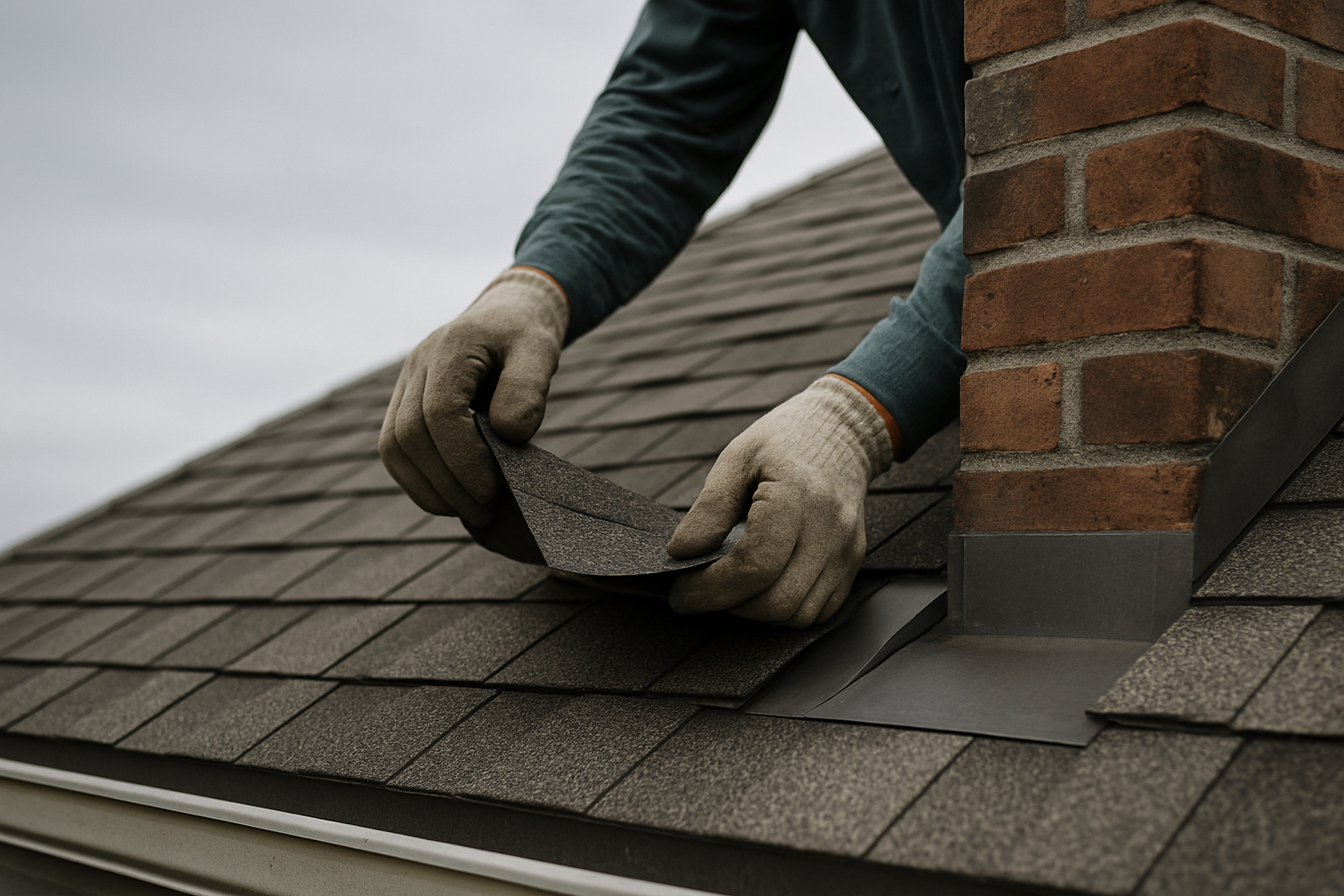
A leak at the party wall is frequently blamed on the neighbor's roof when the actual source is failed counter flashing that belongs to the home being inspected. That is why the inspection has to look at the wall intersection, not just the shingle field. The same logic applies to chimneys, valleys, and pipe boots: roof flashing repair is about finding the actual source instead of patching the stain.
Ventilation on tight island lots
Ventilation is the part of a barrier-island roof that gets skipped on tight lots. Attached and semi-attached homes often have constrained attic space, and a roof sealed up for winter but under-ventilated in summer will cook the shingles and the fasteners. Heat and trapped moisture shorten the life of the assembly just as surely as salt does, on a different clock.
Ridge ventilation that balances intake and exhaust is a detail worth confirming in the proposal, not after the ridge cap goes on. On a coastal home, the ventilation detail also has to hold up to wind-driven rain, so the vent itself and its flashing are part of the salt-exposure checklist. Roof ventilation in Atlantic County covers the humid-attic problem in more depth.
Gutters, hangers, and downspouts in salt air
On a barrier-island home, the gutter system is part of the roof assembly, not a separate project. Salt air attacks gutter hangers on the same clock as roof fasteners, and a failed hanger lets a seamless gutter pull away from the fascia and pour water against the wall — the exact condition that rots soffit, fascia, and trim.
Downspouts matter here too. Wind-driven rain can overwhelm an undersized or clogged downspout during a nor'easter, and the overflow lands against the foundation or the siding. The inspection that documents the roof should check hangers, seams, and downspout discharge at the same time, because water management on a coastal home is one continuous system from the ridge to the ground.
HappyRoof installs gutters and downspouts, and the same salt-exposure logic applies: the hangers and fasteners should be specified for the marine air, not just the gutter itself.
Common failure patterns on older shore homes
Older Margate and Brigantine homes fail in recognizable patterns, and knowing them helps a homeowner read an inspection report instead of waiting for a stain.
The first pattern is fastener corrosion. Fastener heads rust and lose grip, so shingles lift in wind that would not bother a newer mainland roof. The second is wind-lifted shingles after a nor'easter, concentrated at eaves, rakes, and corners. The third is flashing failure at step and counter flashing, valleys, and pipe boots, where salt has eaten the metal or the sealant has dried and cracked. The fourth is leak activity at the low-slope rear sections common on narrow attached and semi-attached buildings. The fifth is slow peripheral failure — vent hoods, gutter hangers, and drip edge corroding while the shingle field still looks serviceable.
None of these patterns announces itself loudly. The leak on the second-floor ceiling is often the last symptom, not the first. A photo-based inspection that documents fasteners, flashing, and underlayment condition is worth more on an island home than a drive-by quote.
The inspection: photos of what salt has already done
HappyRoof's inspection is free and comes with photos of what is actually up there. If the roof has ten good years left, the homeowner hears that and keeps the report. When the roof genuinely needs replacing, the next step is an itemized written proposal before anyone picks up a nail gun.
For a bayfront home, a useful inspection report should show more than the shingle field. It should document fastener condition, drip edge and rake metal, flashing at chimneys, walls, valleys, and pipe boots, the condition of vent hoods and gutter hangers, and any low-slope rear section that is holding water or showing membrane distress. Those are the components salt air attacks first, and they determine whether the roof needs repair or replacement.
The report is also useful when a roof has years left. A homeowner who hears that a roof has five or six good years can plan a replacement instead of reacting to a leak, and can pass that documentation to a buyer rather than guessing. For the maintenance and inspection questions that follow, see the Atlantic County roof lifespan guide.
Reading a bayfront roof before you buy or sell
Shore home transactions move on deadlines, and a roof is the item most likely to derail a closing. A buyer who skips the roof is buying an unknown quantity of salt exposure, and a seller who has not looked at the roof may be surprised by an inspection objection two weeks before closing.
The same free inspection with photos serves both. The report shows whether fasteners are corroded, whether flashing is intact, whether the low-slope rear section is holding water, and how much remaining life the roof has. A buyer gets a factual basis for the price; a seller gets the option to address a small item before it becomes a negotiating point.
A shore home with a documented roof inspection sells differently from one with a mystery overhead. The seller who can hand over photos, a remaining-life note, and an itemized repair scope removes the roof as a bargaining chip, and the buyer who reads the report is pricing a known condition instead of a guess. On attached and semi-attached homes, that documentation also covers the party-wall flashing, which is exactly where the neighbor question comes up.
What a complete bayfront roof replacement should include
A complete bayfront roof replacement is a system, not a shingle order. The reference work should include:
- Complete tear-off to the deck so the sheathing can actually be seen.
- Deck repair or replacement where the sheathing is wet, delaminated, or rotten, with the per-sheet price confirmed before work starts.
- Underlayment and ice-and-water shield in the vulnerable zones: eaves, rakes, valleys, and penetrations.
- Ridge ventilation that balances intake and exhaust rather than adding a vent and calling it done.
- Step and counter flashing at walls and chimneys, valley metal, and pipe boots, all selected for salt exposure.
- Drip edge and rake metal at the perimeter, where wind-driven rain and uplift do their worst work.
- Corrosion-resistant fasteners and enhanced fastening in the high-load zones.
- Full cleanup including a magnet sweep for nails.
The tear-off is the part that turns an estimate into an honest number. Until the old roof comes off, nobody can see how much decking is rotten or how the original flashing was detailed. That is why a written proposal should state the per-sheet decking price up front, so the final number does not arrive as a surprise change order.
Most homes are a one to two day job, with the landscaping tarped, a magnet run over the yard and driveway, and everything hauled away. For the shingle side of that scope — wind ratings, nailing, and underlayment — the asphalt shingle roof replacement guide covers Atlantic County specifics.
Permits and wind-zone verification by municipality
Margate City and Brigantine are separate municipalities with their own processes, and they sit alongside mainland towns such as Egg Harbor Township, Galloway, Somers Point, and Pleasantville. New Jersey requires a permit for a roof replacement, and permit requirements and inspection points can differ from one municipality to the next, so the permit conversation should happen before materials are ordered, not after tear-off.
Before signing any roof replacement contract, confirm three things in writing: who pulls the permit, who meets the municipal inspector, and what the inspection sequence is. HappyRoof pulls the permit and schedules around the weather. A roofer who cannot answer those three questions cleanly is not ready to start.
The permit is also the moment when wind-zone requirements are checked. The municipality's inspector verifies the work against the exposure the home actually sits in, which is exactly the point: a bayfront house in Margate is not supposed to be built to a central Jersey subdivision specification.
Storm response: tarping, documentation, and the adjuster
A nor'easter does not wait for business hours. When wind lifts shingles or a limb opens a hole, the immediate job is to stop water from entering the building, and the second job is to document the damage before anything is disturbed.
HappyRoof provides emergency tarping for Atlantic County homes. Homeowners should photograph what they can see from the ground, keep any receipts for temporary work, and avoid walking a wet or wind-damaged roof themselves.
Tarping is a temporary measure. It buys time to get a written proposal and an insurance settlement without a ceiling collapsing in the meantime. It is not a repair, and it should be followed by an inspection that finds the actual source of the water entry rather than patching the stain.
Coastal storm claims turn on documentation. The more that is photographed and written down before the roof is touched, the cleaner the settlement. HappyRoof documents storm and wind damage for insurance claims and helps homeowners prepare for the adjuster's walk-through, so the homeowner is not the only person translating roof damage into policy language.
The sequence that protects a homeowner: photograph the visible damage from the ground. Get a tarp on any opening to stop further water entry, and keep the receipt. Have the roof inspected and the scope written in itemized form. Then present that scope when the adjuster walks the property. The honest path is a documented scope and a legitimate claim.
Questions to ask before you sign
Before signing a roofing contract in Margate, Brigantine, or anywhere else on the Atlantic County coast, get written answers to these questions:
- What is the per-sheet price if decking has to be replaced?
- What ventilation work is included, and does it balance intake with exhaust?
- Who pulls the permit and who meets the municipal inspector?
- Which components are specified as corrosion-resistant: fasteners, drip edge, flashing, vent hoods, and gutter hangers?
- Where is ice-and-water shield placed, and how is the perimeter detailed?
- What is the enhanced fastening schedule in the eaves, rakes, ridges, and corners?
- What does cleanup include, and is there a magnet sweep for nails?
A contractor who answers these in writing is describing a system. One who waves them off is selling shingles.
Frequently asked questions
What does salt air do to a roof?
Salt aerosol settles on fastener heads, drip edge, flashing, vent hoods, and gutter hangers. It corrodes fasteners years ahead of mainland schedules, so they lose holding power and shingles lift in wind that a mainland roof would shrug off. The damage is cumulative and often invisible from the street until a leak appears. The fix is corrosion-resistant metal on every exposed component and enhanced fastening.
How do I know if my roof fasteners are corroding?
You usually cannot see it from the ground. The signs are lifted or loose shingle edges after moderate wind, rust-colored staining at the eaves, and corroded vent hoods or gutter hangers. An inspection that documents fasteners, drip edge, and flashing with photos is the reliable way to know. The free HappyRoof inspection includes exactly those photos.
Does a metal roof make sense on a Margate bayfront home?
Standing-seam metal is the durability tier for salt air. It sheds wind-driven rain and resists the corrosion that eats fasteners on the barrier islands. The reference range on the HappyRoof site is $18,000 to $45,000 installed, and it makes the most sense on homes where the owner intends to stay and on low-slope sections where shingles struggle.
Do I need ice-and-water shield on a barrier-island roof?
On barrier-island homes, wind-driven rain makes the underlayment the real waterproofing layer. Ice-and-water shield at the eaves, rakes, valleys, and penetrations seals around fasteners and protects the deck where wind pushes water under shingle edges. Wider membrane coverage at valleys and wall intersections is cheap insurance on an oceanfront exposure.
What should I do after a nor'easter lifts shingles?
Stop water entry first, then document. Photograph visible damage from the ground, avoid walking a wet roof, and keep receipts for temporary work. HappyRoof provides emergency tarping and then documents the storm and wind damage for the insurance claim. Tarping is temporary — it should be followed by an inspection that finds the actual source.
Do I need a permit to replace a roof in Margate or Brigantine?
New Jersey requires a permit for a roof replacement. Margate City and Brigantine are separate municipalities, and requirements and inspection points can differ. Confirm in writing who pulls the permit, who meets the municipal inspector, and what the inspection sequence is. HappyRoof pulls the permit and schedules around the weather.
Get a free bayfront roof inspection
The next step is not a guess. Call HappyRoof at (609) 525-4521 or stop by 611 Doughty Rd, Pleasantville, NJ 08232 for a free inspection with photos of your own roof, an honest remaining-life assessment, and a written price before anything starts. Emergency tarping is available when storm damage opens the roof.