
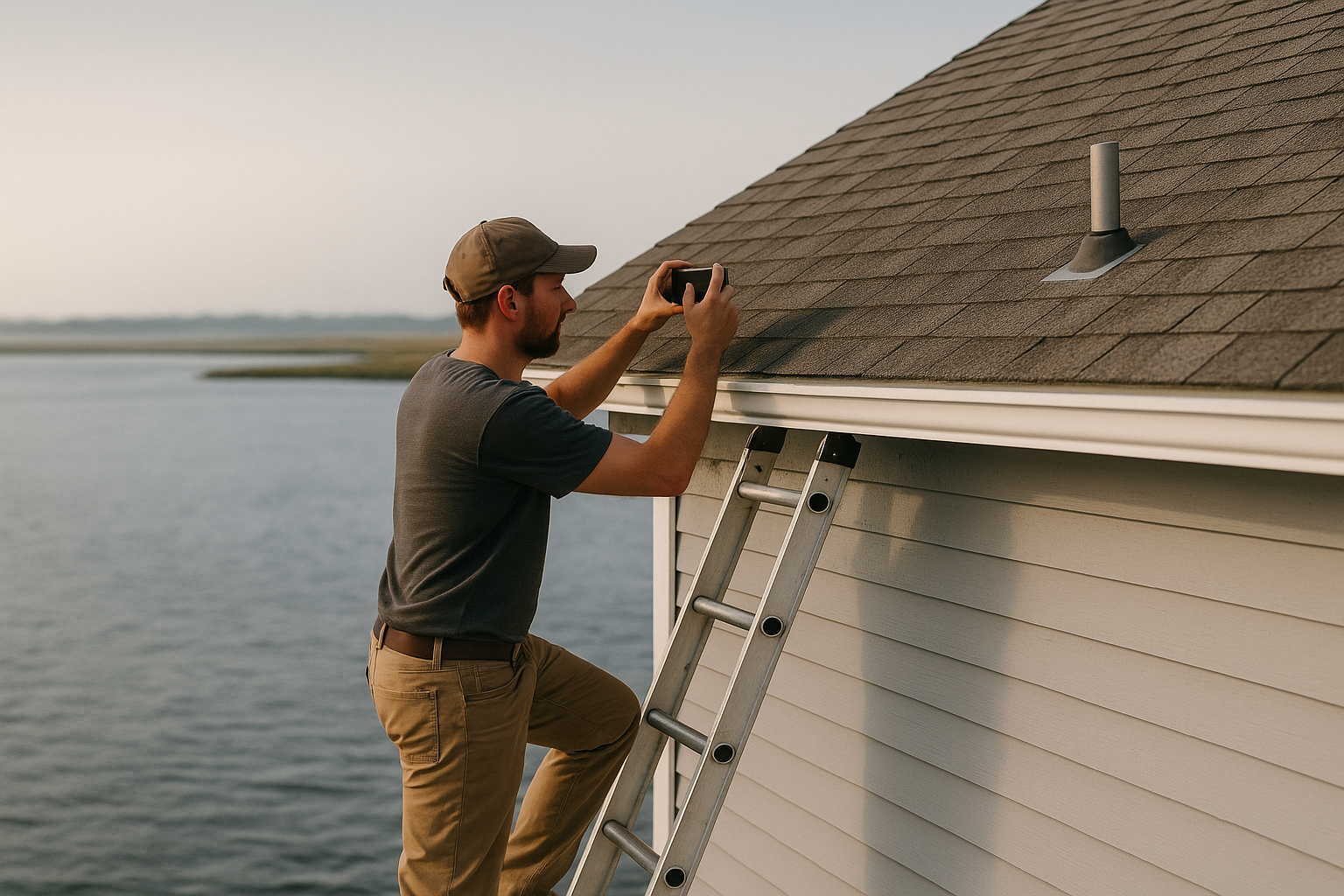
There is no single roof lifespan for Atlantic County NJ. The real answer depends on material, salt-air exposure on the barrier islands versus pine shade inland, installation and ventilation quality, and how well flashing, gutters, and pipe boots are maintained. A free photo inspection turns that into a remaining-life answer instead of a guess.
Why Atlantic County NJ has no one-size-fits-all roof lifespan
A roof lifespan chart that gives one number for every house is not useful here. Atlantic County splits into at least two exposure regimes, and they age roofs differently.
On the barrier islands, Atlantic City, Ventnor City, Margate City, Longport, and Brigantine take a category of damage that does not appear in a single storm report. Sustained ocean wind lifts shingle edges, and salt aerosol carried inland from the surf settles on every exposed metal surface. It attacks fastener heads, drip edge, vent hoods, gutter hangers, and flashing. Corroded fasteners lose holding power, which means the same wind event that a mainland roof shrugs off can lift shingles on an island roof of identical age and specification.
Inland toward the Pinelands, the load is different. Tree cover means limb strikes, shaded slopes that grow moss, and gutters that pack solid with pine needles every autumn. A shaded north slope in Mullica Township with heavy tree cover can fail years before an identical roof on an open lot in Northfield.
The company's own rule applies here: a roof specified for a subdivision in central New Jersey is not specified for a bayfront house in Margate. The same product installed in two parts of the county is not the same roof, and how HappyRoof builds for Atlantic County reflects that.
The same reasoning applies inside a single town. Two homes on the same street in Galloway can age differently if one sits under pines and the other faces open sky. Lifespan follows the site, not the zip code.
Age also matters less than most homeowners assume. Salt air, constant wind, and summer attic heat all accelerate the same aging chemistry. Two roofs of the same calendar age can be in very different condition: one may have ten good years left, another may be near the end of its serviceable life. The number worth knowing is remaining life, not years since installation.
How long do shingles last in NJ?
Shingle life in New Jersey is a range set by product line, site, and upkeep, not a fixed calendar number. Architectural asphalt shingles are what go on the overwhelming majority of homes in Atlantic County, and the wind-rated lines handle coastal exposure well. That still does not produce a single answer for every house.
What moves the number:
- Exposure. Salt air and constant wind on the barrier islands age a shingle roof faster than a quiet inland lot. A shaded north slope under trees ages faster than an open lot in Northfield.
- Ventilation. Summer attic heat accelerates the chemistry that breaks down asphalt. Ridge ventilation that lets the attic breathe changes how hot the shingles run.
- Installation. The same shingle performs differently depending on the underlayment, ice-and-water shield, flashing details, and decking beneath it. Manufacturer-certified installation matters, but warranty coverage and remaining life are not the same thing.
- Maintenance. Gutters that pack with pine needles, moss on shaded slopes, and corroded fasteners all shorten useful life.
Do not let calendar age make the decision for you. A roof's age tells you which questions to ask; it does not tell you the answer. A young roof with poor ventilation or corroded fasteners can be in worse shape than an older roof that was installed well and maintained. The inspection exists to answer the question with evidence rather than with a subtraction problem.
So the question "how long do shingles last in NJ?" has a site-specific answer. The useful question is "how much life does my shingle roof have left?" That answer comes from the shingle field, the flashing, the decking, and the ventilation, all of which a photo inspection can document rather than guess at.
If the inspection finds a sound roof with years left, the right answer may be targeted maintenance and a later re-check. If it finds multiple failure signals across several slopes, patching stops being economical.
What does salt air do to roof lifespan on the barrier islands?
Salt air is a slow, cumulative failure mechanism, and it deserves its own answer. Homes in Atlantic City, Ventnor City, Margate City, Longport, and Brigantine take a category of damage that does not appear in a single storm report: cumulative corrosion.
Salt aerosol carried inland from the surf settles on every exposed metal surface. It attacks fastener heads, drip edge, vent hoods, gutter hangers, and flashing. Corroded fasteners lose holding power. That means the same wind event that a mainland roof shrugs off can lift shingles on an island roof of identical age and specification.
The practical lesson is that a barrier-island roof can fail years ahead of schedule even when the shingles themselves look ordinary from the street. The failure often starts at the metal details, not the shingle field. A homeowner who checks only for missing shingles is watching the wrong thing.
Two consequences follow. First, inspections on the islands should specifically check metal components for corrosion, not just shingle condition. Second, replacement work should specify materials and fasteners for salt exposure. A roof built to a central New Jersey specification is not built for a bayfront house in Margate.
Metal roof lifespan in salt air
Metal is a legitimate roofing option some coastal homeowners consider, and it is not a shortcut around salt air. Salt aerosol attacks metal surfaces, and a metal roof is made of metal: panels, fastener heads, drip edge, vent hoods, gutter hangers, and flashing.
The panel can only hold the wind load if its fasteners hold. When fasteners corrode and lose holding power, a panel edge lifts and wind-driven rain gets underneath. The same applies to flashing at valleys, chimneys, sidewalls, and pipe boots. A metal roof near the ocean lives or dies by the quality of its fasteners and flashings, not by the panel material alone.
That means the question near the coast is not simply "metal or shingle." It is whether the entire assembly is specified for salt exposure and then inspected for corrosion over time. A metal roof with coastal-spec fasteners and flashing, checked regularly, behaves differently from a mainland-spec metal roof that is left alone.
No specific coating or alloy is being claimed here. The point is narrower and more useful: in salt air, fastener and flashing selection is the load-bearing decision.
Low-slope membrane roofs in Atlantic County
Low-slope and flat membrane sections behave differently from steep shingle slopes. Water moves slowly, so the membrane, seams, and flashing at penetrations carry the load. There is no fast downhill shedding to hide a small defect.
A pipe boot, edge detail, or seam that would be a minor issue on a steep roof can become a persistent leak on a low-slope roof because water ponds and sits. Salt air adds the same corrosion problem at edge metal and fasteners that it adds everywhere else in the county.
Remaining life on a membrane roof is read from membrane condition, seam integrity, flashing at penetrations, and drainage. A useful inspection checks for ponding water, cracked or pulled seams, and corroded edge metal. Maintenance is mostly about keeping drains and scuppers clear and repairing small defects before they become large membrane failures.
The same honest principle applies: age alone does not tell you whether a membrane roof is sound. The condition of the seams and flashings does.
Installation details that change roof lifespan
A roof is a system, not a layer of shingles. The parts you do not see decide how long the parts you do see last.
- Underlayment and ice-and-water shield. These are the second line of defense when wind-driven rain gets past the shingles. In a coastal county with nor'easters, they matter.
- Decking. Rotted or flexing decking changes the repair math. The inspection's job is to find decking problems before they become structural.
- Flashing and valley metal. Roughly nine out of ten repairs involve transitions, interruptions, and fasteners rather than the open shingle field. Flashing done well at installation removes most of those future repairs.
- Ridge ventilation. Attic heat accelerates shingle aging. Ventilation is not a comfort feature; it is a lifespan feature.
- Drip edge and rake metal. These hold the roof's edges together and are among the first metal components salt air attacks.
None of these show up in a photo taken from the street. That is why a useful inspection walks the roof and documents the details with photos, and why the report matters even when no replacement is needed.
How ventilation changes the lifespan math
Ventilation is easy to ignore because it is invisible from the street, but it changes how hot the shingles run. Summer attic heat accelerates the same chemistry that ages every asphalt roof. A roof with working intake and exhaust ventilation moves that heat out; a roof without it bakes the shingles from below.
On the coast, ventilation also helps dry the attic after wind-driven rain finds a gap. On inland wooded lots, it helps keep shaded slopes from staying damp. In both cases, ventilation is part of the roof's lifespan, not a separate comfort feature.
A replacement that leaves ventilation unaddressed fixes the surface but not the system. The inspection should note whether intake and exhaust are present and clear.
Barrier island, inland, or open lot: three roofs, three failure patterns
Atlantic County is not one climate. It helps to sort a home into one of three rough exposure classes.
| Exposure class | Examples | Primary aging load | First signs |
|---|---|---|---|
| Barrier island | Atlantic City, Ventnor, Margate, Longport, Brigantine | Salt aerosol, sustained ocean wind | Corroded fasteners, lifted shingle edges, corroded flashing |
| Inland wooded | Mullica Township, Hammonton, Galloway near tree cover | Shade, moss, pine needles, limb strikes | Moss, clogged gutters, granule loss on shaded slopes |
| Open inland lot | Northfield, Egg Harbor Township, Pleasantville | Sun, attic heat, ordinary weather | Curling, granule loss, ventilation stress |
A home can belong to more than one class. A house near the bay in Somers Point may get both salt and wind without being on the oceanfront. The point of the classification is not to file the house into a clean box but to predict which parts of the roof will fail first.
On the barrier islands, the first failure is usually a metal component. Inland, the first failure is often biological: moss holding moisture, or gutters that stop draining. On an open lot, the first failure is usually thermal: hot attics and sun-baked shingles.
The inspection's value is that it reads these local signals instead of applying a generic age formula.
Why a remaining-life assessment beats a lifespan table
A lifespan table gives you an average for a product. A remaining-life assessment gives you a measurement for your roof.
The difference matters because averages hide exactly what homeowners need to know. A table might say a shingle line lasts a certain number of years on average, but your roof is not the average. It has a specific orientation, a specific amount of tree cover, a specific ventilation setup, and a specific maintenance history.
The free inspection reverses the order. It starts with the actual roof: photos of the shingle field, the flashing, the pipe boots, the drip edge, and the decking. Then it gives an honest remaining-life answer. If the roof has ten good years left, that is the answer. If it is near the end of its life, that is the answer too. The report is yours to keep either way.
This is also why the inspection is free and does not come with a sales pitch as the price. An honest remaining-life assessment sometimes ends with "do nothing for now," and that is a legitimate outcome.
What should a roof inspection checklist in NJ include?
A useful Atlantic County roof inspection does not stop at counting missing shingles. It walks the whole system and documents what is actually there. The free inspection HappyRoof offers comes with photos of your own roof and an honest answer on whether it needs replacing.
| Area | What the inspection should check | Why it matters in Atlantic County |
|---|---|---|
| Shingle field | Granule loss, curling, cupping, bald spots | Age shows across slopes before it shows as a leak |
| Valleys and ridges | Metal condition, shingle sealing, debris | Transitions concentrate water flow |
| Flashing | Step, counter, chimney, and sidewall details | Nine out of ten repairs involve transitions and fasteners |
| Pipe boots | Cracking, lifting, failed sealant | A recurring leak source on many roofs |
| Drip edge and rake metal | Corrosion, fastening, lifting | Salt air attacks edge metal on the barrier islands |
| Ridge ventilation | Intake and exhaust, blockage | Attic heat accelerates shingle aging |
| Deck and sheathing | Sagging, flexing, water stains | Deck condition decides repair versus replace |
| Gutters and downspouts | Granule load, pine needles, drainage | Granule buildup is an early aging signal |
The photo-report method is what makes the inspection useful after the inspector leaves. The inspector photographs what is found and shows you the photos, so you are not asked to trust a verbal summary. You keep the report whether or not you buy anything. If the roof has ten good years left, you hear that and leave with the report. If replacement is genuinely needed, the next step is an itemized written proposal before any work starts.
The report is not a pass/fail grade. It is a record of what is present: which components are sound, which are wearing, and which need attention now. That record is what lets a homeowner compare quotes later without starting from scratch.
How often should you maintain gutters, flashing, and pipe boots?
Maintenance is what keeps a roof from failing before its time. Atlantic County has two specific maintenance loads: pine needles and leaf debris inland, and salt corrosion on the coast.
| Item | Practical interval | Atlantic County reason |
|---|---|---|
| Gutters and downspouts | Clean every autumn; check again after storms | Pine needles pack gutters solid every autumn near the Pinelands |
| Flashing, valleys, and chimney details | Inspect at least annually and after major wind events | Most leaks start at transitions, not the open field |
| Pipe boots | Inspect at least annually | A recurring defect in the short list of common repairs |
| Barrier-island metal and fasteners | Check for corrosion at each inspection | Salt aerosol attacks fastener heads, drip edge, vent hoods, and hangers |
| Attic and ventilation | Note at each inspection | Summer attic heat accelerates aging |
Seamless gutters and guards change the maintenance load by reducing joints and debris entry, but they do not remove the need to check downspouts and outlets. Granules still collect at downspout outlets, and that collection is itself a useful aging signal.
After a nor'easter or strong wind event, walk the roof line for lifted shingle edges and wind-driven water. Document what you see with photos and dates, because storm claims depend on documentation. Emergency tarping exists for the gap between damage and repair.
Ground-level checks a homeowner can do between inspections
Between professional inspections, a homeowner can watch for the early signals that something is changing. None of these require getting onto the roof.
- Look for granules collecting in gutters and at downspout outlets after rain.
- Look for shingle corners curling upward or cupping.
- Look for bald spots where the black fiberglass mat is visible.
- Watch for leaks that appear in different areas rather than one recurring spot.
- Look at the roof line for sagging or waviness.
These are the same signals a professional inspection looks for, but the homeowner sees them over time. When one appears, note it. When two or three show up together across slopes, schedule an inspection rather than waiting for a leak to confirm the problem.
Hail and wind damage vs age-related roof failure
Storm damage and age-related failure look different, are documented differently, and should be treated differently.
Wind damage is event-driven. Sustained ocean wind lifts shingle edges over time, and a strong nor'easter tears shingles loose and drives rain under flashing. The damage appears where the wind got under the roof: lifted edges, missing shingles, displaced flashing, and leaks that start right after the storm.
Hail damage is also event-driven. Impact damage concentrates on the slopes facing the storm, while age-related wear spreads across all slopes and worsens slowly.
Age-related failure is gradual. Granules collect in gutters after every rain, shingle corners curl, bald spots appear, and leaks show up in different rooms over months or years. There is no single storm to blame.
The distinction matters because storm damage may be an insurance claim, while age-related failure is maintenance and replacement. HappyRoof documents storm damage, helps with insurance claims, and provides emergency tarping.
What to do after a storm passes
A nor'easter or strong wind event changes the maintenance rhythm. The steps below protect the roof and the insurance claim.
- Look for lifted shingle edges, missing shingles, and displaced flashing from the ground or a safe vantage point.
- Document what you see with photos and dates before anything is moved or repaired.
- Tarp any active leak. Emergency tarping exists for the gap between damage and repair.
- Avoid permanent repairs until the damage is documented and the claim path is clear.
Storm damage is event-driven, so the evidence is fresh and specific. The sooner it is documented, the easier it is to separate storm damage from age-related wear that may already have been present.
When a remaining-life assessment says repair instead of replace
The free inspection's job is to report remaining life honestly, and sometimes the correct answer is repair.
Repair makes sense when the defect is localized. The open field of a roof almost never leaks; shingles in the middle of a slope are doing the simplest job on the whole roof. Roughly nine out of ten repairs involve transitions, interruptions, and fasteners: flashing, valleys, chimney details, and pipe boots. If one of those fails while the shingle field is sound, the correct fix is a targeted roof repair.
Repair also makes sense when the roof has real remaining life. A roof with ten good years left does not need replacement because a pipe boot cracked. A roof with less life left may still justify a modest repair if the decking is sound and the failure is isolated.
Replacement becomes the right answer when the failure signals spread. If two or three signs, granule loss, curling, bald spots, multiple leaks, sagging, show up together across multiple slopes, patching individual spots stops being economical, and a roof replacement conversation should start.
Signs of roof failure
The signals below are the ones that show up repeatedly on Atlantic County roofs.
- Granules collecting in gutters and at downspout outlets after every rain. The shingle is shedding its protective surface, and the loss is no longer incidental.
- Shingle corners curling upward or cupping into a shallow bowl. The mat is losing its shape and its ability to lie flat against wind.
- Bald spots where the black fiberglass mat is visible from the ground. The granule layer is gone in those areas.
- Multiple leaks in different areas of the house rather than one recurring spot. The system, not one detail, is failing.
- A sagging or wavy roof line, or decking that flexes when walked. The structure underneath needs attention.
These signals are listed from the easiest to see from the ground to the ones that need a closer look at the decking. Any one of them deserves a look. Two or three showing up together across multiple slopes is the point where patching stops being economical and a replacement conversation should start.
Frequently asked questions
How long do shingles last in NJ?
Shingle life in New Jersey is set by exposure and upkeep more than by calendar age. Architectural asphalt shingles are the most common choice in Atlantic County, and wind-rated lines handle coastal exposure well. A shaded north slope in Mullica Township can fail years before an identical open-lot roof in Northfield, while salt air and attic heat accelerate aging. The reliable answer is a free photo inspection that reports remaining life.
Does salt air shorten a roof's life in Atlantic County?
On the barrier islands, yes. Salt aerosol settles on fastener heads, drip edge, vent hoods, gutter hangers, and flashing. Corroded fasteners lose holding power, so the same wind event a mainland roof shrugs off can lift shingles on an island roof of identical age and specification. The roof fails years ahead of schedule unless the metal components are specified and maintained for salt exposure.
How often should a roof be inspected in Atlantic County NJ?
At least once a year, and again after any major wind or hail event. Atlantic County has two exposure patterns: salt air and sustained ocean wind on the barrier islands, and tree cover with heavy pine-needle loads inland. A free inspection with photos documents the current condition, checks flashing and pipe boots, and gives a remaining-life assessment before small defects become leaks.
What are the first signs of roof failure?
Watch for granules collecting in gutters after rain, shingle corners curling or cupping, bald spots where the black fiberglass mat shows, multiple leaks in different areas, and a sagging or wavy roofline. If two or three of these appear together across several slopes, patching individual spots stops being economical and a replacement conversation should start.
Can I repair my roof instead of replacing it?
Often, yes. The open field of a roof rarely leaks; roughly nine out of ten repairs involve transitions, interruptions, and fasteners such as flashing, valleys, chimney details, and pipe boots. If the defect is localized and the roof still has years of remaining life, repair is the right call. Replacement makes sense when failure signals spread across multiple slopes.
Is a metal roof a better choice near the ocean?
Metal is a legitimate option for coastal Atlantic County, but it is not automatically trouble-free. Salt air attacks the metal components of every roof: fastener heads, drip edge, vent hoods, gutter hangers, and flashing. A metal roof near the ocean depends on coastal-spec fasteners and flashing and regular corrosion checks, not on the panel material alone.
If you want a remaining-life answer for your roof instead of a generic lifespan table, the free inspection is the place to start. It comes with photos of what is actually up there, an honest assessment, and a written proposal only if replacement is genuinely needed. Call (609) 525-4521 to schedule.