Most Atlantic County roof leaks are a failed flashing detail, not a failing roof. The usual entry points are chimney step and counter flashing, valley metal, pipe boots, and roof-wall intersections. The repair that holds is diagnosis first: trace the stain to the actual water entry point, rebuild that detail, and document what was found.
Start with the symptom, not the component
Most homeowners do not call and say "my counter flashing has lost its reglet grip." They call about a stain, a drip, or a wet patch that appeared after a storm. The fastest way to turn that symptom into a repairable job is to match what you are seeing to the flashing detail most likely to have failed.
| What you see | Likely flashing detail | What to check | Permanent fix |
|---|---|---|---|
| Ceiling stain near or below a chimney, worse after wind-driven rain | Chimney step and counter flashing, or a missing cricket | Reglet grip in the mortar joint, shingle laps around the chimney, chimney width | Replace step flashing course by course, cut a new reglet, install counter flashing, add a cricket on a wide chimney |
| Water stain on a wall below a roof-wall or dormer intersection | Step flashing run, missing kickout flashing | Bottom of the step flashing run, siding lap, gutter placement | Reset step flashing, add a kickout that discharges onto the roof or into the gutter |
| Stain near a bathroom or kitchen ceiling, tracking a vent stack | Cracked pipe boot | Rubber collar for splits, boot base for lifting, shingle laps around the boot | Replace the pipe boot and re-lay the surrounding shingles |
| Drip or stain at the eave below a valley | Valley metal, packed valley debris | Metal for corrosion or creases, deck beneath the valley for rot | Clean and reset sound valley metal, or replace corroded metal and damaged sheathing |
| Water around a skylight shaft | Skylight curb flashing, failed skylight seal | Curb flashing laps, seal between frame and glass | Rebuild curb flashing, replace the seal, rule out attic condensation |
| Rotting fascia or water at the eave on an older home | Missing or failed drip edge | Whether drip edge is present at the eave and rake | Add or reset drip edge so water leaves the sheathing edge |
| Dark spots, lifted shingle edges, scattered stains | Nail pops or wind-lifted shingles found during the same inspection | Backed-out nails, broken adhesive strips, shingle corners | Reset shingles and refasten, replace wind-damaged field |
A caution belongs right up front: water travels. A stain on a living-room ceiling can originate at a chimney flashing on the far side of the roof, and a stain below a window can come from a roof-wall intersection one story up. The table is a starting point, not a verdict. Confirming the entry point means following the water path from the interior stain into the attic and then onto the roof surface.
What roof flashing is, and why it fails before the shingles do
Roof flashing is the metal transition where a roof plane meets something that is not roof. Field shingles rarely leak on their own. The leaks concentrate at chimneys, sidewalls, dormers, valleys, plumbing vents, skylight curbs, and eaves. Those are all flashing details, and each one fails in its own way.
In Atlantic County, the climate makes those failures faster and more visible. Wind-driven rain from a nor'easter pushes water sideways into flashing laps that would shed an ordinary vertical rainfall without trouble. Salt air works on metal over time, especially the thin flashing and fastener heads exposed on the barrier islands. Pine Barrens leaf load fills valleys and holds moisture against the metal long after the rain stops. Freeze-thaw cycles open up mortar joints and reglets. A roof specified for a subdivision in central Jersey is not specified for a bayfront house in Margate, and the flashing details have to be built accordingly.
A permanent flashing repair is not a bead of caulk over a visible crack. It means removing the shingles or siding needed to expose the detail, replacing or resetting the metal, and putting the roof back together so the water path is corrected. Sealant may be used as a supporting material, but it is never the repair itself.
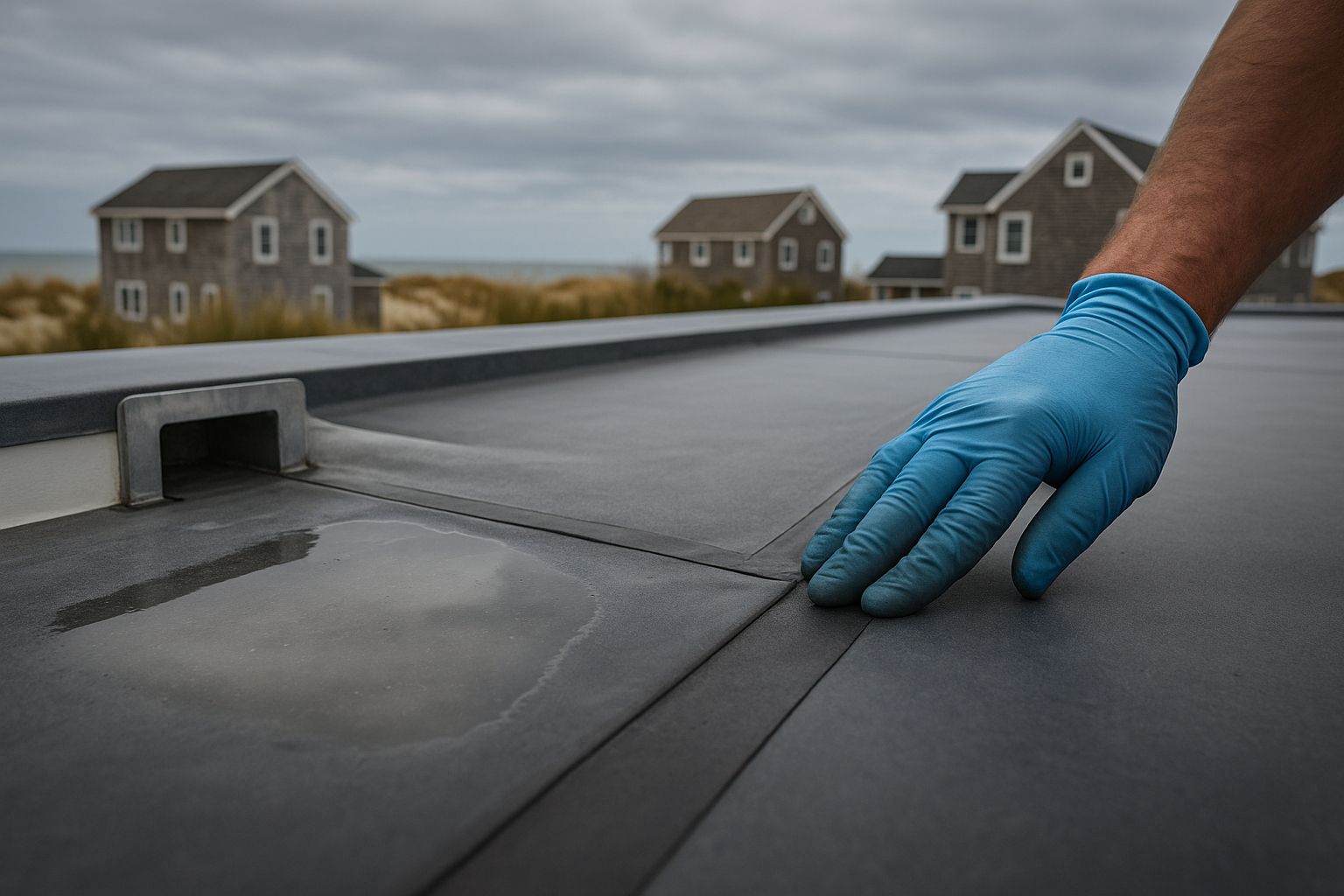
This page covers steep-slope flashing. For shore and addition roofs with low slope, flat roof repair for shore and addition roofs is a separate discipline with its own membrane and penetration details.
Step flashing and counter flashing: two layers, two failure modes
Step flashing and counter flashing are often confused, but they do different jobs. A correct chimney or sidewall installation has both.
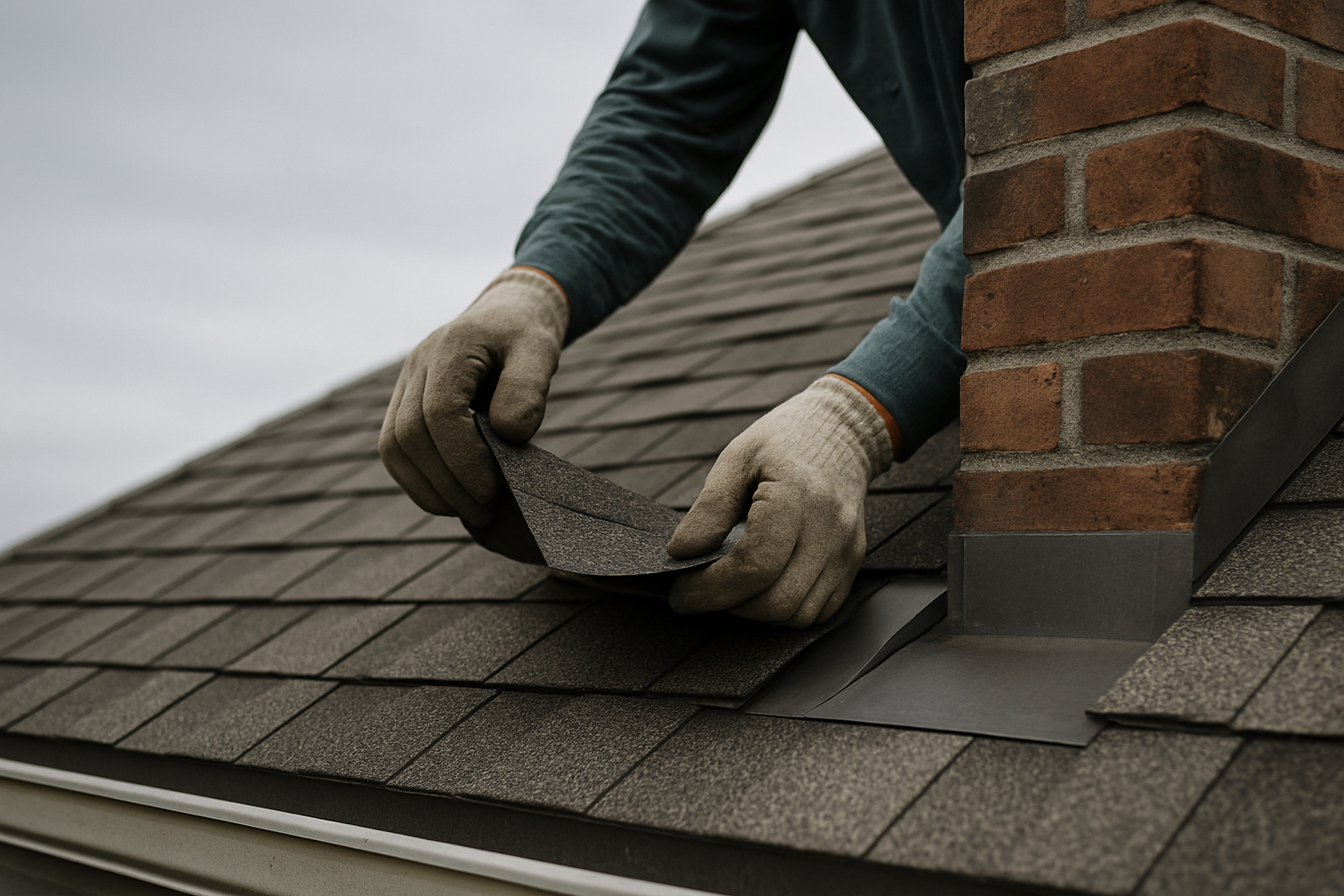
Step flashing is the L-shaped metal that sits under each shingle course and turns up the vertical surface. One piece is installed per course, each lapping the one below. The shingle covers the flat leg of the step flashing, and the vertical leg lies against the masonry or wall. As water runs down the roof, each piece of step flashing directs it onto the shingle course below.
Counter flashing is a separate piece of metal set into a groove, called a reglet, cut into the mortar joint or wall. It bends down over the step flashing so water running down the brick or siding is directed outward onto the roof. Counter flashing does not get woven into the shingles. It gets embedded into the vertical surface and lapped over the step flashing.
The failure modes are different, and the repair is different.
| Detail | What it does | Common failure in Atlantic County |
|---|---|---|
| Step flashing | Woven into each shingle course, turns up the vertical surface | Lifted or pulled loose by wind, corroded at the bend, omitted on a previous repair |
| Counter flashing | Set into the masonry joint or wall, laps over the step flashing | Pulled out of the reglet, caulked in place instead of embedded, missing over a repaired area |
Step flashing fails when the metal pulls away from the wall, when wind-driven rain gets behind the lap, or when a previous crew replaced shingles without replacing the step flashing piece by piece. That cannot be done correctly without pulling the siding back at the intersection. Some crews skip it and run a bead of caulk instead. The caulk shrinks, cracks, and lets water back in.
Counter flashing fails when it is not actually set into a reglet. The groove cut into the mortar joint is the mechanical lock that holds the counter flashing in place. When someone surface-mounts a piece of metal and seals the top edge with roof cement, the sealant is the only thing keeping water out. Once the sealant fails, water runs behind the counter flashing, behind the step flashing, and into the house.
A proper chimney or sidewall repair addresses both layers. Step flashing is replaced course by course. Counter flashing is cut into the masonry or wall and bent down over the step flashing. If the old counter flashing was cemented on, the hardened cement has to be removed before the new metal can be installed correctly.
Chimney flashing leaks: step, counter, and the cricket question
Chimney leaks generate more repeat service calls than any other single detail, because doing the work properly is slow and doing it improperly is fast. The first question in a chimney leak diagnosis is whether the leak is coming from the flashing or from the masonry itself.
The pattern usually answers it. Water that appears only after wind-driven rain and tracks near the chimney-to-roof intersection points to step or counter flashing. Water that soaks through the chimney body itself points to masonry or cap problems. A proper inspection traces the stain from the interior to the roof side before opening anything.
The reference point for a chimney flashing repair is the two-layer metal system described above, but there is another question on wider chimneys: whether a cricket or saddle should be there.
A cricket is a small peaked roof built on the high side of a chimney. It splits the roof plane so water and debris are diverted around the chimney instead of piling up behind it. Without a cricket on a wide chimney, water running down the upper roof slope hits the chimney, collects behind it, and pushes against the flashing. In a coastal Atlantic County roof, the same area also collects leaves and pine needles, which hold moisture against the metal.
A cricket is not decorative. It shortens the length of the roof-to-chimney intersection that has to shed water directly, and it reduces the standing water load against the flashing. Whether a chimney is wide enough to require one depends on the chimney width and the roof slope, and the assessment should be made during the inspection. A repair should not rebuild flashing around a wide chimney without at least asking whether the absence of a cricket is part of the leak.
The failure sequence around a chimney usually starts at the counter flashing. Deteriorated chimney mortar lets the reglet open up. The counter flashing loses its mechanical grip. Wind-driven rain enters behind it, then runs behind the step flashing. Once water is behind the flashing, the leak can travel far from the chimney before it shows up inside.
Repairing a chimney flashing leak means removing the shingles around the chimney, cutting a new reglet into the masonry for counter flashing, fabricating and installing new step flashing course by course, and re-laying the field. If the chimney is wide enough to warrant a cricket, that is the time to frame and flash it. If the masonry itself is deteriorated, that has to be assessed separately, because no flashing will hold in a crumbling mortar joint.
Roof-wall and dormer intersections: kickout flashing and the wall stain
At the bottom of a roof-wall intersection, the step flashing run has to terminate somewhere. The correct termination is a kickout flashing: a small angled piece of metal that turns the last of the water out and away from the wall, into the gutter or off the roof edge.
Without a kickout, water that has been traveling down the step flashing run is released at the bottom of the wall. It runs behind the siding, down the wall sheathing, and often shows up inside as a stain near a window, door, or baseboard. The leak looks like a wall leak or a siding leak, but the source is the roof-wall intersection above.
Kickout flashing is a small detail that is frequently missing on older Atlantic County homes. It is also one of the details that gets skipped when a previous repair replaced a few shingles at a sidewall without pulling the bottom of the run apart. Adding a kickout during a flashing repair is inexpensive and eliminates a whole category of wall damage.
The inspection for a wall-side leak should include the bottom of the step flashing run, not just the top. If water is staining the wall below a roof-wall intersection, the kickout is one of the first details to rule in or out. The fix is part of the flashing repair, not a separate siding job, because the flashing and the kickout work as one drainage path.
Valley leaks: leaf load, corrosion, and the replace-or-reset decision
Valleys are the channels where two roof planes meet. They carry more water than any other part of the roof, and in Atlantic County they also carry leaves, pine needles, and shed granules. A valley that is packed with debris holds water against the metal and the shingle edges long after the rain stops.
Valleys are built in more than one way. In an open metal valley, a formed metal channel runs down the valley center, and the shingles are cut back on both slopes so the metal is exposed. In a closed or woven valley, the shingles cross through the valley, and there may be no exposed metal channel. Both can work when built correctly, but they fail differently.
Open metal valleys fail when the metal corrodes, creases, or separates at a seam. Salt air and standing debris accelerate corrosion. Once the metal is compromised, water reaches the deck below. Closed valleys fail when the shingle laps are too short, when debris forces water sideways under the shingles, or when the underlying membrane is gone.
Valley metal replacement is the permanent repair when the metal is no longer shedding water. That means removing the shingles along both sides of the valley, taking out the old metal, inspecting the deck for soft or stained wood, replacing damaged sheathing, installing new valley metal or the correct valley treatment, and re-laying the field. Resetting valley metal is appropriate when the metal is still sound but has pulled loose, backed out fasteners, or shifted.
The threshold is not simply whether the valley is old. The question is whether water is getting under the metal or under the shingle laps and reaching the deck. A valley that looks stained but is still dry underneath may need cleaning and minor work. A valley that has rotted decking beneath it needs the full repair. Sealant applied along a valley edge is a temporary measure, not a replacement.
Pipe boot leaks: the first component to fail
Pipe boots are the most reliably failing component on any roof. The rubber collar around a plumbing vent stack cracks from ultraviolet exposure, typically well before the shingles around it wear out. Once it splits, the stack becomes a funnel pointed straight at the bathroom or kitchen ceiling.
A pipe boot leak is usually easy to identify once the boot is exposed. The rubber collar may be cracked, split, hard, or missing a section. Sometimes the boot has pulled away from the pipe, or the metal base has lifted. Water running down the roof enters at the collar, follows the vent pipe down through the attic, and shows up inside along the pipe chase.
The repair is to replace the boot, not to caulk the crack. The shingles around the vent stack are lifted, the old boot is removed, and a new boot is installed with the base integrated into the shingle courses. The rubber collar must sit tight around the pipe and shed water onto the shingles below. If the old boot was sealed over several times, the hardened sealant has to be cleaned off before the new boot can be installed correctly.
Because pipe boot rubber ages faster than shingles, this is a repair that often makes sense even when the rest of the roof is still in serviceable condition. A homeowner who notices a stain near a bathroom or kitchen ceiling should have the vent boot checked. It is a low-cost repair compared with replacing the damaged ceiling and insulation after the leak has run for months. The boot is cheap to fix; the interior damage it causes is not.
Skylight curb flashing and seals
Skylights are two flashing details stacked on top of each other. The curb is the framed box that lifts the skylight above the roof plane, and it needs the same step and counter flashing treatment as a chimney. The skylight unit itself has a seal between the frame and the glass, and that seal is its own failure point.
A leak around a skylight can come from either place. If the curb flashing has pulled loose or was never lapped correctly, water enters at the curb and runs down the skylight shaft. If the seal has dried out, water can enter through the skylight frame itself. On a humid coastal attic, water staining around a skylight shaft can also be condensation rather than a roof leak, which is why the diagnostic step matters before anyone starts pulling metal apart.
The repair path is to expose the curb, rebuild the flashing so the laps shed water, replace the skylight seal where it has failed, and then rule out condensation by checking the attic ventilation. When trapped moisture is the problem rather than a flashing failure, roof ventilation in Atlantic County is the repair to assess.
Drip edge and eave flashing
Drip edge is the small detail that ties the roof edge together. Metal drip edge at the eave carries water off the sheathing edge and into the gutter rather than letting it curl back onto the fascia. Plenty of older Atlantic County homes never had it, and adding it during a repair is inexpensive and eliminates a whole category of eave damage.
When a leak appears near an exterior wall or as rotting fascia, drainage is one of the first things to rule in or out. A missing drip edge lets water wick back onto the fascia board and, over time, into the rafter tails. The repair is often folded into a flashing job because the crew is already working at the eave, and the material cost is modest compared with replacing rotted fascia later.
Nail pops and wind-lifted shingles found during the same inspection
Not every leak that gets blamed on flashing is actually flashing. Nail pops and wind-lifted shingles show up in the same inspection and cause the same interior stains.
A nail pop happens when a fastener backs out over time and lifts the shingle above it. Water runs down the roof, hits the lifted edge, and gets under the field. A wind-lifted shingle is the coastal version of the same problem: sustained ocean wind works at shingle edges until the factory adhesive strip lets go, and once a corner lifts, every subsequent gust drives water underneath and levers the shingle further.
These are not flashing details, but they are found during the same roof-surface inspection and repaired in the same visit. The point is that the diagnosis has to stay open until the water path is confirmed. A stain near a chimney can turn out to be a nail pop three courses above the chimney, and the only way to know is to look at the roof, not just the stain.
How Atlantic County geography changes the repair
Roof flashing work in this county divides along geography. On the barrier islands of Ventnor City, Margate City, Longport, Brigantine, and Atlantic City, the dominant failure mode is mechanical. Sustained ocean wind works at shingle edges and flashing laps, and salt aerosol compounds it by corroding fastener heads and thin flashing metal. Repairs on the islands often involve replacing metal that has simply rusted through rather than correcting any installation error.
On the mainland, the failure modes are slower and wetter. Pine Barrens leaf load fills valleys and gutters. Freeze-thaw cycles open reglets and mortar joints. Homes under trees keep flashing damp for longer, which is how a metal detail that would last decades elsewhere corrodes early here.
The same repair steps apply everywhere, but the materials and details have to match the exposure. For barrier-island homes, the bayfront and barrier-island roofing specification walks through those exposure differences in more detail. When a storm has opened a flashing detail to active water, emergency tarping is available to stop the interior damage until a dry-day repair can be made.
The diagnostic method, step by step
A flashing repair is only as good as the diagnosis that precedes it. The goal is to find where water actually enters, not to patch the spot where the ceiling turned brown. The method works from the interior stain outward to the roof surface.
- Map the interior stain. The location of the ceiling stain gives a starting point, but water travels. A leak at a chimney flashing can show up several feet away from the chimney. A pipe boot leak usually follows the vent pipe. A valley leak may show up at the eave. The stain tells you where the water ended, not where it entered.
- Inspect the attic or roof cavity. The underside of the decking, the framing, and the insulation show the water path better than the ceiling. Wet insulation, stained decking, and water marks on rafters point back toward the entry point. This is where the diagnosis starts to separate a flashing failure from a shingle failure, a plumbing leak, or condensation.
- Inspect the roof surface. Each transition gets checked: chimney step and counter flashing, sidewall step flashing, valleys, pipe boots, skylight curbs, drip edge, and nail pops. Nail pops that back out and lift the shingle above them are a common Atlantic County repair item and are usually found during the same inspection. Deteriorated chimney mortar, lifted shingles from wind, and clogged gutters that let water stand at the eave are all ruled in or out.
- Document what is found. The inspection includes photos of the actual condition, whether that means a repair, a replacement, or nothing at all. The homeowner should see the cracked boot, the pulled counter flashing, or the corroded valley metal before agreeing to the work. After the repair, after photos are filed with the invoice so there is a record of what was done.
- Water-test where warranted. Where the situation calls for it, the repair is water-tested before the crew leaves. This is the step that catches a flashing lap that looks right but still lets water through.
This documentation matters because a flashing repair is mostly hidden after the fact. The new metal is under the shingles or behind the siding. The photos are the only way the homeowner can verify what was actually replaced. A contractor who will not show the photos is asking the homeowner to trust an invisible repair.
What to have ready before the inspection
The inspection moves faster and the diagnosis is sharper when the homeowner can answer a few questions and provide a few pieces of information.
- When the stain first appeared, and whether it correlates with a specific storm, wind direction, or season.
- Photos of the stain from inside, including what it looked like wet versus dry.
- The history of any past roof work, especially caulk, roof cement, or previous flashing repairs.
- Where the attic access is, and whether the attic has finished areas or stored belongings that matter.
- Whether the home has skylights, solar equipment, or a chimney that has been repointed or rebuilt.
- Any insurance claim documents if the leak is storm-related.
None of this replaces the roof inspection, but it shortens the time spent chasing possibilities and helps the crew distinguish a new leak from an old stain.
Permanent repair versus the seal-over
The difference between a permanent flashing repair and a temporary seal-over is the difference between rebuilding the detail and covering it. A generous smear of black roof cement over a chimney flashing joint will stop a leak, sometimes for a full year. Then the sealant shrinks, cracks along the seam, and the leak resumes.
Seal-over work makes the next repair harder. The next contractor has to chisel hardened cement off the metal before doing the real repair, which adds labor to the eventual proper fix. Roofs that have been "repaired" this way four or five times are visibly worse to work on than roofs that were left alone.
A permanent repair rebuilds the detail the way it should have been built. New step flashing is woven into the courses. New pipe boots are installed. Valley metal is reset or replaced. Sheathing is replaced where the wood is soft. Sealant is a supporting material, never the repair itself.
The cleanup is part of the permanent repair. Debris goes in the truck. The property gets a magnet sweep for nails. The homeowner gets after photos filed with the invoice. A repair that leaves nails in the driveway or old flashing in the flower bed is not finished, no matter how well the metal was installed.
What drives flashing repair cost and scheduling in Atlantic County
Roof repairs in Atlantic County typically run $400 to $1,800. That is general guidance, not a quote. A flashing repair quote requires an inspection, because the price is set by what the inspection finds.
The lower end covers straightforward, accessible work: replacing a cracked pipe boot, resecuring a lifted piece of step flashing, sealing and re-securing a section of drip edge, or correcting nail pops on a walkable slope. These are single-visit jobs where the material cost is modest and the labor is measured in hours.
The upper end covers detail rebuilds. Full chimney flashing replacement means removing shingles around the chimney, cutting a new reglet into the masonry for counter flashing, fabricating and installing new step flashing course by course, and re-laying the field. Rebuilding a valley, repairing a skylight curb, or cutting out and replacing rotted sheathing under a long-running leak sit in that range too. Steep pitches, third-story access, or difficult staging on a barrier-island lot with no driveway push the labor higher.
Scheduling is driven by access and weather. The roof has to be dry enough to work safely, and the flashing has to be installed in conditions that let the sealant and the laps do their jobs. HappyRoof offers same-day service for roof repairs where conditions allow, and the office can be reached at (609) 525-4521 for a free inspection and itemized written pricing before work starts.
If the inspection finds that the flashing failure is part of a roof near the end of its serviceable life, the honest recommendation may be a larger repair or replacement rather than a detail fix. The Atlantic County roof lifespan and inspection questions guide covers that decision. When a full tear-off is the better call, the asphalt shingle roof replacement guide covers wind ratings, nailing, and underlayment.
Where HappyRoof works in Atlantic County NJ
HappyRoof serves Atlantic County, New Jersey. The service area includes Egg Harbor Township, Galloway, Hammonton, Mays Landing, Northfield, Linwood, Somers Point, Absecon, Pleasantville, Atlantic City, Ventnor City, Margate City, Longport, Brigantine, Egg Harbor City, Mullica Township, Hamilton Township, Buena, Folsom, Port Republic, Estell Manor, and Weymouth Township.
The same in-house crew that inspects the roof is the crew that installs the flashing repair. That matters on a flashing job, because the person who saw the water path in the attic is the person who has to weave the step flashing correctly. The work is licensed, bonded, and insured, and the company is the roofing arm of HappyVac Heating & Air.
For a homeowner in Atlantic County, the practical next step is not to guess which flashing detail failed. It is to get the roof inspected, see the photos, and make a decision from the actual water path. The repair should be quoted in writing before work starts, and the record should include what was found and what was replaced.
FAQ
Water stain on the ceiling after rain: is it flashing or the shingles?
Start with the pattern. Stains near a chimney, wall intersection, valley, vent stack, or skylight shaft usually point to a flashing detail. Stains in the open field of the roof, especially near a lifted shingle edge or a backed-out nail, point to shingles or fasteners. The confirmation is in the attic and on the roof surface, not in the stain alone.
How do I know if a chimney leak is coming from the flashing instead of the brick?
Water that appears only after wind-driven rain and tracks near the chimney-to-roof intersection usually points to step or counter flashing. Water that soaks through the chimney body itself may point to masonry or cap problems. A proper inspection traces the stain from the interior to the roof side before opening anything.
Can a cracked pipe boot really cause a ceiling leak?
Yes. A plumbing vent stack passes through a rubber collar at the roof. Once the rubber cracks from ultraviolet exposure, water running down the stack enters the house along the pipe and shows up at the bathroom or kitchen ceiling. The pipe boot is often the first component on a roof to fail.
When should valley metal be replaced instead of resealed?
Replace or reset valley metal when it is corroded through, creased, separated at a seam, or pulling loose enough that water reaches the deck. Sealant alone is not a permanent repair. The decision depends on what the inspection finds under the metal and around the valley edges.
Why does my leak show up far from where the roof is damaged?
Water travels along decking, rafters, and insulation before it drops onto the ceiling. A chimney flashing leak can surface several feet from the chimney, and a valley leak can show up at the eave. The interior stain marks where the water ended, not where it entered.
Will the repair crew show me what was actually wrong?
Yes. The inspection includes photos of what is found, and the repair includes after photos filed with the invoice. If a water test is warranted, that is done before leaving. You should not have to guess what was repaired.
Get the leak found, not guessed at
A flashing repair is a diagnosis job before it is a metal job. The ceiling stain tells you where the water ended. The flashing detail tells you where it entered. The only way to know the difference is to inspect the roof, document the water path, and rebuild the detail that failed.
If you are seeing a stain near a chimney, a wall, a valley, a plumbing vent, or a skylight in Atlantic County, start with a free inspection that shows you the actual source. Call HappyRoof at (609) 525-4521 and get the flashing detail assessed before the next storm does more damage.