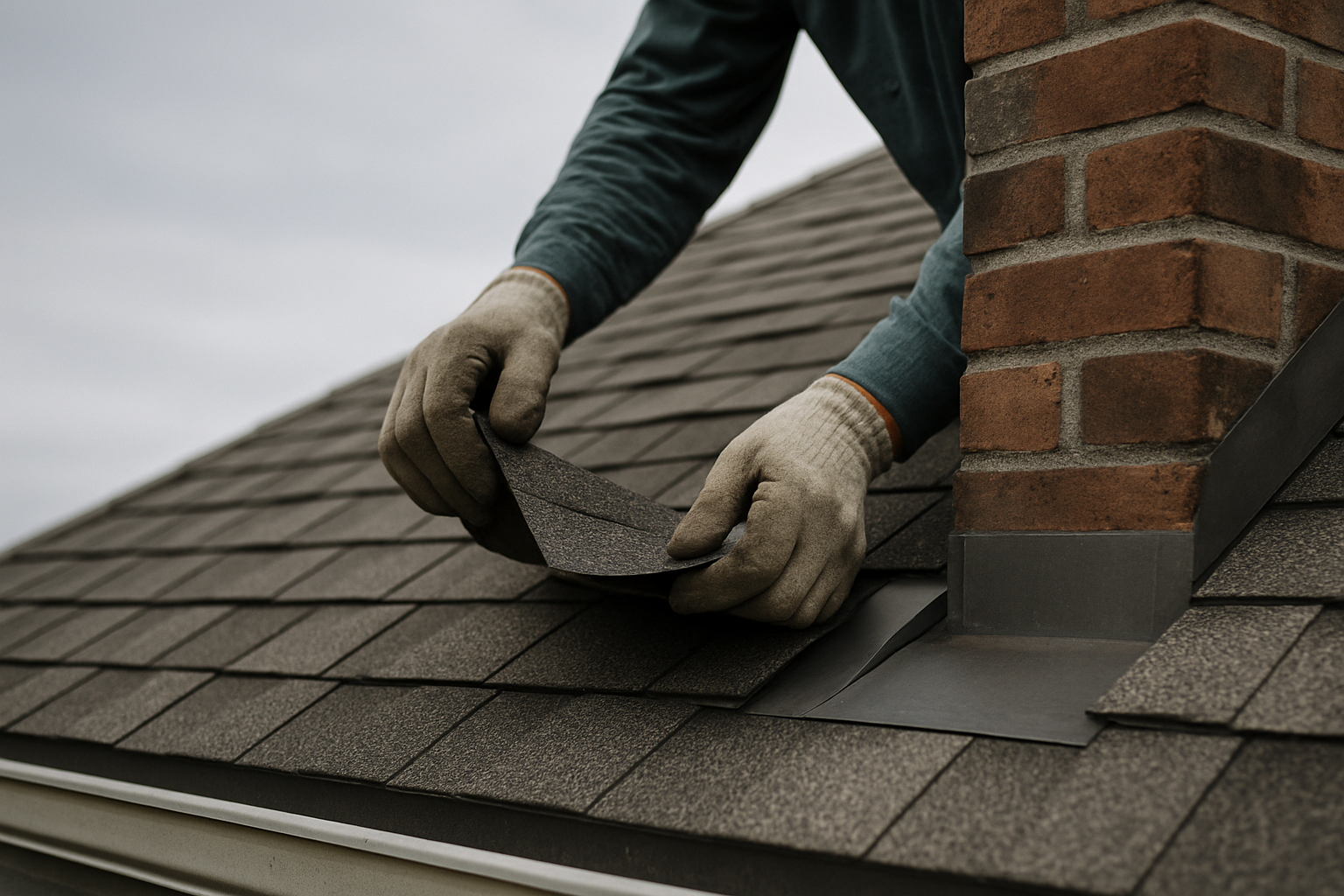
Chimney flashing repair in Atlantic County, NJ stops leaks at the joint where masonry meets the roof. The correct fix uses step flashing under each shingle course and counter-flashing set into a cut reglet, plus a cricket behind wide chimneys and sound crowns, caps, and mortar. HappyRoof diagnoses from the attic and roof and prices the repair in writing.
Most chimney leaks are flashing failures, but not all of them. The same ceiling stain can come from step flashing, counter-flashing, a missing cricket, a cracked crown, or open mortar joints. On Atlantic County chimneys, wind-driven rain, salt air, and freeze-thaw cycles make the distinction matter, because the correct repair is different for each. This page explains the anatomy, when a chimney needs a cricket, the difference between reglet-cut and surface-mount counter-flashing, the crown and mortar failures that masquerade as flashing leaks, and when masonry work has to happen alongside the metal work.
What chimney flashing repair in Atlantic County, NJ is and who needs it
Chimney flashing repair is the fix at the most leak-prone penetration on a residential roof: the joint where a masonry chimney passes through the shingles and the roof deck. It means rebuilding the metal layers that shed water off the roof and away from the brick, not smearing sealant over the stain. Homeowners need it when they see ceiling stains near the chimney, damp insulation in the attic above the firebox, water running down the chimney inside the house, or efflorescence and spalling on the masonry after heavy rain.
The job matters because chimney leaks generate more repeat service calls than any other single roof detail. That is a statement about how many ways water can enter at one intersection: under the step flashing, behind the counter-flashing, through the crown, through open mortar joints, or around a chimney wide enough to dam water and debris on its uphill side. A correct repair identifies which path the water is actually taking before any metal is cut.
Not every homeowner needs this page. A roofer can replace a pipe boot in an hour. Chimney work is different. It involves two trades, four materials, and a detail that has to shed water under pressure. If the leak is near the chimney, this is the page that explains what the contractor should be looking for.
The anatomy of a chimney flashing system
A correct chimney flashing installation is a series of layered metal pieces, each shedding water onto the piece below it. The four parts most often named are step flashing, counter-flashing, the apron, and the saddle or cricket.
| Component | Location | What it does |
|---|---|---|
| Step flashing | One piece per shingle course along each sloped side of the chimney, tucked under the shingle and turned up the masonry | Carries water off the roof slope and stops it from running down the chimney side |
| Counter-flashing | A separate layer set into a groove cut in a mortar joint and bent down over the step flashing | Directs water running down the brick outward onto the roof, away from the joint |
| Apron | The single piece across the lower, downslope face of the chimney | Sheds water onto the shingles below the chimney |
| Saddle or cricket | A small peaked roof built behind the chimney on the uphill side | Splits water and debris around the chimney instead of letting it pool behind the masonry |
Step flashing sits under the shingle courses and turns up the masonry, one piece per course, each piece lapping the one below. Counter-flashing is a separate piece embedded into a groove cut in the mortar joint, bent down over the step flashing so water running down the brick is directed outward onto the roof. The apron performs the same shedding function at the lower face, and the cricket handles the uphill side.
The two-layer step and counter system exists because shingles and chimneys move independently. The house settles, the roof deck flexes, and the masonry expands and contracts with temperature and moisture. A single piece of metal cannot stay sealed to both surfaces. Two overlapping layers let each surface move while water always sheds downhill. When a repair replaces only one layer or welds both together with sealant, it removes the movement allowance and guarantees a future leak.
Lap direction is the part nobody sees. Every piece of metal has to lap the piece below it the way shingles lap each other, so water running down always meets a surface that carries it outward, never a seam that catches it. A step flashing piece installed backward or a counter-flashing lip that stops short of the step flashing turns the detail into a funnel.
The apron and the cricket handle the two faces that gravity treats differently. The apron is on the lower face, where water flows off the chimney and onto the shingles below. The cricket is on the upper face, where water would otherwise pile up behind the masonry. A chimney flashing job that gets the sides right but omits the cricket still fails, just at a different joint.
Why chimneys leak more than any other roof penetration
Chimneys bring four materials together: masonry, sheet metal, asphalt shingles, and sealant. Each has a different rate of thermal movement, and each can fail on its own schedule. When one fails, the stain inside the house may be far from the defect.
Water travels. It enters at a flashing joint on the north side of a chimney, runs sideways along a rafter, drops onto a ceiling joist, and finally shows itself in a hallway ten feet from where it got in. That single fact explains why so many chimney repairs fail on the second try: somebody sealed the stain instead of the source. A leak at the chimney can present as a stain in a bedroom, a damp patch in a closet, or water in the firebox, none of which points directly to the failed piece.
The other reason chimney leaks recur is temporary work sold as permanent. A generous smear of black roof cement over a chimney flashing joint will stop a leak, sometimes for a full year. Then the sealant shrinks, cracks along the seam, and the leak resumes, except now the next contractor has to chisel hardened cement off the metal before doing the real repair. Chimneys that have been repaired this way four or five times are visibly worse to work on than ones that were left alone.
There is also a geometry problem. A chimney interrupts the roof slope in two directions at once. Water running down the slope hits the uphill face, and water running sideways along the shingles hits the side faces. A pipe boot only has to handle the first kind of flow. A chimney has to handle both, plus the water running down the vertical brick itself.
Step and counter flashing done correctly
Step flashing is installed course by course. Each piece is tucked under a shingle, runs up the chimney face, and laps the piece below so water cannot run back under the lap. This is slow work, which is why it is done improperly often. A correct installation cannot be rushed with a single length of bent metal, because the shingle courses and the masonry both need independent movement at every course line.
Counter-flashing is the second layer. It is cut into the masonry rather than stuck onto it. The distinction matters in two ways. First, a reglet-cut counter-flashing is anchored by the groove, so thermal movement does not peel it away. Second, it sheds water outward onto the step flashing rather than trapping it behind a bead of caulk.
| Method | How it is installed | What happens over time |
|---|---|---|
| Reglet-cut counter-flashing | A groove is cut into a mortar joint; the top edge of the metal is inserted and sealed; the face is bent down over the step flashing | The metal stays anchored to the masonry and diverts water; the joint remains repairable |
| Surface-mount counter-flashing | Metal is fastened or caulked directly to the brick face without a cut groove | Fastener holes and caulk joints open under thermal movement; water gets behind the metal |
The reglet should be cut into a sound mortar joint, not into the brick faces. Cutting into the brick weakens the units and leaves a jagged seat for the metal. Cutting into soft, sandy, or eroded mortar gives a poor anchor, which is why repointing sometimes has to come first. The masonry condition drives the choice of joint and the order of work.
Masonry type changes the detail. A hard-fired brick chimney takes a clean reglet in the bed joint. A soft older brick or a stone chimney may require a shallower cut and a different sealant. A stucco-faced chimney is not cut the same way at all, because the counter-flashing must tie into the drainage plane behind the stucco rather than a groove in the face coat. In every case, the goal is the same: the counter-flashing must sit above and in front of the step flashing, and water must shed outward.
On a New Jersey chimney, step and counter flashing also has to survive the winter. Water that gets behind a surface-mount counter-flashing freezes in the gap and levers the metal away from the brick. A reglet holds because the metal is mechanically seated in the masonry, not held by adhesive that hardens and cracks in the cold.
When a chimney needs a cricket
A cricket, or saddle, is the small peaked roof built behind the chimney on the uphill side. Without one, a wide chimney becomes a dam. Water running down the slope hits the back face, stalls, and finds its way into the joint. Leaves and pine needles collect there and hold moisture against the masonry and metal for weeks.
The wider the chimney measured parallel to the ridge, the more water and debris it dams on the uphill side, and the more a cricket matters. Whether a given chimney requires one is confirmed by the local building official against the code edition adopted by the municipality. The principle does not change: the wider the obstruction, the more water and debris it traps, and the more important the cricket becomes.
Chimney cricket installation in New Jersey is not a decorative upgrade. It is the difference between a flashing detail that works and one that is asked to do something no flashing can do. On shallow-pitch roofs, even a narrower chimney can hold water, because the slope does not move water away quickly. On steep roofs, the cricket has to be framed and flashed correctly or it becomes its own leak source.
A cricket is not just a lump of framing under shingles. It is a small roof with its own ridge, its own underlayment, and its own flashing where it meets the chimney and the main roof deck. The cricket ridge has to be high enough to split water, and the cricket valleys have to carry the split water around the chimney and back onto the slope. If the cricket is too flat, it holds water. If its flashing is not integrated with the chimney counter-flashing, it leaks at the very point it was meant to protect.
In Atlantic County, the debris load makes crickets more important than they are in a cleared suburban development. Pine needles and oak leaves load the roof in the fall, and a chimney without a cricket collects them like a strainer. A cricket sheds that material around the masonry instead of letting it sit against the flashing.
Crown, cap, and mortar failures that mimic flashing leaks
Not every chimney leak is a flashing leak. Three masonry failures produce the same interior stain and are misdiagnosed constantly.
| Failure | What you see | How it leaks |
|---|---|---|
| Cracked or spalled crown | Hairline cracks, missing pieces, or standing water on top of the chimney | Water enters the masonry itself, travels down through the chimney wall, and appears below the roofline |
| Missing or damaged cap | Rain falls straight into the flue; birds and debris enter | Water inside the flue, a damp firebox, and rusting dampers |
| Open or eroded mortar joints | Recessed joints, sandy mortar, loose or spalling brick faces | Water enters the wall, bypasses the flashing entirely, and freezes and expands inside the joints |
These failures mimic flashing leaks because the water follows the same path once it is inside the chimney chase or the wall. A stain on the ceiling next to the chimney does not tell you whether the water came through the metal joint or through the crown. The diagnosis has to look at both.
The timing of the leak is a clue. A flashing leak usually appears during or after rain that runs down the roof, especially wind-driven rain that pushes water sideways under laps. A crown leak can appear after any rain, even a light one, because the crown is exposed to direct rainfall. A cap problem often shows up as water in the firebox rather than on the ceiling. These clues narrow the search, but the confirming evidence comes from the attic side and the roof side together.
The crown is the most overlooked part of a chimney. It is the concrete or mortar cap that covers the top of the masonry and sheds water away from the flue. A crown should overhang the brick slightly so water drips off rather than running down the face. When the crown cracks, water gets inside the masonry and freezes, and each freeze-thaw cycle widens the crack. By the time the homeowner sees a ceiling stain, the crown has usually been failing for years.
Mortar joints fail the same way. Atlantic County winters push water into tiny openings and then freeze it, and the expansion pries the joints open a little more each season. Eroded joints are a separate problem from flashing, but they sit directly above the reglet. A counter-flashing cut into failing mortar cannot hold, and the wall above it is still letting water in.
Wind-driven rain and salt air on coastal New Jersey chimneys
Atlantic County chimneys do not fail the same way on the barrier islands as they do inland. On the island towns, the dominant failure mode is mechanical. Sustained ocean wind works at shingle edges until the factory adhesive strip lets go, and once a corner lifts, every subsequent gust drives water underneath and levers the shingle further. At the chimney, that same wind drives rain horizontally into the flashing laps, where a joint that sheds ordinary rainfall becomes a leak.
Salt aerosol compounds the problem. It corrodes fastener heads and thin flashing metal, so repairs in Ventnor City, Margate City, Longport, Brigantine, and Atlantic City often involve replacing metal that has simply rusted through rather than any installation error. A flashing joint that looks intact from the ground may be held together by paint and rust scale.
Nor'easters are the real test. They combine sustained wind with hours of rain, and they hit the chimney from every direction as the storm rotates. Wind-driven rain under pressure finds the smallest gap in the counter-flashing lap, the step flashing corner, or the crown. This is why coastal chimney repairs are often more extensive than the same repair a few miles inland: the metal has to be replaced, not re-caulked, and the laps have to be set for pressure-driven water, not gravity alone.
For chimney leak repair in NJ, the coastal answer is usually not more sealant. It is replacement of the corroded metal and re-setting of the laps so water cannot be driven uphill into the joint. The repair also has to account for the next nor'easter, not just the last one.
Freeze-thaw cycles add a second failure mode across the whole county. Water that enters a hairline crack in the crown, an open mortar joint, or a sealant bead freezes and expands. Each cycle widens the crack a little more. By spring, a joint that looked acceptable in October has opened enough to leak.
Repair vs rebuild: when masonry work accompanies the metal
The decision is rarely flashing or masonry. It is usually flashing, then masonry, or flashing and masonry together. The question is what has to happen first so the metal work has a sound substrate.
Flashing-only repair is the right scope when the masonry is sound and the leak is at the metal joint. That means the mortar joints are intact, the bricks are not spalling, the crown is shedding water, and the reglet can be cut into solid mortar.
Repointing comes first when the mortar joints are eroded. A reglet cut into sandy, recessed mortar does not hold the counter-flashing, and the new flashing will not stop water that is entering the wall through the joints above it. The masonry has to be brought back to a solid bed before the metal is cut in.
Crown repair or replacement is a separate scope from flashing. A cracked crown can be patched with the right material in some cases and rebuilt in others. If the crown is the source, new flashing will not stop the leak, because the water is entering the chimney above the roof line. The written repair scope has to say whether the crown is addressed or left for a separate trade.
A full chimney rebuild is the extreme case, usually driven by spalled brick, loose masonry, or structural movement. It is not a roofing repair, but it must be sequenced with the flashing work. The roofing crew cannot flash against masonry that is coming apart, and the mason cannot leave a flashing detail that leaks. HappyRoof's written scope states what the repair does and does not address, so the homeowner knows whether masonry work is required and in what order.
| Condition | What it means for the repair |
|---|---|
| Sound mortar, intact bricks, cracking at the metal joint | Flashing-only repair is appropriate |
| Recessed or sandy mortar joints | Repoint the joints before cutting the reglet |
| Cracked or spalled crown | Crown repair or replacement, separate from flashing |
| Loose or spalling brick, structural movement | Masonry rebuild before or alongside flashing |
The honest answer sometimes is that the chimney is not worth repairing. A chimney that needs a full rebuild plus flashing plus a cricket can cost more than the value of the repair, and the written scope makes that plain before any work starts.
How HappyRoof diagnoses a chimney leak in Atlantic County
Roof chimney leak diagnosis in Atlantic County starts with the understanding that water travels. The stain is evidence, not a location. HappyRoof approaches the repair as diagnosis first and caulk gun last: trace the water path from the attic side, confirm it from the roof side, and only then quote the fix.
The attic-side inspection follows the water. A dark streak on a rafter, rust on a fastener, or a wet patch of insulation points back toward the entry point, even when the visible stain is ten feet away. The roof-side inspection confirms it: the flashing laps, the reglet, the crown, the cap, and the mortar joints are all checked against what the attic showed.
Photographs are part of the record. The homeowner gets before and after photographs of the actual defect, so the repair is not a vague claim about resealing the chimney. The written quote states what the repair does and does not address, which is the only way to know whether masonry work, a crown, or a cricket is included.
This is also where a free inspection earns its keep. The inspection is not a sales call. It produces real photographs of your own chimney and an honest answer on whether the leak is flashing, crown, mortar, or wind-driven. If the chimney has years left and the leak is minor, the recommendation reflects that.
What the repair includes, and what it does not
A full chimney flashing replacement includes more than new metal. It includes removing the shingles around the chimney, cutting a new reglet into the masonry for counter-flashing, fabricating and installing new step flashing course by course, and re-laying the field. The counter-flashing is set into the cut reglet and bent down over the step flashing, not stuck to the face.
What it does not include by default: interior drywall repair or painting, crown rebuilding, a full masonry repoint, or a chimney rebuild. Those are separate scopes. The written statement says what the repair does and does not address, so there is no ambiguity about what a leak-free chimney required and what was left for another trade.
The cleanup is part of the job. After the field is re-laid, the work area is cleared of debris and old sealant, and the repaired detail is photographed. The goal is a chimney that sheds water, not one that has to be re-caulked every fall.
The chimney flashing repair process, step by step
- Free inspection. The attic side is checked first for the water path, then the roof side confirms the defect. Photographs document the condition.
- Written price and scope. The itemized price states what is included, what is excluded, and whether masonry, crown, or cricket work is required.
- Access planning. Steep pitches, third-story access, and barrier-island staging are planned before the repair, because access drives both safety and labor.
- Tear-off around the chimney. Shingles are removed far enough to expose the step flashing and the deck, so the existing laps can be inspected and replaced.
- Masonry assessment. The mortar joints are checked before the reglet is cut. If the mortar is soft or recessed, repointing is sequenced first.
- Reglet cut. A groove is cut into a sound mortar joint for the counter-flashing, not into the brick faces.
- Step flashing installation. New step flashing is fabricated and installed course by course, each piece lapping the one below.
- Counter-flashing installation. The counter-flashing is set into the reglet and bent down over the step flashing so water running down the brick sheds outward.
- Field re-lay. The shingles are re-laid around the chimney and the laps are checked against the new metal.
- Final photos and cleanup. The finished detail is photographed and the work area is cleared.
Each step is deliberately slow. Step flashing installed course by course cannot be done by a crew rushing to the next job, and a reglet cut too shallow will not hold the metal. The pace is part of why the repair lasts.
The sequencing matters as much as the metal. Repointing before the reglet, flashing before the field is re-laid, and counter-flashing last so it is never buried under shingle work. Each step depends on the one before it, which is why a rushed chimney repair fails at the seam it skipped.
What to have ready before you call
A few notes shorten the diagnosis. Before you request an inspection, gather what you can:
- Photographs of the interior stains and the chimney from the ground
- A note on when the leak appears: heavy rain, wind from a particular direction, snowmelt, or every storm
- The history of any previous repairs, especially caulking or roof cement
- Whether there is attic access above the chimney and whether the insulation is damp
- The roof pitch and chimney height, if you know them, or a note that the chimney is on a steep or third-story roof
None of this is required to book the free inspection, but each item shortens the time between the first call and the written price. The most useful single piece of information is the weather that precedes the leak, because it separates wind-driven flashing leaks from crown and cap leaks before anyone climbs a ladder.
Where HappyRoof repairs chimneys in Atlantic County
HappyRoof runs chimney repairs across Atlantic County, and the logistics differ by geography. On the barrier islands, staging is the challenge. Narrow lots, shared driveways, and summer parking restrictions mean access is planned before the repair is planned. A chimney on a Margate or Longport house may need the crew to stage material by hand from a street that will not hold a truck.
In the older neighborhoods of Atlantic City and Pleasantville, the chimney detail can sit on a low-slope rear or porch roof that needs membrane work rather than shingle work. That is a different repair and a different material, and the flashing detail has to match the membrane system rather than a shingle course.
The service area includes every municipality in Atlantic County. Among the towns served are Egg Harbor Township, Galloway, Pleasantville, Atlantic City, Margate City, Brigantine, Ventnor City, and Longport.
Cost and scheduling for chimney flashing repair
Most roof repairs in Atlantic County fall between $400 and $1,800. The lower end covers straightforward, accessible work. A full chimney flashing replacement sits at the upper end of that range, because it means removing shingles around the chimney, cutting a new reglet, fabricating and installing step flashing course by course, and re-laying the field. Steep pitches, third-story access, or difficult staging on a barrier-island lot with no driveway push the labor higher.
A price range is general guidance, not a quote. The written price follows the inspection, because the scope depends on what the diagnosis finds: flashing only, flashing plus a cricket, flashing plus repointing, or flashing plus a crown repair. Each changes the material and labor.
Scheduling depends on weather, access, and masonry condition. Flashing work needs dry conditions and enough daylight to cut, fit, and re-lay without rushing. If repointing or crown work is sequenced in, the schedule has to allow for material curing.
Frequently asked questions
Why does my chimney leak only during certain storms?
Wind direction is usually the answer. Wind-driven rain pushes water sideways into flashing laps that shed ordinary rainfall. On the barrier islands, sustained ocean wind works at the laps until a gap opens. A leak that appears with east or northeast wind points to a wind-driven entry, not a simple gravity leak, and the repair has to be set for pressure-driven water.
Can chimney flashing be caulked instead of replaced?
Caulk is a temporary measure. Roof cement over a chimney flashing joint can stop a leak for a year, then shrinks, cracks, and fails, leaving hardened cement for the next contractor to chisel off. A permanent repair replaces the step and counter flashing and sets the counter-flashing into a cut reglet, where it sheds water instead of depending on a sealant bead.
When is a chimney cricket required?
A cricket or saddle sits on the ridge side of a chimney and splits water and debris around it. The wider the chimney measured parallel to the ridge, the more a cricket matters, and the local building official can confirm whether one is required under the code edition adopted by the municipality. Even on narrower chimneys, water and debris can still pile against the uphill face, and a cricket is often the practical fix.
How do I tell if the leak is the flashing or the chimney crown?
The interior stain looks the same. Flashing leaks usually follow wind-driven rain on the roof; crown leaks can follow any rainfall because the crown is directly exposed. Open mortar joints and a cracked cap point to masonry. The confirming check is an attic-side trace and a roof-side inspection of both the metal and the masonry.
Does homeowners insurance cover chimney flashing repair?
Coverage depends on the cause and the terms of the policy. Storm-related damage may be covered, while wear, age, and deteriorated mortar are usually maintenance items. HappyRoof documents the condition with photographs so the homeowner has a clear record for the claim.
Get the free chimney inspection
The next step is a free inspection with photographs of your own chimney, an honest answer on whether the leak is flashing, crown, mortar, or wind-driven, and a written price before anything starts. Call (609) 525-4521 to schedule it.