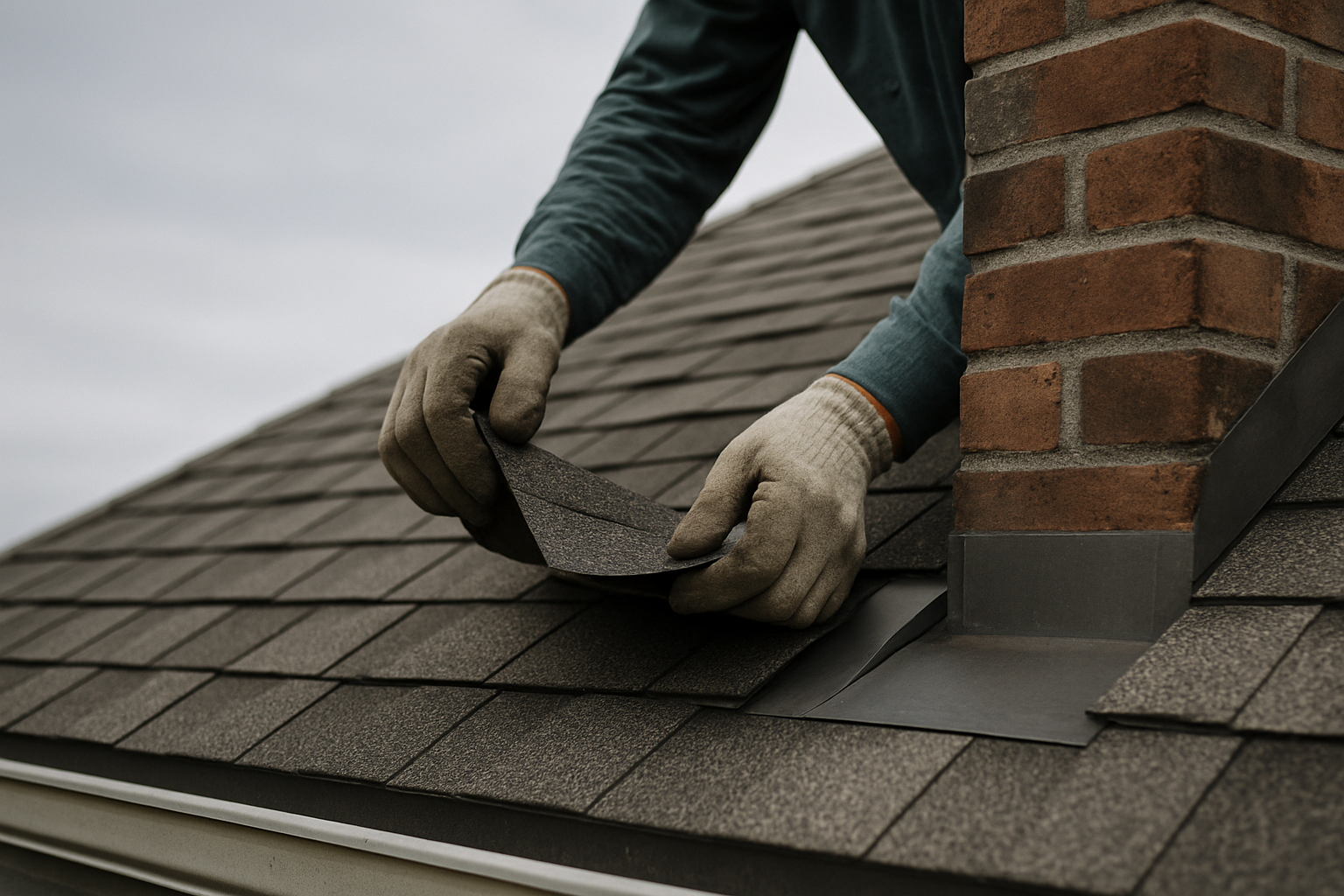
For a roof tear off vs overlay NJ decision, the controlling fact is New Jersey's two-layer limit. An overlay saves removal and disposal on install day, but defers the full tear-off and hides the deck. For most Atlantic County homes, tear-off protects the deck, flashing, and warranty.
What "tear-off" and "overlay" actually mean
A full tear-off means removing the existing roof covering down to the bare deck, or sheathing. That includes old shingles, old underlayment, and any failed flashing that has to come out with them. The deck is then inspected, repaired as needed, and the new roof is installed from the sheathing up.
An overlay, also called reroofing over existing shingles, means nailing new shingles directly over the existing ones. The old roof stays in place. It is cheaper on the front end because nobody has to remove and haul away the old roof, and some contractors push it hard for exactly that reason.
The two methods look similar from the street once the job is done, but they are not the same roof. One exposes what is underneath. The other covers it.
Roof tear off vs overlay NJ: the two-layer code rule
The roof overlay code New Jersey follows is the adopted building code's two-layer limit. New Jersey's adopted building code limits a roof to two layers of covering. An overlay means nailing new shingles directly over the existing ones. Once a second layer is on, the next roof has to be a full tear-off no matter what. An overlay does not avoid the cost of removal. It defers it and adds the weight of an extra layer to the bill.
That rule matters most in Atlantic County, where older shore housing stock frequently already carries two layers from decades of deferred work. A home with two layers cannot legally receive a third. Any contractor who offers an overlay on a roof that already has two layers is proposing work that conflicts with the adopted code limit. The correct method is a full tear-off to the bare deck, followed by a single new roof covering.
The permit process runs through each municipality's own construction office. New Jersey requires a construction permit for a roof replacement, and the requirement is not optional or negotiable based on how busy the township is. Filing details and lead times vary between, say, Egg Harbor Township and Atlantic City, but the shape of the process is the same: application, permit issued, work performed, inspection by the municipal inspector, permit closed. A legitimate quote should include the permit and inspection as part of the job, not leave them to the homeowner.
| Attribute | Overlay | Full tear-off |
|---|---|---|
| New Jersey layer limit | Allowed only when the roof currently has one layer; creates the second layer | Resets the roof to a single layer |
| Deck inspection | No access to sheathing; the existing deck stays covered | Every square foot of sheathing is exposed and inspected |
| Flashing | Existing step, chimney, valley, and pipe-boot flashing can remain buried or partially reused | Flashing can be reset or replaced: step, chimney, valley metal, and pipe boots |
| Ice-and-water shield | Cannot be installed directly to clean sheathing beneath the existing layer | Installed directly to clean sheathing as part of the system |
| Upfront cost | Lower: no tear-off, haul-away, or disposal labor | Higher: labor and disposal for removing the old layers |
| Long-term cost | Defers the mandatory full tear-off and adds an extra layer of weight | Pays removal once now and avoids burying deck damage |
| Manufacturer warranty | Get written manufacturer confirmation before relying on the warranty | Manufacturer-certified installation keeps the shingle warranty valid |
The permit and inspection reality in Atlantic County
Roof replacement in New Jersey requires a construction permit, and the requirement is not optional or negotiable based on how busy the township is. Each Atlantic County municipality runs its own construction office, so filing details and lead times vary between, say, Egg Harbor Township and Atlantic City, but the shape of the process is the same.
The permit is not just paperwork. It puts the job on the record, and it brings a municipal inspector to the site after the work is done. That inspection is the homeowner's backstop against work that was never looked at by anyone except the contractor.
An overlay and a tear-off both require the same permit process. A contractor who offers to skip the permit to save money is not offering a lower-cost roof. They are offering a roof that was never inspected by the township.
What a roof deck inspection during tear off actually uncovers
Nobody can see the condition of the sheathing until the old shingles come off. That is a physical fact, not a sales tactic, and it is why every honest roofing proposal includes a per-sheet price for decking replacement rather than pretending the number is zero. In an overlay, the new shingles go down on top of whatever is already there: old shingles, old underlayment, and any decking that may have been quietly rotting beneath them.
In Atlantic County, deck rot usually clusters in predictable places. It appears along the eaves where ice dams and wind-driven rain have backed water up under the shingles, around chimneys and skylights where old flashing leaked slowly for years, in valleys, and on shaded north slopes that never fully dry out between storms. A full tear-off exposes all of those areas. The crew can replace what is bad, install ice-and-water shield directly to clean sheathing, and reset the flashing properly. An overlay leaves all of that buried and unexamined.
A roof deck inspection tear off is not a quick glance. It is the only point in the project where the structural surface under the roof covering can be tested and replaced sheet by sheet. If the decking flexes when walked, or daylight is visible through the roof deck when you look up from the attic, those are signs the deck needs attention before new material goes down. Only a tear-off makes that work possible.
Why the deck is the decision, not the shingle
Homeowners often compare shingle products and colors before they compare decking. The shingle is the visible product, but the deck is what the shingle is nailed to. If the deck is soft, the best shingle in the world will not hold. In Atlantic County, the deck is also the part of the roof most likely to have been wet, because wind-driven rain works its way under failed flashing long before the ceiling shows a stain.
A full tear-off turns the deck from an unknown into a known. The crew can inspect every square foot, replace the bad ones at a written per-sheet rate, and install the new roof over a surface that is actually sound. An overlay keeps the deck an unknown. The homeowner pays less on install day but accepts that the most important layer of the roof was never looked at.
That is why the per-sheet decking price matters. It is not an optional add-on. It is the honest way to price the part of the job that cannot be seen until the old shingles come off. A proposal that pretends the number is zero is not lower cost. It is guessing.
Flashing is the second thing an overlay buries
Decking is the most expensive surprise, but flashing is the most common source of leaks. Step flashing, chimney flashing, valley metal, and pipe boots all fail slowly. They fail at the exact points where water wants to enter: where a roof meets a wall, where two slopes meet, where a chimney or pipe penetrates the covering.
A full tear-off lets every piece of flashing be reset or replaced as part of the new roof: step flashing, chimney flashing, valley metal, and pipe boots. An overlay leaves much of that flashing buried under the old roof, where it cannot be inspected or replaced without opening the roof.
In a coastal climate, flashing is not a detail. Wind-driven rain finds the smallest gap and drives water sideways into the roof assembly. A roof that gets new shingles but old flashing has the visible part of the job renewed and the vulnerable part left in place.
When reroofing over existing shingles NJ is not allowed
Reroofing over existing shingles NJ is not a neutral choice. There are three conditions that make it prohibited or self-defeating.
The roof already has two layers
Under New Jersey's adopted code, a roof is limited to two layers of covering. If the existing roof is already a second layer, an overlay would create a third. That is outside the code limit. The next roof has to be a full tear-off no matter what.
The decking condition is unknown or suspect
If the roof line sags or waves, the deck flexes when walked, or daylight shows through the roof deck from the attic, the sheathing is not a sound substrate for new shingles. Covering it with another layer hides the problem and lets water keep working on the structure.
The manufacturer will not stand behind an overlay
Material warranties ride on the installation. A manufacturer-certified installation is what keeps the shingle warranty valid. An overlay changes the installation from the standard clean-deck assembly. Before accepting an overlay, get written confirmation that the manufacturer permits installation over an existing layer. If that confirmation does not exist, the overlay is a self-defeating way to save money.
Signs a roof may already carry two layers
A homeowner may not know how many layers are on the roof, but there are places to look. The rake edge and the eave edge often show the cross-section of the roof. If two distinct shingle lines are visible at the edge, the roof may already be at the code limit. The same is true around vents and pipe penetrations, where the layers can sometimes be counted.
The age of the house is a clue, not a proof. Older Atlantic County shore housing stock has often been reroofed at least once, sometimes with an overlay to save money. A roof that looks acceptable from the ground can still be a second layer that is nearing the end of its life.
If there is any doubt, the answer comes from a roof inspection. The question is not academic. If the roof already has two layers, an overlay is not allowed under the adopted code limit, and the next roof has to be a full tear-off no matter what.
Tear off vs second layer roof: the weight and ice-barrier problem
Leaving old layers in place is not free. A second layer adds weight to the structure. The adopted code's two-layer limit matters in part because each extra layer adds weight the structure must carry. In a coastal area subject to wind-driven rain and nor'easters, that extra weight sits on a deck that has never been inspected beneath the old layer.
Ice-and-water shield is the clearest example of what an overlay gives up. The shield is installed directly to clean sheathing in the vulnerable areas of the roof. In a tear-off, that happens before the new covering goes down. In an overlay, the new shingles sit on top of the old roof, so the shield cannot be installed directly to the deck beneath the existing layer. The old roof remains between the shield and the sheathing it is meant to protect.
Atlantic County roof tear off: why coastal exposure changes the math
Atlantic County roofs face a specific combination: nor'easters, wind-driven rain, and older shore housing stock. A roof that was specified for a subdivision in central New Jersey is not specified for a bayfront house on the shore, and the work should be built accordingly. That means wind-rated shingles, enhanced nailing patterns chosen for the exposure the specific street gets, and flashing that can handle repeated wind-driven rain.
The coastal exposure is also why deck inspection matters more, not less. Water driven by a nor'easter finds the small failures: a lifted shingle, a pipe boot that dried out, a valley where debris held water against the metal. Those failures rot the deck slowly and invisibly. By the time a homeowner sees a stain on a ceiling, the sheathing has often been wet for years. An overlay would cover that history. A full tear-off reveals it.
An Atlantic County roof tear off is not an upsell. It is the method that lets a contractor reset the roof from the deck up: new underlayment, new ice-and-water shield in the specified locations, new step and chimney flashing, new valley metal, new pipe boots, and a single new layer of covering that meets the code limit.
Wind uplift, nailing patterns, and coastal exposure
Atlantic County roofs are not all exposed the same way. A roof on a sheltered inland street faces different wind than a bayfront house on the shore or a home on an open lot in Galloway. The right roof is specified for the exposure the specific street gets, with wind-rated shingles and enhanced nailing patterns chosen to resist uplift.
A full tear-off lets the installer start from a clean, inspected deck and install the new roof as a single assembly. An overlay keeps the old layer in place, so the new covering is not installed as the same clean assembly.
Wind-driven rain is the test. A nor'easter can drive rain under the roof edge and into the weak points a tear-off would have exposed. The difference between a roof that holds and one that leaks is often decided by what was inspected before the new material went down.
The honest cost comparison: install day vs roof life
On install day, an overlay is lower cost. Nobody has to remove and haul away the old roof, and that is the entire reason some contractors push it hard. The added cost of a tear-off is disposal and labor. Those are real line items, and an honest quote separates them: labor, materials, disposal, and the per-sheet rate for any decking replacement.
The problem is that the install-day saving is not the life-of-roof saving. An overlay does not avoid the cost of removal. It defers it and adds the weight of an extra layer to the bill. When the overlaid roof eventually fails, the next roof has to be a full tear-off no matter what, and that future tear-off will remove two layers instead of one. If hidden deck rot has spread in the meantime, the decking replacement line item will be larger, and there may be interior damage that an earlier tear-off would have prevented.
A useful way to compare the two methods is to ask which one pays for the unknown. A tear-off pays to remove the old roof now and inspect the deck before new material goes down. An overlay pays less now but postpones the inspection, the disposal, and the structural reckoning to the next roof. For a roof that will be on the house for decades, the lower install-day option is not automatically the lower-cost roof.
An itemized written proposal is the only way to compare the two fairly. If an overlay quote has no disposal line, that is because there is no disposal. But it should also disclose that the next roof will be a full tear-off, that the deck was not inspected, and that the manufacturer's written installation requirements must be met. If those disclosures are missing, the quote is not lower cost. It is incomplete.
How an overlay changes the next roof
An overlay is sometimes sold as a way to save money now, but it changes the next roof in three ways. First, the next roof must remove two layers instead of one, which means more disposal and labor. Second, the next roof must inspect a deck that has been hidden for the entire life of the overlay, so the decking replacement line item is an open question. Third, the next roof begins only after the homeowner has paid for the overlay and then paid again for the full tear-off that was always coming.
That sequence is the real cost of an overlay. The removal cost is not avoided. It is moved to the next roof, with interest paid in the form of an extra layer to haul away and a deck that has gone longer without inspection.
For a homeowner who plans to stay in the house, that deferral rarely makes sense. The tear-off is the part of the job that determines whether the next thirty years go well, and it is less expensive to do it once now than twice later.
Where each method wins
Where a full tear-off wins
For most Atlantic County replacement roofs, full tear-off is the right call. It wins when the roof already has two layers, when the deck condition is unknown or suspect, when the homeowner wants the material warranty to stay valid through manufacturer-certified installation, and when the house sits in a coastal exposure where wind-driven rain has had years to work on the deck. It is the only method that lets the crew see the whole deck, replace what is bad, install ice-and-water shield directly to clean sheathing, and reset the flashing properly.
Where an overlay might be considered
An overlay may be worth considering only in a narrow case: the roof currently has a single layer, the deck has been verified sound, the manufacturer confirms in writing that installation over an existing layer is permitted, and the homeowner accepts that the next roof will be a full tear-off no matter what. Even then, the saving is limited to removal and disposal, and the deck inspection that a tear-off provides is given up. That is a short-term trade, not a way to avoid the cost of removal.
Cost of getting it wrong
The cost of choosing an overlay when a tear-off was needed is not just the difference between two quotes. It is the cost of discovering the mistake later, after the new layer has been nailed down.
If the deck is rotten under an overlay, the new shingles are fastened to a surface that is already failing. The roof may look fine for a season and then begin to sag, leak, or lose shingles in the first nor'easter. At that point the homeowner pays for a full tear-off of two layers, replaces more decking than would have been needed earlier, and may also be repairing ceilings, insulation, and framing inside the house.
If the roof already had two layers, an overlay puts the home outside the adopted code limit, and the homeowner is back to a full tear-off after having paid for an overlay. If storm damage is involved, documentation matters. The only way to prove the full extent of hidden deck damage is to remove the covering and look. A claim that does not account for what is underneath can leave the homeowner with the most expensive part of the repair.
The least expensive wrong decision is usually the one made twice.
What the two methods have in common
Both an overlay and a full tear-off are roof replacement work in New Jersey, and both trigger the same municipal permit and inspection process. New Jersey requires a construction permit for a roof replacement, and each Atlantic County municipality runs its own construction office. The shape is the same whether the job removes one layer or leaves it: application, permit issued, work performed, inspection, permit closed.
Both should also be priced the same way. A written, itemized proposal should separate labor, materials, disposal, and the per-sheet rate for decking replacement. The difference is that an overlay has no disposal line and no decking replacement line, because no deck is exposed. That is not a virtue. It is a missing line item that represents missing information.
Both methods also depend on the same underlying discipline: manufacturer-certified installation, correct flashing, and a contractor who will put pricing in writing and let the homeowner read it without a clock running.
How to compare a tear-off quote and an overlay quote
When two quotes sit side by side, the questions are the same. Is this a full tear-off, and how many layers are coming off? What underlayment is being used, and where exactly does ice-and-water shield go? Is every piece of flashing new, including step, chimney, and pipe boots? What is the per-sheet price if decking has to be replaced? Who pulls the municipal permit, and who schedules the township inspection?
An overlay quote should answer the same questions, and its answers will reveal what is being given up. If the answer to "how many layers are coming off" is "none," then no deck inspection is happening, no ice-and-water shield is being installed directly to clean sheathing, and the existing flashing is staying buried. If the answer to "what is the per-sheet price for decking" is "not applicable," the quote is not protecting the homeowner from the most common surprise in an Atlantic County roof.
HappyRoof recommends full tear-off on essentially every replacement, and on older shore housing stock it is frequently mandatory because the roof already carries two layers from decades of deferred work. The added cost is disposal and labor, and it is the part of the job that determines whether the next thirty years go well.
Material warranty is an installation warranty
Manufacturers do not warrant shingles in a vacuum. They warrant shingles installed to their requirements by a certified installer. That is what manufacturer-certified installation means: the installation is the condition that keeps the material warranty valid.
A tear-off gives the installer a clean, inspected deck and a single new roof assembly. That is the standard manufacturer-certified installation. An overlay changes the substrate and the assembly. The shingle may be the same, but the installation conditions are not.
Before accepting an overlay, the homeowner should ask for written confirmation from the manufacturer that installation over an existing layer is permitted. If the contractor cannot produce that confirmation, the warranty is not something to count on. A lower install-day price is not a good trade for a material warranty that may not be there when it is needed.
Insurance and material-warranty differences
Material warranties and insurance claims both depend on what can be documented. A manufacturer-certified installation is what keeps the shingle warranty valid. A tear-off lets the contractor perform a manufacturer-certified installation on a clean, inspected deck. An overlay changes the substrate and the assembly, so the homeowner should get written confirmation from the manufacturer before relying on the warranty. If the manufacturer will not confirm that installation over an existing layer is permitted, the warranty is not something to count on.
Insurance is different. A storm damage roof claim covers damage from a covered cause, but the roof's condition before the storm matters. If a roof was already carrying two layers, or if the deck was already rotting under the old shingles, the full extent of the damage cannot be documented without a tear-off. That is why HappyRoof documents claims to support your insurance claim: the goal is to show what is actually there, not what is convenient. An overlay does not create that record. It covers the evidence.
The homeowner should not treat an overlay as a way to avoid a code-required tear-off after a storm. If the roof is at the two-layer limit, the next roof must be a full tear-off no matter what. The question is whether the tear-off happens before or after the deck has been hidden under another layer.
What a full tear-off should include in Atlantic County
On a full tear-off replacement, the job should include:
- Removal of all existing layers down to bare deck
- Inspection and replacement of any bad sheathing at a written per-sheet rate
- New underlayment and ice-and-water shield installed to clean sheathing
- New step, chimney, and pipe-boot flashing
- New valley metal where slopes meet
- Municipal permit pulled and township inspection scheduled
- Full cleanup including a magnet sweep of the lawn, beds, and driveway for stray nails
Overlay checklist: what has to be true before it makes sense
An overlay should be considered only when all of the following are true:
- The roof currently has one layer
- The deck has been verified sound
- The manufacturer confirms in writing that installation over an existing layer is permitted
- There are no signs of sagging, flexing, or daylight through the roof deck
- The homeowner accepts that the next roof will be a full tear-off no matter what
- The permit is still pulled and the township inspection still scheduled
If any of those items is missing, the overlay is not a lower-cost roof. It is a roof with an unexamined deck, buried flashing, and a removal bill that has been pushed into the future.
Frequently asked questions
Is it legal to put new shingles over old shingles in New Jersey?
New Jersey's adopted building code limits a roof to two layers of covering. An overlay is allowed only if the existing roof is a single layer; it creates the second layer. Once two layers are on, the next roof must be a full tear-off. A roof already carrying two layers cannot legally receive another overlay.
Why can't a contractor inspect the deck under an overlay?
The sheathing is covered by the existing shingles and underlayment. Nobody can see its condition until the old shingles come off. A full tear-off exposes every square foot of sheathing so bad decking can be replaced before new material goes down. An overlay leaves the deck buried and unexamined.
Does an overlay save money over the life of the roof?
It saves removal and disposal on install day, but it defers those costs, because the next roof must be a full tear-off no matter what. If hidden deck rot is present, the future tear-off may also include more decking replacement and interior repairs, so the install-day saving can disappear.
How does a second layer affect ice-and-water shield?
Ice-and-water shield is installed directly to clean sheathing. In a tear-off, that happens before the new covering goes down. In an overlay, the old roof remains between the shield and the sheathing, so the shield cannot be installed directly to the deck it is meant to protect.
Does an overlay void the shingle warranty?
Material warranties ride on the installation. Manufacturer-certified installation is what keeps the shingle warranty valid. An overlay changes the installation from the standard clean-deck assembly, so the homeowner should get written confirmation that the manufacturer permits installation over an existing layer before counting on the warranty.
Does a roof replacement require a permit in New Jersey?
Yes. New Jersey requires a construction permit for a roof replacement, and the requirement is not optional. Each Atlantic County municipality runs its own construction office, so filing details and lead times vary, but the process is the same: application, permit issued, work performed, municipal inspection, permit closed.