Roofing in Brigantine NJ is not an inland Atlantic County specification with a beach postcode. Salt aerosol corrodes fastener heads, drip edge, vent hoods, gutter hangers, and flashing years early, while sustained ocean wind lifts shingle edges until the adhesive strip lets go. The right specification pairs corrosion-resistant metal, enhanced fastening, wind-rated perimeter detailing, and flood-elevation-aware gutter and access planning.
What roofing in Brigantine NJ actually has to solve
Brigantine is one of the five Atlantic County barrier island towns named in HappyRoof's own service notes: Atlantic City, Ventnor City, Margate City, Longport, and Brigantine. On that stretch of land, the governing factors are not the same as a Galloway or Egg Harbor Township roof. The reference material puts it plainly: on the barrier islands, the governing factors are sustained wind, salt aerosol, and a housing stock that includes a lot of narrow attached and semi-attached buildings with low-slope rear sections.
That means a Brigantine roof is specified around three questions. First, what will the salt do to every exposed metal part over ten or fifteen years? Second, how much wind load can the perimeter of the roof resist before a shingle edge starts to work loose? Third, how does the height and layout of the home — raised, low-slab, attached, or freestanding — change access, flashing, and where the gutters discharge?
This page is written for the homeowner who is budgeting a replacement, chasing a leak, preparing to sell, or staring at storm damage and deciding whether to repair or file a claim. It is not a generic roofing explainer. It is the barrier-island specification discussion, with the parts that differ from inland Atlantic County called out.
Why salt air changes the metal on a Brigantine roof
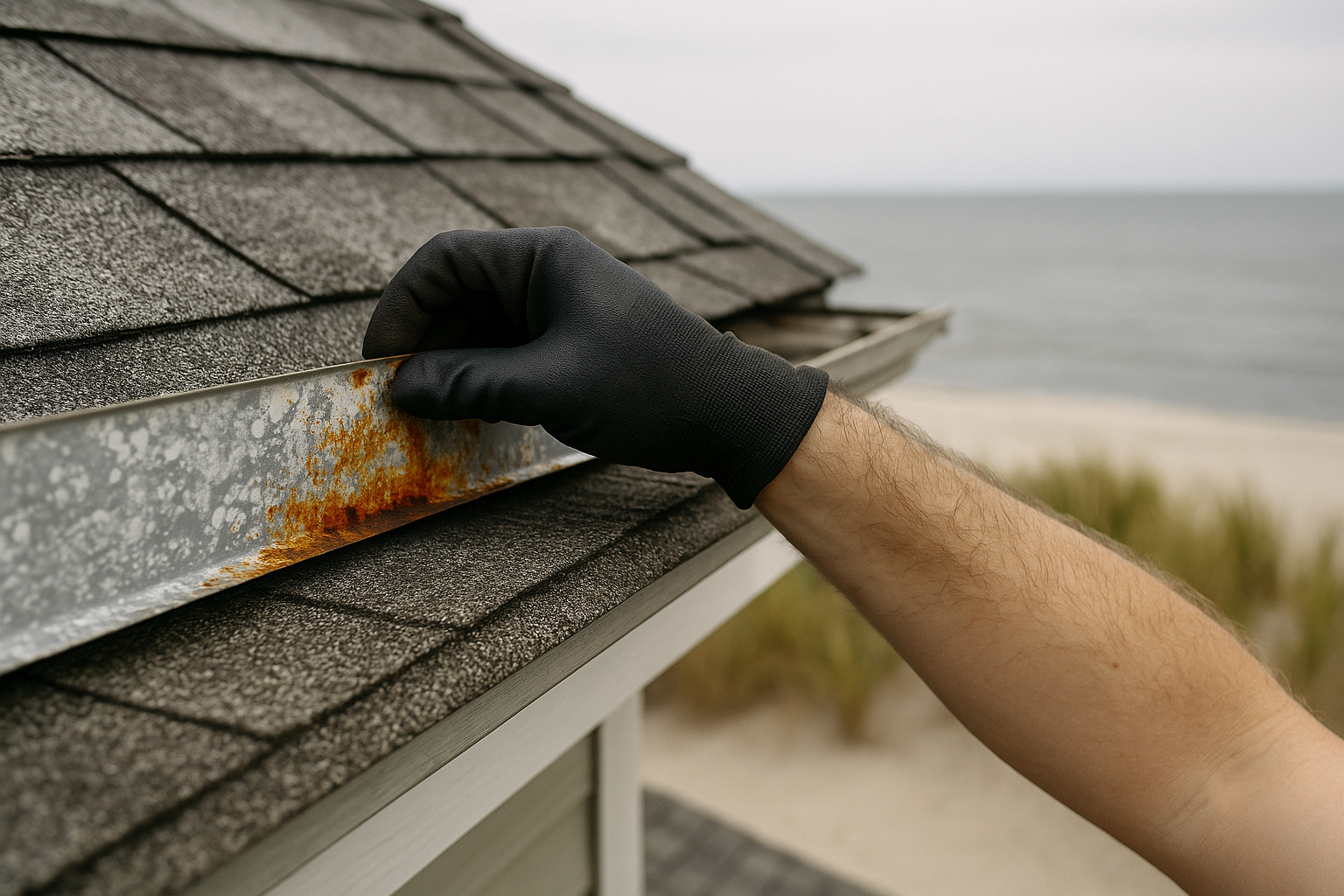
Salt air is the slow failure that never shows up in a single storm report. HappyRoof's storm-damage reference describes it exactly: salt aerosol carried inland from the surf settles on every exposed metal surface, and it attacks fastener heads, drip edge, vent hoods, gutter hangers, and flashing. Corroded fasteners lose holding power, which means the same wind event that a mainland roof shrugs off can lift shingles on an island roof of identical age and specification.
The implication is not that Brigantine roofs need exotic materials. It is that they need the right corrosion-resistant metal in the right places, and they need it inspected before it has rusted through. The two weak points worth watching are fasteners and thin flashing metal.
Fasteners are the quiet risk. A shingle does not need to fail for a roof to fail; the nail or screw holding it can corrode first. Once a fastener head rusts, the shingle loses its mechanical hold even if the shingle itself still looks serviceable. This is why enhanced fastening and corrosion-resistant fasteners are listed together with perimeter detailing in the company's barrier-island notes: the specification has to survive both the wind and the salt.
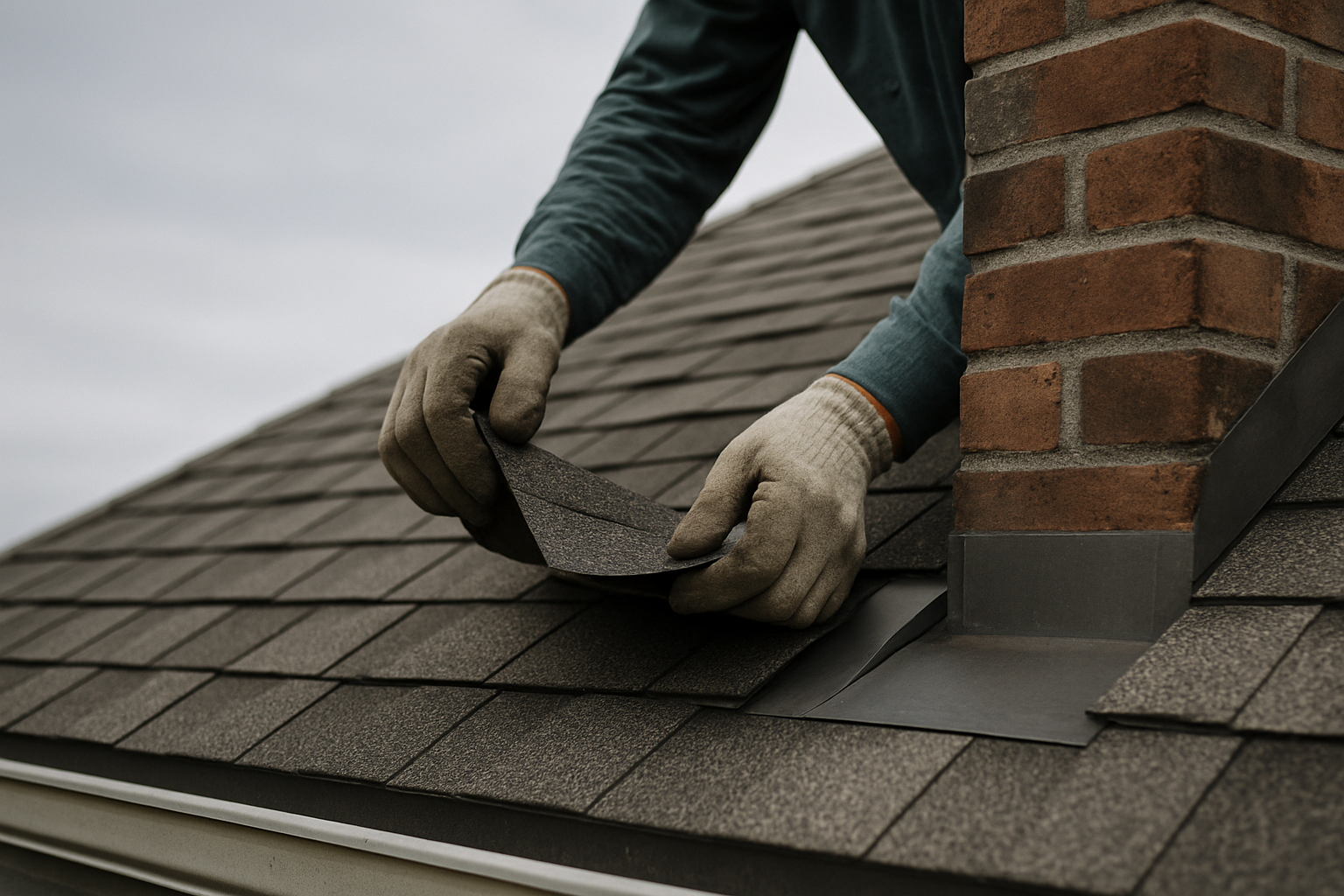
Flashing is the visible risk. Step flashing, counter flashing, valley metal, pipe boots, drip edge, and rake metal are all thin metal in constant contact with salt-laden air and runoff. On an island home, repairs are often not about installation error at all; the reference notes that repairs in Brigantine, Ventnor City, Margate City, Longport, and Atlantic City often involve replacing metal that has simply rusted through.
What this means for material choice is straightforward in principle and specific in execution. The principle: specify corrosion-resistant metal for flashing, drip edge, vent hoods, gutter hangers, and fasteners, and verify the alloy and coating against the manufacturer's guidance for marine or coastal exposure. The execution: do not assume a mainland detail will hold. A roof specified for a subdivision in central Jersey is not specified for a barrier-island house, and the metal is the first place that shows.
At an inspection, the telltale signs are rust streaks at fastener heads, flaking or pinholes in drip edge, corroded vent hoods, and flashing that has separated at the seams. None of these are cosmetic. Each one is a place where water and wind have already found a path.
How much wind does a Brigantine roof have to resist?
Wind is the failure mode that moves fastest on the island. The roof-repair reference describes the dominant island failure as mechanical: sustained ocean wind works at shingle edges until the factory adhesive strip lets go, and once a corner lifts, every subsequent gust drives water underneath and levers the shingle further.
That sequence matters because it tells you where to spend money. A Brigantine roof does not fail in the middle of the field first. It fails at the edges, the rakes, the ridges, and the eaves — everywhere the wind can get a purchase under a shingle or a piece of metal. The response is what the company's replacement notes call perimeter detailing and enhanced fastening.
Uplift-rated shingle installation is not a single number printed on a box. It is a combination of three things: the shingle's own published wind rating, the nailing pattern and fastener type the manufacturer requires to achieve that rating, and the edge metal that keeps the first course of shingles from peeling up. The exact nail count, fastener placement, and seal-down requirements come from the shingle manufacturer's published installation instructions for the wind exposure of the job. A homeowner should ask to see that the installation matches the rated method, not just that the shingle was bought with a wind rating attached.
Drip edge and rake metal do more than trim the roof. On a barrier island, they are the first line of defense against wind-driven rain at the eave and rake. When drip edge is corroded, loose, or installed with the wrong lap, the wind gets under the starter course and the underlayment is exposed to exactly the conditions it exists to resist. Securing edge metal properly — with the right fasteners, at the right spacing, and with the laps running the right direction — is part of the wind specification, not an afterthought.
The same logic applies to the roof's perimeter zones. Enhanced fastening in the eaves, rakes, and ridge areas is where uplift resistance is won or lost. The field of the roof is the easy part; the perimeter is where sustained ocean wind concentrates its force.
For a homeowner, the practical questions are simple to ask and revealing to hear answered. Will the installer follow the manufacturer's published wind-rated installation method for this shingle? Are the fasteners corrosion-resistant? Is the drip edge new, and how is it secured at the eave and rake? Are the ridge and rake details enhanced, or is this a standard inland layout moved to the island? If the answers are vague, the specification is probably vague too.
What flood elevation changes about roof and gutter work
Flood elevation is the Brigantine variable that gets ignored in most roofing discussions, and it is usually ignored at the owner's expense. The working rule on a barrier island is that the height of the finished floor and the mechanical equipment relative to base flood elevation drives a set of choices that have nothing to do with shingle color and everything to do with access, flashing, and water discharge.
This page will not invent an elevation number for your lot. Base flood elevation varies by location, and the authoritative figure for a specific Brigantine property is on the elevation certificate for that structure and in the municipal floodplain records. If the home has been raised, is on pilings, or has a low slab, the roofing and gutter work has to be planned around that geometry rather than a mainland assumption.
For a raised home, the roof itself may be higher off the ground, which changes staging and access. The reference material notes that access planning matters on the barrier islands because there is often no driveway to stage from. A raised home on a narrow lot can compound that: ladder placement, material handling, and disposal all have to be worked out against the house's elevation and the available clearance.
For a lower-slab or ground-level home, the concern shifts to water management. Gutters and downspouts on a Brigantine home have to move heavy shore rain away from the foundation, and on a low-slab home there is less elevation to work with. The discharge point matters, and so does the slope of the ground at the downspout outlet. Seamless gutters and downspout runs sized for the rain load, discharging well away from the slab or pilings, are part of the roof system's job, not a separate cosmetic purchase.
Flood elevation also touches the eave-to-wall transition and any low-slope rear section. Where a roof plane meets a raised wall, the flashing at that transition has to be detailed so wind-driven rain cannot drive up and under it. On the narrow attached and semi-attached buildings common on the island, the rear sections are often low-slope, and those are governed by membrane detailing rather than shingle work.
The coordination point is the permit. The company's replacement checklist asks who pulls the permit and who meets the municipal inspector. On an island home where flood-elevation and wind requirements both apply, the permit and the inspection are where the plan gets checked against the municipality's requirements. Ask the contractor to walk through that coordination before the tear-off, not after.
Coastal underlayment and ice-and-water shield versus inland Atlantic County
The underlayment is the part of the roof a Brigantine homeowner never sees but needs most during the exact storm that causes the most damage. On the barrier islands, the dominant water threat is wind-driven rain: water moving horizontally under shingle laps and behind flashing. Inland toward the Pinelands, the threats are different — shaded slopes that grow moss, limb strikes, and gutters that pack solid with pine needles. A single underlayment strategy does not serve both.
The coastal answer starts with the principle that the underlayment is the secondary water barrier. The shingles and metal are the primary covering; the underlayment is what keeps water out when wind forces rain past the first layer. In a coastal climate, that means the underlayment has to be selected and installed as part of the wind and water specification, not as a commodity layer.
Ice-and-water shield — a self-adhered membrane — earns its place in the vulnerable zones: eaves, valleys, roof penetrations, and any transition where wind-driven rain or ice can concentrate. The reason is not that Brigantine gets extreme ice damming every winter. The reason is that a self-adhered membrane seals around fasteners and stays adhered when wind gets under the roof covering, which is precisely the failure mode the island creates.
Contrast the mainland. On the Pine Barrens side of the county, the underlayment is more often protecting against slow moisture and moss retention on shaded slopes, while the mechanical threats are tree limbs and clogged gutters. The reference material puts the two environments in opposition: on the barrier islands, sustained ocean wind lifts shingle edges and salt air corrodes fasteners; inland, tree cover means limb strikes, shaded slopes that grow moss, and gutters that pack solid with pine needles every autumn.
The practical takeaway for a Brigantine roof replacement is to confirm three things in the proposal: what underlayment is specified, where the self-adhered membrane runs, and whether the deck is sound enough to receive it. If the proposal describes only "new felt" with no coastal detailing, it is an inland specification being applied to an island roof.
Does a metal roof make sense on a Brigantine island home?
Metal roofing is worth a serious look in Brigantine, but the salt air changes the conversation. The company's replacement service lists metal as one of three systems — architectural asphalt, metal, or flat membrane — and its barrier-island notes say corrosion-resistant metal earns its keep on the islands. The question is not whether metal can work; it is which metal system and which fastening method survive the salt.
The critical distinction is between exposed-fastener and concealed-fastener systems. In an exposed-fastener metal roof, the fastener heads are exposed to the same salt aerosol that attacks every other metal surface. The roof's mechanical hold depends on those fasteners, so their corrosion resistance is the entire ball game. In a standing seam system, the fasteners are concealed under the seam, and the seam itself is raised, which changes how water and wind interact with the roof surface.
This does not mean standing seam is automatically right and exposed-fastener is automatically wrong. It means the decision has to be made against the island's conditions, not against a price sheet. A homeowner weighing the choice should compare standing seam metal versus architectural asphalt shingles with the salt and wind load in mind, and should ask the installer how the fasteners, clips, and flashing are specified for coastal exposure.
Metal also interacts with the low-slope rear sections common on Brigantine's attached and semi-attached homes. A steep-slope metal panel is not a low-slope membrane, and the transition between the two has to be flashed as a deliberate detail. The metal roof decision is therefore part of a larger system decision: steep-slope covering, low-slope covering, and the transition between them. HappyRoof's standing seam and exposed-fastener metal roofing service page covers the system-level questions in more depth.
The honest answer is that no material choice eliminates salt. Every choice shifts where the corrosion risk sits. The specification question is whether the fasteners and flashing in that system are specified to resist the island's salt aerosol, and whether the installation method matches the manufacturer's published requirements for a coastal wind exposure.
What a roof replacement in Brigantine NJ includes
A Brigantine roof replacement is a full tear-off and replacement in architectural asphalt, metal, or flat membrane, sized, vented, and flashed correctly for a coastal climate. That last clause is the part that separates an island job from a mainland one. Sizing, ventilation, and flashing are not generic; they are the three places where a barrier-island roof either holds or fails.
The tear-off is where the real condition of the roof is revealed. The company's replacement checklist includes the question of the per-sheet price if decking has to be replaced, because deck condition is unknowable until the old roof comes off. A Brigantine home that has lived through years of salt air and wind may have deck damage at the eaves, rakes, and around penetrations even if the field of the deck is sound.
Ventilation is part of the replacement, and the checklist asks whether it balances intake with exhaust. On a humid coastal roof, ventilation is not a luxury; it is how the attic sheds the moisture that salt air and the marine climate put into it. A roof that is sealed up tight without balanced ventilation moves the problem into the attic.
Access planning is a Brigantine-specific line item. Many island lots have no driveway to stage from, and the housing stock includes narrow attached and semi-attached buildings. The tear-off, material handling, and disposal plan has to be worked out against that reality before the crew arrives, not improvised on the day.
The low-slope rear sections common on those narrow attached homes are a separate discipline. They require low-slope and flat roof repair or replacement in membrane, sized and flashed for coastal exposure, with the steep-slope-to-low-slope transition treated as its own flashing detail. A proposal that treats the whole roof as shingle work is missing part of the job.
The permit is part of the job. The checklist asks who pulls the permit and who meets the municipal inspector, and on an island home the permit is where wind and flood-elevation requirements get checked. A written proposal should make the permit responsibility explicit.
The proposal itself should be itemized and in writing before any work starts. The company's stated practice is an itemized written proposal before anyone picks up a nail gun, with the same crew that inspected the roof doing the installation. That matters on an island because the person who saw the corroded flashing and the wind-lifted edges is the person who should be specifying the repair.
What roof repair in Brigantine NJ usually finds
Roof repair in Brigantine NJ divides into two families of problems, and they usually arrive together. The first is mechanical: wind has worked a shingle edge loose. The second is chemical: salt has corroded the metal that was supposed to hold the roof together.
The mechanical failure follows a known sequence. Sustained ocean wind works at shingle edges until the factory adhesive strip lets go. Once a corner lifts, every subsequent gust drives water underneath and levers the shingle further. By the time a leak shows up inside, the failure has often been running for a while, because the water travels before it stains.
The chemical failure is quieter. Salt aerosol corrodes fastener heads and thin flashing metal, and the repair often involves replacing metal that has rusted through rather than correcting any installation error. Step flashing at a wall, counter flashing at a chimney, valley metal, and pipe boots are all candidates. When they rust through, the shingles above and around them may still look fine.
This is why the company's repair language says it finds the actual source instead of patching the stain. A leak at a ceiling is frequently not where the water entered; on an island home, the water often entered at a corroded flashing or a wind-lifted edge some distance away.
Chimney and valley work carries extra weight on a barrier island because those are the intersections where wind-driven rain is most aggressive. The flashing at a chimney or valley has to shed water moving sideways, not just falling water. When the metal is also corroding, the detail fails faster than the same detail inland. The full diagnosis process for chimney, valley, and pipe boot leaks is covered on the roof flashing repair service page.
The practical advice for a Brigantine homeowner is to treat a visible leak as a sign to inspect the metal, not just the shingle. A repair that replaces only the missing shingle while leaving rusted-through flashing in place is a repair that will be back. The correct repair identifies the actual entry point, replaces the failed metal, and re-secures the perimeter so the next nor'easter does not simply repeat the failure.
Storm readiness and emergency tarping for island homes
Brigantine's exposure means storm readiness is part of owning the roof, not an emergency-only afterthought. The company's storm and wind damage service covers nor'easter and hurricane damage, emergency tarping, and documentation to support an insurance claim. On an island, all three are used in sequence, and the order matters.
Emergency tarping is the first step after damage, and it exists to stop water from making a bad situation worse while the permanent repair is scheduled. A tarp is not a repair; it is a temporary water barrier. But on a barrier island, a properly secured tarp is the difference between a contained claim and a secondary interior loss that no adjuster will enjoy sorting out.
Documentation is the second step, and it is where island claims are won or lost. The company documents storm damage and can meet adjusters. Photographs taken immediately, of the lifted shingles, the corroded flashing, the displaced edge metal, and the tarped area, create the record the claim will be judged against. The deductible rules and the adjuster meeting process are covered in the New Jersey roof storm damage claims article.
Ahead of a nor'easter, the highest-value work is usually inspection and small repair, not waiting for the storm to find the weak point. A free inspection that finds a loose drip edge, a corroded pipe boot, or a wind-lifted corner before the storm is cheaper and calmer than a tarp call at the height of the weather. The company's inspection is free and comes with photos of what is actually up there, so the decision can be made on evidence rather than anxiety.
One point deserves explicit attention: New Jersey deductible law. The site's storm guidance warns against the deductible scam, and the company's materials state that no one may lawfully absorb or waive a deductible in New Jersey. A contractor offering to do so is not doing the homeowner a favor; they are describing an arrangement that is not lawful, and the homeowner is the one who carries the risk.
For a Brigantine homeowner, the storm plan is concrete: know who to call for tarping, have the policy documents reachable, photograph the roof before and after, and do not wait until the forecast is certain. By the time the nor'easter track is locked in, every roofer on the island is already busy.
The same-crew inspection-to-install workflow
The workflow HappyRoof describes is built to remove the gap between what was inspected and what gets installed. That gap is expensive on a barrier island, where the difference between a coastal detail and a mainland detail is the difference between a roof that holds and a roof that fails.
The process runs in a sequence, and each step produces something the homeowner keeps.
First, the inspection. It is free and it comes with photos of what is actually up there. The stated position is explicit: if the roof has ten good years left, the homeowner hears that and keeps the report. The inspection is not a sales call with a ladder; it is a condition assessment with evidence.
Second, the honest remaining-life answer. The company says it tells the homeowner when a roof does not need replacing. On an island, that answer matters because salt and wind can make a roof look older than it is, and a homeowner deserves to know whether the corrosion they can see is cosmetic or structural.
Third, the itemized written proposal. If the roof genuinely needs work, the proposal is in writing before anyone picks up a nail gun. Itemized means the decking, ventilation, flashing, edge metal, and material choices are called out, not folded into one round number.
Fourth, the installation by the same in-house crew that inspected. The company's claim is that the same people inspect and install, with no day-labor crews or disappearing subcontractors. On a Brigantine job, that continuity is what carries the coastal specification from the inspection notes into the finished roof: the person who saw the corroded flashing is the person who specifies its replacement.
Fifth, the cleanup. Full cleanup includes a magnet sweep for nails, which matters on an island where wind scatters debris and where a stray nail in a driveway or a neighbor's yard is a real hazard.
Sixth, the manufacturer-certified installation. The site describes the company as manufacturer-certified installers, and the point of that certification is that material warranties stay valid because the installation meets the manufacturer's requirements. A Brigantine homeowner should ask which certification applies to the system being installed and how the coastal fastening and flashing details are documented.
The practical result is a paper trail: inspection photos, an itemized proposal, and a written workmanship warranty. On a barrier island, that paper trail is also the beginning of the insurance record if a future storm damages the roof.
What is included, and what is not
Being clear about the boundaries prevents a bad surprise, and on a barrier island the boundaries matter because conditions change fast once a roof is open.
Included in the company's stated service: free roof inspections with photos; an honest remaining-life assessment even when no replacement is needed; itemized written pricing before work starts; emergency tarping; storm and wind damage documentation and adjuster meetings; full cleanup with a magnet sweep; and manufacturer-certified installation. Roof replacement covers architectural asphalt, metal, and flat membrane. Roof repair covers leaks, missing shingles, failed flashing, valley, and chimney work. Gutters are seamless, with guards and downspout runs sized for the rain and leaf load.
What is not claimed is just as important. The site does not publish a specific license number, bond amount, or insurance certificate, so this page will not invent one. It does not name a shingle, metal, gutter, or siding manufacturer, so this page will not either. It does not publish a price for a specific home, because the company's stated position is that price ranges are general guidance and a quote requires an inspection. It does not offer financing, payment plans, or deductible waivers, and the site states that no one may lawfully absorb or waive a deductible in New Jersey.
The company is presented as licensed, bonded, and insured, and as manufacturer-certified installers, with a physical shop at 611 Doughty Rd in Pleasantville. A homeowner who wants to verify a license, bond, or insurance detail should ask for the specific document rather than accept a footer badge as proof.
What to have ready before you call
A Brigantine roofing call goes faster and produces a better proposal when the homeowner arrives with the right facts. None of these are mandatory, but each one removes a round trip.
The address and the lot's access reality. Brigantine has lots with no driveway to stage from, and the reference material calls out access planning as a barrier-island issue. Tell the contractor whether there is a driveway, an alley, a narrow side yard, or a raised home with limited clearance.
The roof's known history. Age if known, any prior repairs, any past storm claims, and any spots that have leaked. A homeowner who has lived with a recurring stain for three years is describing a pattern, not an isolated event.
Photographs. Any photos of prior storm damage, lifted shingles, rusted flashing, or interior stains are evidence the inspection can build on. If the roof has been tarped before, say so.
Insurance details. Have the policy number and the date of any prior claims reachable if storm damage is part of the reason for the call. The documentation path is part of the service.
The elevation certificate if the home is raised or in a flood zone. The contractor does not need it to look at the roof, but the certificate is the authoritative source for the finished-floor elevation and helps frame the access and gutter-discharge questions.
The question you are actually trying to answer. Replacement budgeting, leak chasing, pre-sale, post-storm, or a second opinion each lead to a different inspection emphasis. State it plainly at the start.
Where HappyRoof works in and around Brigantine
HappyRoof states that it serves every town in Atlantic County, and Brigantine is named in both the service-area list and the barrier-island notes. The barrier-island towns the company names are Atlantic City, Ventnor City, Margate City, Longport, and Brigantine. The footer service list adds Egg Harbor Township, Galloway, Hammonton, Mays Landing, Atlantic City, Somers Point, Margate City, and Brigantine.
The physical shop is at 611 Doughty Rd, Pleasantville, NJ 08232, and the company is presented as a sister company of HappyVac Heating & Air. The phone number for inspections and emergency tarping is (609) 525-4521.
The relevance of the shop location is not decorative. A contractor with a mainland shop can stage material and crews and still serve the island, but the island work has to be planned around access, wind, and salt in a way that a purely inland crew might not anticipate. The Brigantine specification — corrosion-resistant metal, enhanced fastening, perimeter detailing, and flood-elevation-aware gutter work — is the same barrier-island logic that applies to bayfront homes in Margate, and it is worth asking the contractor to say, in writing, which coastal details are included in the proposal.
What drives scheduling and lead time
This page will not publish a lead time, because the honest answer depends on factors that are not knowable before the inspection. On a Brigantine job, the drivers are the condition of the deck once the old roof is off, the municipal permit schedule and inspector availability, the weather window for a coastal tear-off, and material availability for the specified system. A raised or attached home can also add staging time.
The company lists contact hours of Monday through Saturday, 7:00 AM to 7:00 PM, with emergency tarping available outside those hours. The correct sequence for a homeowner is to book the free inspection first, receive the written proposal, and then schedule the work against the permit and weather windows the proposal identifies. Call (609) 525-4521 to start.
Frequently asked questions about roofing Brigantine NJ
Is roofing in Brigantine NJ really different from the mainland?
Yes. Brigantine is one of the five Atlantic County barrier island towns the company names, alongside Atlantic City, Ventnor City, Margate City, and Longport. Salt aerosol corrodes fastener heads and flashing years ahead of schedule, and sustained ocean wind works shingle edges loose. The governing factors — wind, salt, and narrow attached or semi-attached housing with low-slope rear sections — change the metal, fastening, and perimeter detailing versus inland Atlantic County.
What metal holds up best against Brigantine salt air?
The starting point is corrosion-resistant metal, not a specific brand. Salt aerosol attacks fastener heads, drip edge, vent hoods, gutter hangers, and flashing, and exposed fasteners are the weak point in any system. Concealed-fastener standing seam is worth comparing against exposed-fastener metal for that reason. Confirm the alloy and coating with the installer against the manufacturer's marine or coastal corrosion guidance.
How do you handle a low-slope rear section on a narrow island home?
Low-slope rear sections are common on Brigantine's attached and semi-attached buildings and they require flat or low-slope membrane work sized and flashed for coastal exposure, not shingle patching. The transition between the steep-slope and low-slope planes is where wind-driven rain gets in, so that intersection has to be detailed as its own flashing job.
Should I get a roof inspection before storm season?
Yes. A free inspection with photos can find the loose drip edge, corroded pipe boot, or wind-lifted corner before a nor'easter turns it into an interior loss. The inspection also creates a pre-storm photographic record, which is the starting point for any future insurance documentation.
Can you tarp a Brigantine roof ahead of a nor'easter?
The company provides emergency tarping as part of its storm and wind damage service. A tarp is a temporary water barrier, not a repair, but a properly secured tarp prevents a contained exterior problem from becoming a secondary interior loss. Call (609) 525-4521 as soon as damage or vulnerability is identified.
How does insurance documentation work after island storm damage?
The company documents storm damage and can meet adjusters. Photographs of lifted shingles, corroded or displaced flashing, and the tarped area create the record the claim is judged against. New Jersey deductible law matters: no one may lawfully absorb or waive a deductible, and any contractor offering to do so should be treated as a warning sign.
The next step for a Brigantine roof
Book the free inspection. It comes with photos of your own roof, an honest answer on remaining life, and — if work is needed — an itemized written proposal with the coastal details called out before anything starts. Call (609) 525-4521 or reach the shop at 611 Doughty Rd, Pleasantville, NJ 08232.