Documenting a roof insurance claim in New Jersey means recording the date of loss, taking date-stamped photos of shingle, flashing, and interior damage, and getting a written contractor scope before the adjuster arrives. The roof insurance claim documentation New Jersey requires also includes understanding RCV versus ACV and what a contractor may not lawfully do with your deductible.
Why documentation decides the claim before the adjuster arrives
A roof claim is decided on evidence, not on how the roof looks from the ground on the day the adjuster visits. By the time an adjuster arrives — sometimes a staff employee and sometimes an independent contractor working for the carrier — the storm may be days or weeks behind you. Shingles that were creased by wind can lie back down. Water stains can dry. The adjuster is writing an estimate of what the carrier believes the covered damage is worth, and that estimate starts from what can be shown, not from what the homeowner remembers.
The documentation you create in the first days after a storm is therefore the claim file. It does three jobs. First, it records the date of loss and connects the damage to a specific weather event. Second, it shows the adjuster the damage at its most visible, before repair, tarping, or weathering changes the evidence. Third, it gives your contractor a basis for a written repair scope that can be handed directly to the adjuster and, later, used to support a supplement if the first estimate misses something real.
HappyRoof's storm damage page states the sequence plainly: report the loss to your carrier promptly and get a claim number, mitigate further damage, and keep every receipt and photo. That sequence is the spine of this page. The rest is the detail that makes the file hold up.
What belongs in a complete New Jersey roof claim file
A claim file is not a single document. It is a set of records that lets the carrier see the loss, the date of loss, the mitigation, and the repair scope without asking you to reconstruct anything from memory.
The core pieces are:
- The date of loss and the date the damage was first noticed, kept separate.
- Date-stamped photos and video of the roof, flashing, and interior stains.
- A written contractor scope describing the damage and the proposed repair.
- The claim number, placed on every document and photo submission.
- Receipts for tarping, mitigation, and emergency repair.
- The policy declarations page and any notes on RCV or ACV coverage.
- Notes from any conversation with the carrier, including names and dates.
The file should be organized so the adjuster can move from the storm to the damage to the repair without hunting. A folder or PDF that groups the overview photos, close-ups, interior photos, and receipts in that order does the job.
Photo and video checklist for a New Jersey roof claim
The photo set is the most important evidence most homeowners can create themselves. A good set does not need professional equipment; it needs coverage, date stamps, and enough context that someone who was not there can understand what they are looking at.
What to photograph
| Area | What the photos should show |
|---|---|
| Roof overview | The full roof from the ground on each side of the house, so the adjuster can see the roof's general condition and layout. |
| Shingle close-ups | Wind-creased, lifted, torn, or missing shingles, with the camera close enough to show the break, crease, or nail line. |
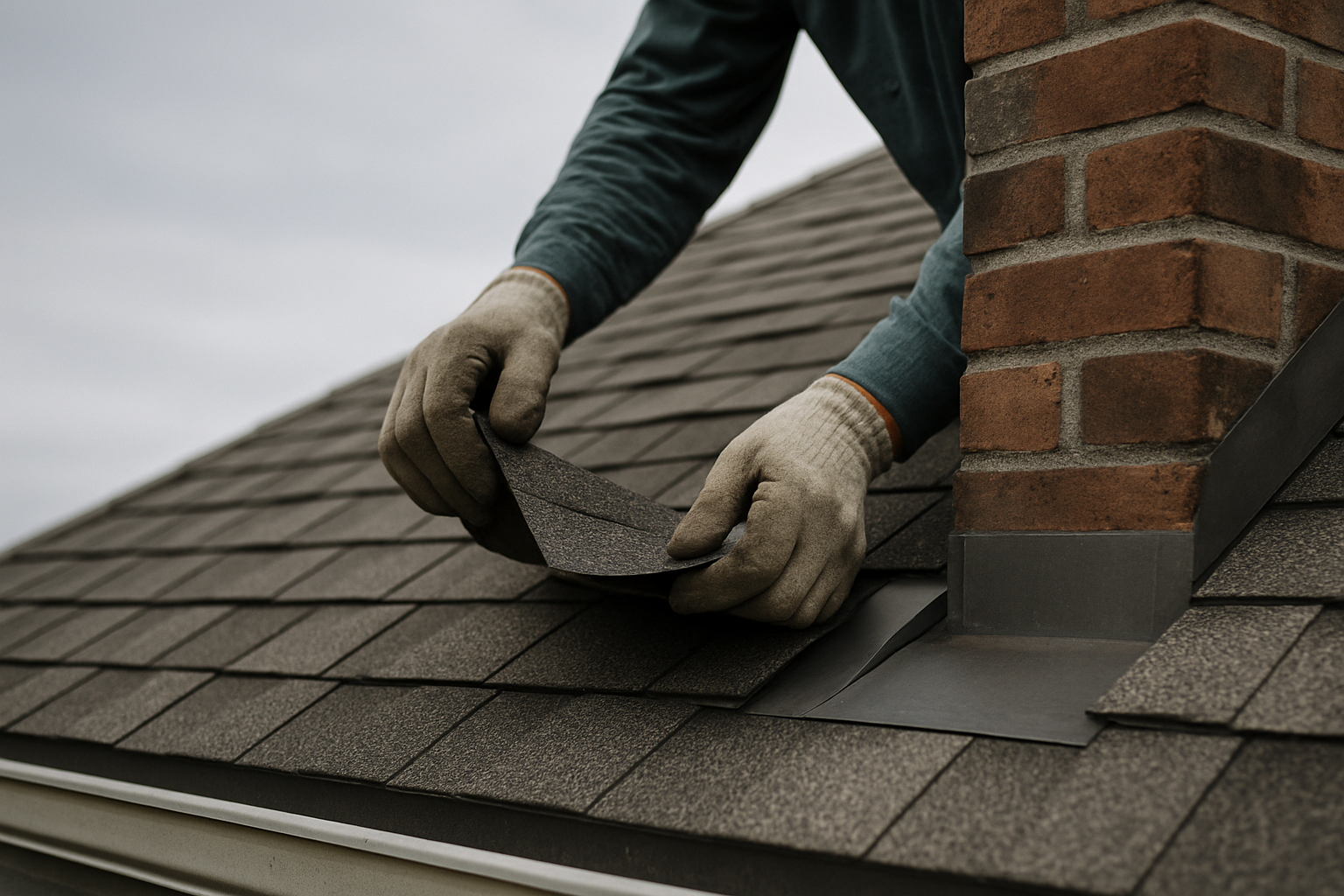
| Flashing | Step flashing, counter flashing, chimney flashing, pipe boots, and valley metal, especially where metal is lifted, torn, or separated. |
| Ridge and edges | Ridge caps, drip edge, and rake metal that is bent, missing, or pulled away. |
| Penetrations | Vents, skylights, pipes, and anything that passes through the roof, with the surrounding sealant or boot. |
| Interior stains | Ceiling stains, wall stains, and attic water marks, photographed wide enough to show location and close enough to show the stain. |
| Gutters and downspouts | Dents, pulled-away sections, and granule accumulation that indicates shingle wear or impact. |
| Temporary mitigation | Tarps, buckets, and any emergency repair, with receipts and before-and-after photos. |
How to make the photos useful
Put a date and time stamp on every photo or video. Most phone cameras record this in metadata, but a visible stamp helps when the file is printed or exported. Include a location reference in at least some photos — a house number, street sign, or a wide shot that shows the property — so the file is tied to the correct address.
Take the overview shots first, then the close-ups. A close-up of a torn shingle with no context can be impossible to place on the roof. A sequence that goes from the full roof face, to the area around the damage, to the defect itself is much harder to dismiss.
Photograph the interior stains as soon as they appear, before they dry or are painted over. A dried stain still matters, but a fresh one with a date stamp connects the interior damage to the storm window in a way that a repainted ceiling cannot.
Take video of the roof from the ground or from a safe ladder position. Walk slowly, name what you are filming, and keep the date and time visible. Video is not a substitute for still photos, but it captures the relationship between damaged areas and the rest of the roof.
A note on safety
Do not walk a wet, steep, or storm-damaged roof to take photos. Ground-level and ladder-level photos are enough for the first claim file. A roofing contractor with the right equipment can take the roof-level documentation later, and the adjuster will do their own inspection. HappyRoof documents wind, hail, and impact damage as part of its claim-help process and organizes the photos for the claim file.
Recording the date of loss and connecting damage to a specific storm
Insurance policies respond to a loss that occurs during the policy period and is caused by a covered peril. For a roof claim in New Jersey, the date of loss is usually the date of the storm, nor'easter, wind event, or hail event that most likely caused the damage. Recording that date accurately matters because the claim will be evaluated against the weather on that date and against the policy in force at that time.
Write down the date and approximate time you first noticed the damage, and separately write down the date of the weather event you believe caused it. Those are not always the same day. A leak may appear hours or days after the wind-driven rain that opened the path for it. Keeping the two dates separate prevents a small inconsistency from becoming a reason to question the whole file.
Then connect the damage to the storm. The strongest connection is a photo or video taken close to the event, but supporting records also help: local weather reports, news coverage, and notes from neighbors whose homes were damaged in the same event. You do not need to become a meteorologist. You need enough to show that the damage is consistent with a specific storm rather than with ordinary aging.
The carrier will look for that consistency. Wind damage and ordinary wear can look different to a trained eye, and HappyRoof says it gives straight answers about what is storm damage and what is ordinary wear before a homeowner files. That distinction matters because filing a claim for wear that the policy does not cover can waste time and can put a claim on your history without a payout.
If the damage is from hail, look for impact marks on soft metal, such as vents, flashing, or gutters, not only on shingles. If the damage is from wind, note the direction the wind came from and which roof slopes face that direction. Those details help the adjuster see a storm pattern rather than a random collection of defects.
Emergency tarping and mitigation: documenting the stopgap
Mitigation is not a side task. It is a policy obligation and a claim expense, and the documentation around it matters as much as the roof photos. After a storm opens a path for water, the first job is to stop further interior damage. That usually means a tarp over the damaged area or a temporary repair at the penetration.
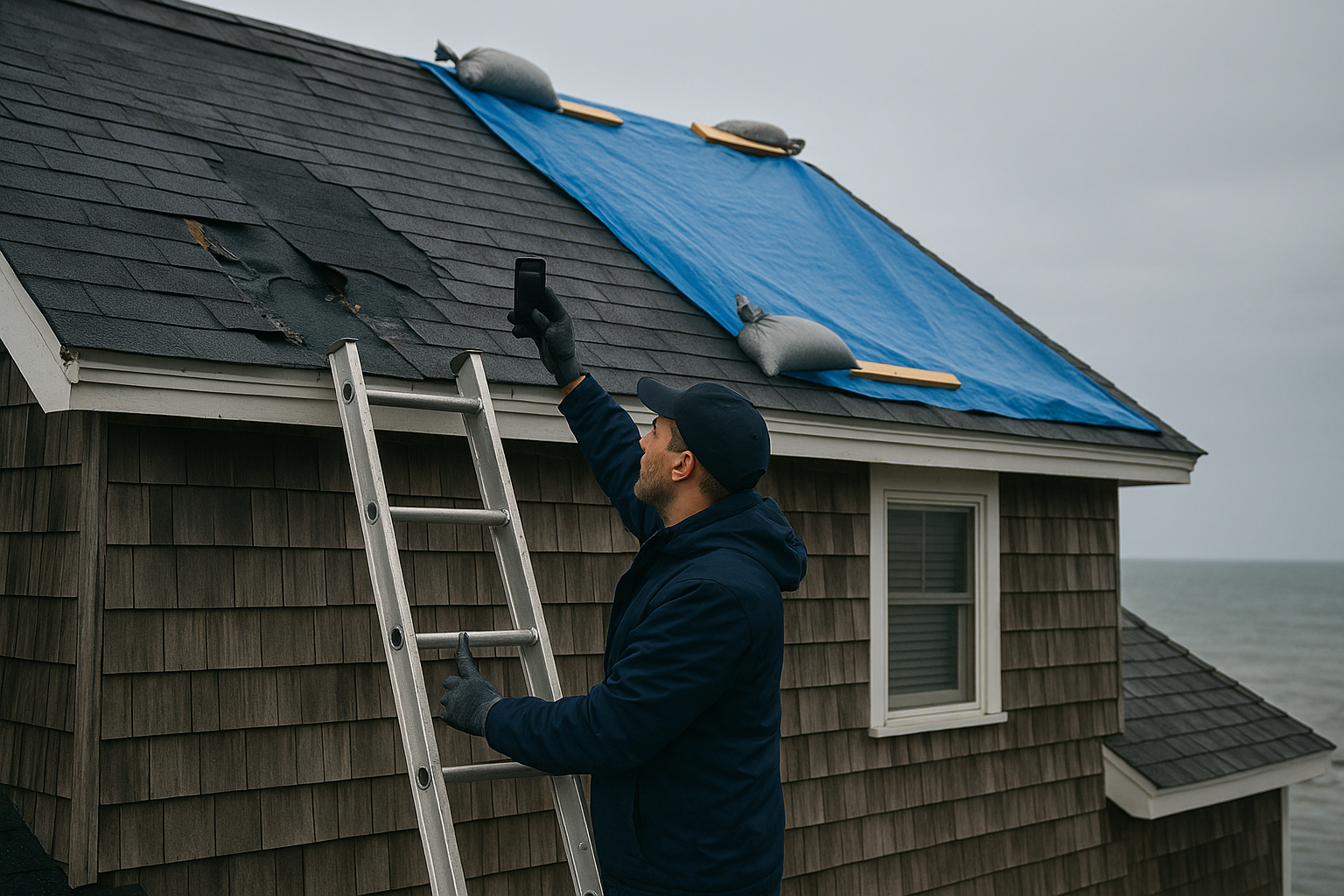
HappyRoof lists emergency tarping as part of its claim-help process, specifically to stop further interior damage while the claim is being processed. The tarp is not the repair; it is the stopgap that keeps a bad situation from becoming a larger loss.
Document the mitigation the same way you document the original damage. Photograph the damaged area before the tarp goes on, photograph the tarp after it is in place, and keep the receipt. If you buy materials yourself, keep those receipts too. If the tarp fails or the weather worsens, photograph that as well. The carrier needs to see that you acted to protect the property, not that you waited.
The receipt for emergency tarping may be reimbursable as part of the claim, subject to policy terms. It is also evidence that the loss was serious enough to require immediate action. Both reasons make it worth keeping.
Reading your policy: the terms that matter before you file
You do not need to read an entire policy to understand a roof claim, but you do need to find a small number of terms on the declarations page and in the loss settlement section. The two that control most of the money are replacement cost value and actual cash value, and the two that control the rest of the process are the deductible and the claim-reporting requirement.
The declarations page shows the deductible, the policy period, and the property address. The loss settlement section shows whether the roof is settled on an RCV or ACV basis. Some policies settle certain roof surfaces differently, so the answer may not be a single word. If the language is unclear, ask the carrier or your agent to point to the exact provision.
The claim-reporting requirement is the reason the storm damage page says to report the loss promptly and get a claim number. Reporting is not the same as committing to a claim. It starts the file and creates a record of the date you notified the carrier, which matters if the damage later worsens.
The deductible is the portion of the loss your policy requires you to pay. It is not a fee the contractor can absorb, and it is not a line item the contractor can hide. It stays with you.
RCV vs ACV, depreciation, and how the payout is structured
The two most important policy terms in a New Jersey roof claim are replacement cost value and actual cash value. They determine how much the carrier pays, when it pays, and how much of the loss stays with you.
The definitions
Replacement cost value (RCV) is the cost to repair or replace the damaged roof with materials of like kind and quality, without subtracting for age or wear. Actual cash value (ACV) is replacement cost minus depreciation — the reduction for the age and condition of the roof before the loss.
A simple way to hold the distinction: RCV asks what it costs to put the roof back; ACV asks what the old roof was worth the moment before the storm.
| Term | What it measures | What it means for the homeowner |
|---|---|---|
| Replacement cost value (RCV) | Cost to repair or replace with like kind and quality, before depreciation | The full covered cost of the work, but usually paid in two installments. |
| Actual cash value (ACV) | RCV minus depreciation | The first payment on an RCV policy, or the only payment on an ACV policy. |
| Depreciation | The reduction for age, condition, and expected remaining life | The portion the carrier withholds until replacement is completed on an RCV policy. |
| Deductible | The portion of the loss the policyholder pays | Subtracted from the claim payment, never absorbed by the contractor. |
How a replacement cost claim is paid
On a replacement cost policy, the payment is usually structured in two installments.
The first installment is the actual cash value payment. It is the replacement cost minus depreciation and minus your deductible. That payment may be enough to begin the work, but it is not the whole claim.
The second installment is the recoverable depreciation payment. After the work is completed and documented, the carrier releases the depreciation that was withheld, subject to the policy terms and the evidence submitted. If the final cost is lower than the estimate, the carrier may adjust the payment accordingly.
The key word is "recoverable." On an RCV policy, depreciation is withheld, not lost. On an ACV policy, depreciation is not recoverable; the ACV payment is the end of the claim, and the homeowner funds the difference between ACV and the actual repair cost.
For an RCV vs ACV roof claim in New Jersey, the practical difference shows up when you compare the first check to the contractor's estimate. If the check is lower than the estimate, that is not necessarily a denial. It may be the ACV installment with depreciation still withheld, waiting for proof that the work was completed.
Coverage decisions belong to the carrier and depend on your policy language, your deductible, and what the evidence shows. Nothing in this page guarantees a particular outcome, and neither does a contractor's estimate. The policy and the claim file decide.
Preparing for the adjuster meeting in New Jersey
The adjuster meeting is the point where the claim file meets the carrier's estimate. The adjuster may be a staff employee or an independent contractor working on the carrier's behalf. Either way, the meeting is an inspection, not a negotiation in the usual sense. The adjuster writes an estimate of what the carrier believes the covered damage is worth.
What to have ready before the adjuster arrives
Have the claim number, the date of loss, and your policy declarations page in one place. Have the photos and videos organized, not scattered across a phone and a spouse's phone. Have the written contractor scope if you have one. Have receipts for any mitigation, tarping, or emergency repair. Have the names and dates of any prior roof work if you know them.
The claim number matters more than it seems. It is how every document, photo, and conversation gets attached to the right file. If you email photos or send a scope, put the claim number in the subject line and on the document itself.
Why your contractor should be there
You are entitled to have your roofing contractor present for the inspection, and it is generally a good idea. A contractor who has already documented the roof can point to specific broken seals, creases, and flashing failures rather than leaving the adjuster to find them unaided in an hour on a large roof. The adjuster's time on the roof is limited, and the roof does not always show its damage from the ground.
HappyRoof says it can meet the adjuster at the property and walk the roof with them. That is not a substitute for your own involvement, and it does not make the contractor a public adjuster. It means there is a second set of trained eyes on the same evidence at the same time.
The contractor's role during the adjuster meeting
A roofing contractor's role at the adjuster meeting is evidentiary, not legal. The contractor can show the adjuster what is damaged, where, and why it matters to the repair. The contractor cannot decide coverage, set policy limits, or speak for the carrier.
During the meeting, the contractor can point to the specific defects in the photos and on the roof. Wind-creased shingles, broken seals, lifted flashing, and pipe boot failures are the kinds of damage that can be missed or under-scoped if the adjuster is looking at a large roof in a limited time. The contractor can also explain what the repair would require, which is different from what the carrier chooses to pay for.
What the contractor should not do is promise a particular settlement, tell you to inflate the scope, or offer to handle the deductible. Those are the boundary lines that separate a contractor helping with documentation from a contractor creating a problem for the homeowner.
HappyRoof's stated process is to provide a written repair scope you can hand directly to the adjuster, to meet the adjuster at the property, and to document wind, hail, and impact damage in an organized claim file. It does not claim to act as a public adjuster or to decide coverage.
The supplement process when the first estimate misses items
A first estimate is not always the final word. If the adjuster's scope omits something real, the contractor submits a supplement with photographs and documentation asking the carrier to revise the estimate.
A supplement is a request to correct an under-scoped estimate, not a demand for more money. It works only when it is tied to evidence: a photo of damage that was not in the first estimate, a code requirement the estimate did not include, or a measurement the adjuster did not take. The carrier reviews the supplement and decides whether to revise.
Common reasons a first estimate misses items include damage that was not visible during the initial inspection, additional decking revealed after tear-off, and components the adjuster did not itemize. When the tear-off exposes rotted decking or failed underlayment that could not be seen from above, the contractor documents it and submits it as a supplement. The same applies when the initial estimate does not account for something the adopted building code requires, such as the layer limit that applies when a roof already has two layers of covering.
The supplement process is why the early documentation matters. A photo taken before the adjuster arrived can support a supplement weeks later. A written scope from a contractor can show what was identified before the inspection and what the first estimate left out. Without those, a supplement is just an argument; with them, it is a correction.
The carrier, not the contractor, decides whether the revision is accepted.
New Jersey deductible law and what a contractor may not lawfully do
The deductible is the portion of the loss your policy requires you to pay. In New Jersey, that obligation is not a negotiating point.
After a significant storm, contractors sometimes appear in Atlantic County neighborhoods offering to "take care of" the deductible, "work with" it, "eat it," or "build it into the estimate." The words change; the offer is the same. A contractor who waives the deductible and then bills the insurer the full amount is submitting a claim for a price nobody actually charged. That is insurance fraud under New Jersey law.
The homeowner who signs that paperwork is a participant, not a bystander. The consequences are not theoretical. New Jersey specifically prohibits this conduct, and the exposure can include criminal charges, civil penalties, denial of the claim, cancellation or non-renewal of the policy, and difficulty obtaining coverage afterward.
There is a second reason to walk away from a deductible-waiver offer that has nothing to do with the law. HappyRoof's storm damage page puts it directly: a company willing to falsify a document to get your signature is not a company with a strong internal culture around doing things correctly on a roof nobody will ever look at.
A contractor may help you document the claim, meet the adjuster, and submit a supplement. A contractor may not lawfully absorb, waive, rebate, or disguise your deductible in New Jersey. If a contractor offers to do so, keep the offer out of your claim file and keep the contractor out of your home.
What a contractor should give you in writing
The same documentation discipline applies to the contractor you choose. Before you authorize work, you should have in writing what the contractor believes is damaged, what specifically will be done about it, what materials will be used, what the total price is, and what happens if the problem returns.
For a claim file, that written scope is the document you hand to the adjuster. It should not be a vague line like "repair storm damage." It should identify the damaged areas, the proposed repair, and the materials. The more specific the scope, the easier it is for the adjuster to compare it with the carrier's estimate.
The contractor should also provide before and after photographs of the actual defect and a clear statement of what the repair does and does not address. Proof of current New Jersey licensing and insurance should be available on request. HappyRoof states that it is a licensed and insured New Jersey contractor with a current certificate available on request.
A contractor who will not put the scope in writing before the work starts is a documentation risk. The claim file is only as strong as the paper in it.
How HappyRoof documents a claim without acting as a public adjuster
HappyRoof is a residential roofing and exterior contractor in Atlantic County, not a public adjuster and not a legal advisor. Its claim-help process is built around what a licensed contractor can legitimately do: document the damage, write a repair scope, and stand next to the adjuster on the roof.
The company's storm damage page lists the pieces:
- Detailed photo documentation of wind, hail, and impact damage, organized for a claim file.
- Emergency tarping to stop further interior damage while the claim is being processed.
- A written repair scope you can hand directly to the adjuster.
- The ability to meet the adjuster at the property and walk the roof with them.
- Licensed and insured New Jersey contractor status, with a current certificate available on request.
- Straight answers about what is storm damage and what is ordinary wear, before you file.
The first item in that list is the one most homeowners cannot produce on their own: a roof-level, contractor-documented set of photos organized for the carrier. The last item is the one that saves the most time: a straight answer on whether the damage is a covered storm loss or ordinary wear that the policy likely will not pay for.
HappyRoof also offers a free inspection with real photos of your own roof, an honest answer on whether it needs replacing, and a written price before anything starts. That inspection is not a claim guarantee. It is the evidence-gathering step that makes the rest of the claim file coherent.
Atlantic County conditions that shape the claim file
Atlantic County is not a single roofing climate. The island towns, the bayfront properties, and the older neighborhoods each create different documentation questions, and the claim file should reflect where the house actually sits.
On the island towns, the logistics are part of the story. Narrow lots, shared driveways, and summer parking restrictions mean access is planned before the repair is planned. The same conditions affect the adjuster meeting: a roof that is hard to reach is a roof that is easier to under-inspect, which makes the contractor's presence and the roof-level photos more important.
In the older neighborhoods of Atlantic City and Pleasantville, low-slope rear and porch roofs are common, and they often need membrane work rather than shingle work. That is a different repair and a different material, and the documentation should show the membrane surface, the seams, and the flashing rather than only shingles.
The coastal exposure matters too. Wind-driven rain, salt air, and nor'easters are part of the county's weather pattern. A roof that was specified for a calmer inland site may not be specified for a bayfront house, and the claim file should show the conditions the roof actually faced. The evidence is not just "there is damage"; it is "there is damage consistent with the storm that hit this location."
Common documentation mistakes that weaken a New Jersey roof insurance claim
Most weak claim files fail the same way. They have photos without dates, close-ups without context, or no record of the date of loss. They wait until the adjuster is scheduled to start documenting. They throw away the tarp receipts. They accept a verbal scope instead of a written one.
These are the mistakes to avoid:
- Taking only distant photos of the roof. The adjuster cannot see a broken seal from the street.
- Taking close-ups with no location context. A torn shingle that cannot be placed on the roof is easy to dismiss.
- Failing to date-stamp photos and video. An undated photo proves the damage existed, not when it happened.
- Waiting to photograph interior stains. Once a ceiling is painted or the stain dries, the evidence is weaker.
- Discarding receipts for tarping, mitigation, or emergency repair. Those costs may be part of the claim.
- Filing before understanding RCV versus ACV. You cannot plan around a two-installment payment if you do not know which kind of policy you have.
- Meeting the adjuster without a written contractor scope. A scope gives the adjuster something concrete to respond to.
- Signing a contract that promises to "handle" the deductible. That promise is the red flag that should end the conversation.
- Treating the first estimate as final. If the estimate omits something real, the supplement process exists for exactly that reason.
A documentation timeline from storm to settlement
The process is easier to hold together as a sequence. The order matters because each step creates the evidence the next step depends on.
- Mitigate first. Stop further damage with a tarp or temporary repair, and keep every receipt. Mitigation is a policy obligation and a claim expense.
- Document immediately. Date-stamped photos and video of the roof, flashing, and interior stains, from overview to close-up.
- Record the date of loss. Write down the storm date and the date you first noticed damage, and keep them separate.
- Report the loss promptly. Call the carrier, get a claim number, and put that number on everything that follows.
- Get a contractor scope. A written scope with photos gives the adjuster something to review.
- Attend the adjuster meeting with your contractor. Walk the roof together and point to the specific damage.
- Review the first estimate against the scope. If the estimate omits something real, ask the contractor to submit a supplement.
- Complete the work and document completion. On an RCV policy, the recoverable depreciation payment is released after the work is completed and documented.
The two-installment structure means the claim does not end when the first check arrives. It ends when the work is done, the completion is documented, and the carrier has reviewed the file for the recoverable depreciation.
Frequently asked questions
Do I need a public adjuster to document a roof claim in New Jersey?
No. A public adjuster is one option, but the documentation itself can be handled by you and a licensed roofing contractor. You can take date-stamped photos, record the date of loss, and get a written repair scope. Your contractor can meet the carrier's adjuster at the property and point to the specific damage. HappyRoof documents claims without acting as a public adjuster.
What photos matter most for a New Jersey roof insurance claim?
The most useful set includes date-stamped overview shots of each roof face, close-ups of creased, lifted, or missing shingles, flashing and pipe boot defects, and interior stains photographed wide and close. Include enough context to place each defect on the roof. Add video from the ground or a safe ladder position, with the date visible.
What is the difference between RCV and ACV on a roof claim?
Replacement cost value is the cost to repair or replace with like kind and quality before depreciation. Actual cash value is replacement cost minus depreciation for age and wear. On a replacement cost policy, payment is often made in two installments: an initial ACV payment minus your deductible, then a recoverable depreciation payment after the work is completed and documented.
Can my roofing contractor meet the insurance adjuster in New Jersey?
Yes. You are entitled to have your roofing contractor present for the adjuster's inspection, and it is generally a good idea. The contractor can point to specific broken seals, creases, and flashing failures rather than leaving the adjuster to find them unaided. HappyRoof can meet the adjuster at the property and walk the roof with them.
What if the adjuster's first estimate leaves something out?
If the adjuster's scope omits something real, your contractor submits a supplement with photographs and documentation asking the carrier to revise the estimate. The supplement should be tied to evidence, such as photos the first estimate missed or code-required items. The carrier decides whether to accept the revision.
Is it legal for a New Jersey contractor to waive my deductible?
No. New Jersey prohibits a contractor from waiving, rebating, or building your deductible into the estimate. A contractor who waives the deductible and bills the insurer the full amount is submitting a claim for a price nobody actually charged. The homeowner who signs that paperwork is a participant, not a bystander, and the consequences can include denial of the claim and criminal charges.