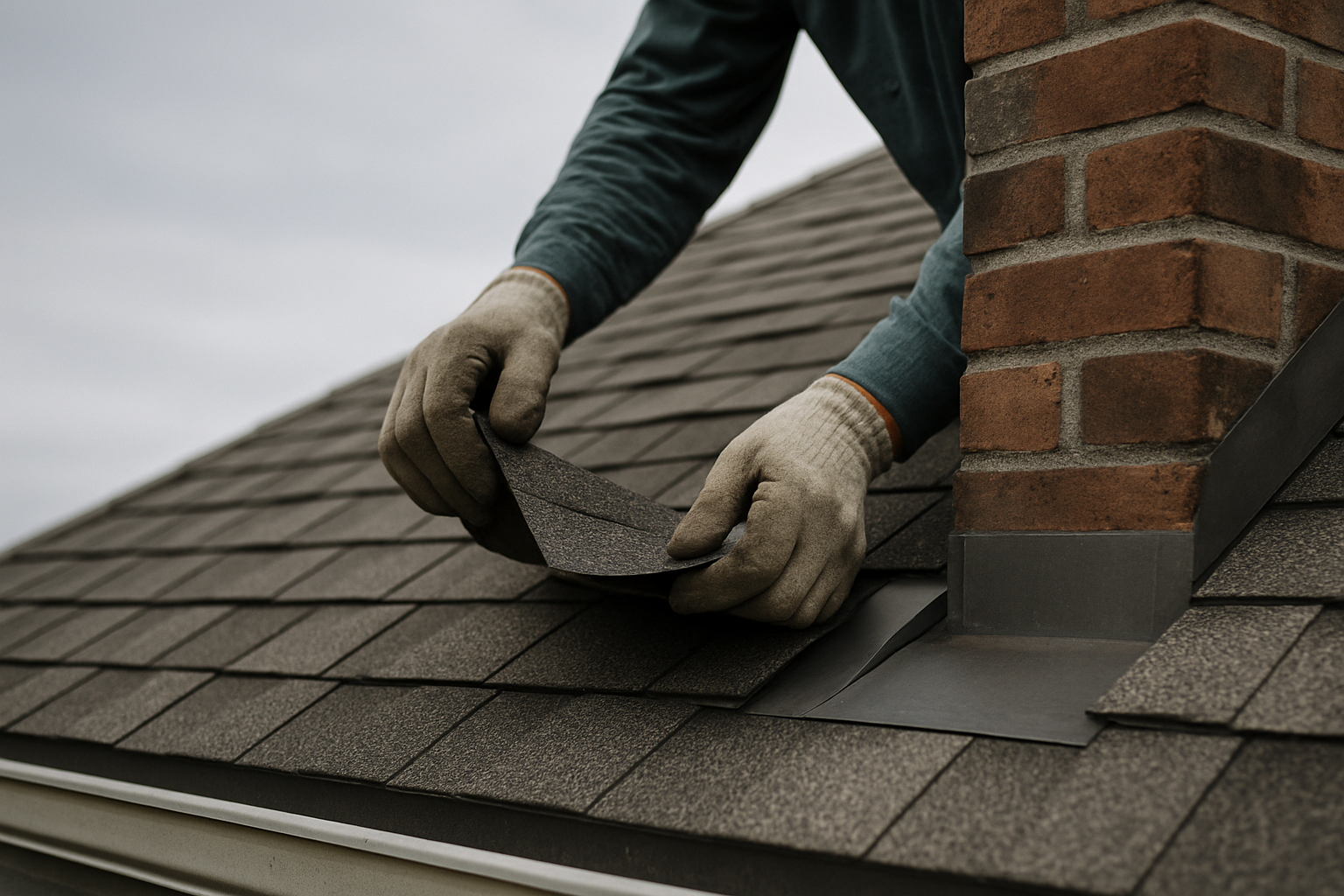
Roofing Galloway NJ is specified by exposure, not by county. Wooded streets near the Pine Barrens load roofs and gutters with pine needles and oak leaves; open, bay-influenced sections take more wind-driven rain; older Smithville-area homes hide decking conditions under shingles. HappyRoof inspects, specs, and installs roof replacement, repair, and gutters across Galloway with written pricing.
What roofing in Galloway actually has to handle
Galloway Township reads as one municipality on a map, but it is not one exposure zone. The township stretches from wooded, Pine Barrens-adjacent neighborhoods to open and bay-influenced sections, with older Smithville-area and mixed-age subdivisions in between. Those differences change the roof specification more than the town line does.
A wooded Galloway street puts organic debris on the roof in every season. Pine needles and oak leaves settle in valleys, behind chimneys, at pipe boots, and along rake edges, where they hold moisture against the shingles and slow the roof's drying. An open or bay-influenced section may carry little debris, but it takes wind with less friction in the way. Uplift, wind-driven rain, and salt air become the controlling loads instead. An older Smithville-area home adds a third variable: the decking and flashing under the shingles are decades old, and their condition is unknown until the roof is opened.
The practical result is that two houses a mile apart in Galloway can need different shingle selection, nailing, underlayment, gutter capacity, and flashing detailing. A roof specified for a shaded, Pine Barrens-adjacent street is not specified for an open, wind-exposed one, and the work should be built accordingly. Galloway NJ roofers who treat the township as one uniform job are specifying for an average that does not exist.
| Exposure zone | Controlling load | What it changes on the roof | What it changes at the gutter |
|---|---|---|---|
| Wooded, Pine Barrens-adjacent streets | Pine needle and oak leaf accumulation, trapped moisture | Valley and rake detailing, ventilation, long-term granule wear from held moisture | Downspout capacity, guard choice, cleanout access |
| Open and bay-influenced sections | Wind uplift, wind-driven rain, salt air | Shingle wind rating, nailing pattern, underlayment and flashing at edges | Debris load is lower; heavy shore rain still drives water-volume sizing |
| Older Smithville-area and mixed-age subdivisions | Unknown decking and flashing condition beneath old shingles | Full tear-off decking inspection, per-sheet replacement pricing | Aging fascia and soffit read as part of the exterior system |
Pine and oak leaf load: the load Galloway's wooded streets carry
Pine needles and oak leaves are not the same problem, and Galloway's canopy often delivers both. Pine needles are long and stiff. They wedge into gaps, interlock into mats, and shed water slowly. Oak leaves are broad and flat; they mat when wet and break down into a fine sludge that can pack a downspout. Either one, left against shingles, holds moisture in place for months.
The damage from leaf load is usually not a single season of debris. It is years of moisture held against the same valley, the same chimney flashing, and the same rake edge. That trapped moisture accelerates granule loss on asphalt shingles and invites moss and lichen where the roof stays shaded. The surface of the shingle degrades where the debris sits, not evenly across the roof.
Where debris accumulates matters as much as how much accumulates. Valleys concentrate both water and needles into a single channel. Chimneys and pipe boots interrupt the flow and catch debris on their uphill side. Rake edges on the windward side of a wooded street collect whatever the wind pushes across the roof. A roof detail that sheds water cleanly but traps needles will still fail early, because the trapped needles keep the detail wet.
The answer is not only gutter cleaning. It is detailing that sheds debris and a gutter-and-downspout system sized for the load the specific street sees. On a heavily canopied Galloway street, the inspection has to read the roof and the trees together, because the trees are part of the roof's exposure.
Gutter installation Galloway NJ: sizing for leaf load and heavy shore rain
Gutters in Galloway do two jobs at once. They carry heavy shore rain during storms, and they carry pine needles and oak leaves the rest of the year. The cross-section of the gutter and the number and placement of downspouts have to be matched to the roof area draining into each run and to the debris load that street actually carries.
A wooded Galloway roof with a heavy needle load needs more capacity and more forgiving details than an open-section roof of the same footprint. A gutter sized only for rain, with an undersized downspout run for the mat of needles that arrives in one fall, backs up and overflows at the fascia. That overflow is how water ends up against the siding, the soffit, and the foundation instead of away from the house.
HappyRoof sizes the gutter and downspout run during the inspection. The calculation starts with the roof area and pitch draining to each run, then adds the number of valleys feeding the run and the tree cover on the street. Guard choice follows the dominant debris. A screen that pine needles wedge into is the wrong guard on a pine-shaded street; a surface that oak leaves mat against is the wrong guard under an oak canopy.
| Debris | How it behaves on the roof and in the gutter | What the system has to do |
|---|---|---|
| Pine needles | Long and stiff; wedge into openings and interlock into mats | Shed needles at the guard, keep downspout capacity high, plan for mat-clearing access |
| Oak leaves | Broad and flat; mat when wet and break down into sludge | Shed leaves at the surface, keep downspouts clear of sludge, provide cleanout access |
| Mixed pine and oak | Alternating needle mats and leaf sludge through the year | Size and guard for the worst of both, not an average load |
Wind uplift on Galloway's open and bay-influenced sections
Wind loses energy as it drags across trees and buildings. On an open, flat Galloway section, or a street with a clear fetch to the bay, less of that energy is scrubbed away before it reaches the roof. The result is higher uplift at the eaves, rakes, ridges, and corners, and more wind-driven rain pushed sideways under shingles and flashing.
Nor'easters matter more in Galloway than a single high gust. A nor'easter can deliver hours of sustained wind from the northeast with rain driven nearly horizontally. That combination tests the roof differently from a short thunderstorm. The water is pushed into laps, joints, and penetrations while the shingles are lifted and relaxed repeatedly. A roof that survives a quick storm can fail in a long nor'easter because the water has hours to find the path in.
The specification answers this at several layers. The shingles have to be wind-rated and installed with enhanced nailing patterns chosen for the street's exposure. The starter strip, drip edge, and rake metal have to be fastened so the edge is the strong point, not the weak point. Underlayment and ice-and-water shield at the eaves, valleys, and penetrations provide the second line when wind-driven rain gets past the shingle layer.
The shingle layer is what homeowners see, but the water-shedding system is the underlayment, the flashing, and the fastener pattern. When wind lifts a shingle and drives rain beneath it, the underlayment is what keeps that water off the deck. On a Galloway roof with real fetch, underlayment is not the place to save. Enhanced nailing matters because each shingle acts as a small sail once the wind gets under its edge; more fasteners, placed correctly, keep the shingle seated.
The Atlantic County roof replacement guide walks through wind ratings, nailing, and underlayment in more detail for the shore climate.
Bay-influenced does not mean barrier-island, and the distinction matters. Galloway's open sections are not Margate, and a specification should follow the actual exposure rather than borrowing one from a more severe coast.
Older Smithville-area homes and the decking beneath the shingles
The Smithville area and other older, mixed-age Galloway neighborhoods carry a different risk. The visible surface of a roof can look acceptable while the decking under it is not. Sheathing that has lived through decades of humidity cycles, past leaks, and earlier roof layers can be soft, delaminated, or rotted in places that never showed on the ceiling below.
This is the strongest argument for a full tear-off rather than a shingle-over. HappyRoof tears every replacement down to the bare deck so that every sheet of sheathing gets inspected before new material goes down. The written proposal already separates a per-sheet rate for any decking that has to be replaced, so a rotten sheet found mid-job is not an open-ended change order. The homeowner sees the decking rate before the tear-off starts, not after.
An older Galloway home can also hide flashing details that were acceptable when the house was built but are not the way water should be handled now. The inspection reads the decking, the flashing, and the attic together rather than treating the shingle layer as the whole roof. Soft decking is usually a moisture story, and the source of the moisture is often upstream: a flashing that failed quietly, an attic that stayed humid, or a valley that held debris for years.
The roof edge is part of the same story. On older Galloway homes, the fascia and soffit are often as old as the roof and are the first place wind-driven rain and gutter overflow show themselves. Because soffit, fascia, and trim are part of the exterior scope, the roof replacement and the edge that finishes it get read together rather than repaired as two unrelated jobs.
Galloway Township permits and inspections
Roof replacement in Galloway Township goes through the township's permitting process. HappyRoof pulls the municipal permit and schedules the township inspection as part of the job, not left to the homeowner to chase.
The scope of the job determines what the township requires. A full tear-off replacement goes through the permit and inspection process. A smaller repair may or may not require a permit depending on what is being done, and HappyRoof confirms the requirement for the specific job rather than assuming either way.
Roof replacement Galloway NJ: how a replacement gets specified
A Galloway replacement is not a shingle swap. It starts with a full tear-off to the bare deck so the sheathing can be inspected. The replacement material is then chosen for the exposure: architectural asphalt, metal, or flat membrane, sized, vented, and flashed for the coastal climate rather than a generic inland default.
The written price separates labor, materials, disposal, and the per-sheet rate for decking replacement. That itemization matters on an older Galloway home, where decking discoveries are likely. Manufacturer-certified installation keeps the material warranty valid, so the warranty the homeowner is paying for does not disappear because of an installation shortcut.
For the wind side, the replacement uses wind-rated shingles and enhanced nailing patterns chosen for the specific street's exposure. A wooded section and an open section do not get the same default.
Cleanup is part of the replacement, not an afterthought. Full-property cleanup includes a magnet sweep of the lawn, beds, and driveway for stray nails. On a Galloway property with landscaping under the eaves, that sweep is the difference between a finished job and a nail left for a tire or a bare foot.
Roof repair Galloway NJ: finding the actual source
Leaks in Galloway show up as ceiling stains, but the source is often somewhere else. A stain under a bedroom can come from a failed chimney flashing, a valley that opened, a pipe boot that dried and cracked, or wind-lifted shingles that let rain in during the last nor'easter. The repair that lasts is the one that finds the actual source instead of patching the stain.
Wet insulation with no visible hole is a common Galloway call. Water travels along the underside of the deck from a flashing or penetration far from the stain. That kind of leak needs diagnosis, not caulk, and it usually points to flashing rather than the shingle field.
Storm-related repair is a separate path. Missing shingles after a nor'easter need to be documented before they are disturbed, and emergency tarping has to go on quickly to stop interior damage. HappyRoof tarping is part of the storm response, not a substitute for the permanent repair that follows.
Roof inspection Galloway NJ: the free photo inspection
The inspection is free and it is not a sales call. HappyRoof photographs the actual roof, shows the homeowner what was found, and gives an honest remaining-life read even when the answer is that no work is needed yet. If your roof has ten good years left, you will hear that too, because the report tells you what is actually there rather than pushing a replacement that is not needed.
That honesty is the point of the inspection. A roof at the end of its life should be replaced before it leaks; a roof with real life left should not be. The inspection separates those two cases with photos and a written explanation, so the decision is made from evidence rather than pressure.
The inspection also reads the specific Galloway exposure. The same visit that checks shingle condition looks at leaf load in the valleys and gutters, wind damage at the edges, and the attic for moisture.
Storm damage and insurance documentation in Galloway
Nor'easter and hurricane damage in Galloway has to be handled in a specific order: stop the water, document the damage, then repair. Emergency tarping stops the interior damage. Documentation supports the insurance claim. A repair done before the damage is documented can make the claim harder, because the evidence is gone.
HappyRoof documents storm damage to support your insurance claim and provides emergency tarping to stop interior damage. For an Atlantic County homeowner working through a claim, the documentation and the order of the work are the part that protects the claim.
How Galloway compares to its Atlantic County neighbors
Galloway sits between two exposure profiles that other Atlantic County towns carry in a purer form. It is not Brigantine or Margate, where salt air and open water dominate the specification. It is not Hammonton or Folsom, where the Pine Barrens canopy is the controlling load. Galloway has both, in different sections, which is exactly why the street matters more than the town.
HappyRoof serves every town in Atlantic County, but the specification is written for the specific street, not the county line. A Galloway homeowner should expect a roofer to ask which section the house is in before quoting a system, because the canopy and the wind fetch change the answer.
A Galloway roof's year
The loads on a Galloway roof are seasonal and predictable. Reading them by season is how a homeowner catches problems before they become interior damage.
| Season | Controlling load | What to watch |
|---|---|---|
| Fall | Pine needle and oak leaf drop | Valleys, gutters, and downspouts; schedule gutter clearing before winter rains arrive |
| Winter | Nor'easters and wind-driven rain | Wind-lifted shingles, flashing, and new interior stains after storms |
| Spring | Post-storm damage and leftover debris | Free inspection, flashing and valley check, gutter condition after the winter |
| Summer | Heat, humidity, and trapped moisture | Attic ventilation, granule wear where debris sat, moss on shaded slopes |
Fall is the season that sets up most of the other problems. The needles and leaves that sit through a wet winter are the ones that hold moisture against the shingles and pack the gutters before the nor'easter season starts. Spring is the natural point for the free inspection, because it catches what the winter did before the summer heat bakes any moisture into the deck.
The Galloway workflow, step by step
The workflow is built around the inspection, the written price, and the permit, in that order.
- Free inspection with photos. The roof is walked, photographed, and read against its exposure: canopy, wind fetch, decking age, and gutter load.
- Written, itemized price. Labor, materials, disposal, and the per-sheet decking rate are separated before anything starts.
- Permit and inspection scheduled. The Galloway Township permit is pulled and the township inspection is put on the calendar as part of the job.
- Full tear-off to the bare deck. Every sheet of sheathing is inspected before new material goes down.
- Installation to the street's spec. Wind-rated shingles, enhanced nailing, underlayment, ice-and-water shield, flashing, and ventilation are installed for the exposure the specific street gets.
- Cleanup, including the magnet sweep. The lawn, beds, and driveway are swept for stray nails.
- Walkthrough. The finished roof is reviewed with the homeowner against the written scope.
What is included, and what is not
Being clear about scope saves more time than being vague.
Included: full tear-off to the bare deck with decking inspection; written itemized pricing that separates labor, materials, disposal, and decking replacement; manufacturer-certified installation; wind-rated shingles and enhanced nailing for the street's exposure; municipal permit handling and township inspection scheduling; full-property cleanup with a magnet sweep; emergency tarping for storm damage; and insurance claim documentation.
Not included or not offered: service outside Atlantic County, and any binding price without an inspection. The free inspection is an assessment with photos and an honest remaining-life read, not a bid. The written price follows the inspection and the roof's actual measurements.
What to have ready before you call
A little preparation makes the first visit more useful.
- The street and nearest cross street, and whether the section is wooded or open.
- The roof's age if you know it, and any prior roof work or layers.
- Interior stains: where they are, when they first appeared, and whether they show only after rain.
- Attic access and any known wet insulation or damp sheathing.
- Recent storm dates if the concern follows a nor'easter.
- Whether you have filed or plan to file an insurance claim.
None of these are required before the inspection. They shorten the diagnosis and keep the visit focused on the actual roof rather than a re-telling from memory.
Roofing Galloway NJ: questions Galloway homeowners ask
Does Galloway Township require a permit for a roof replacement?
Yes. A roof replacement in Galloway Township goes through the township's permitting process. HappyRoof pulls the municipal permit and schedules the township inspection as part of the job.
Do pine needles really shorten the life of a Galloway roof?
The needles themselves do not destroy shingles; the moisture they trap does. Needles wedge into valleys, behind chimneys, and at rake edges, then hold water against the shingle surface and slow drying. Years of that held moisture accelerates granule loss and invites moss. The counter is detailing that sheds debris plus a gutter and downspout system sized for the canopy.
How will I know if my Smithville-area roof needs decking replaced?
You usually cannot know until the shingles come off. Sheathing can be soft or rotted in places that never showed on the ceiling below. HappyRoof tears every replacement to the bare deck and inspects every sheet, and the written price already includes a per-sheet rate for any decking that has to be replaced.
Is the roof inspection really free, and will you tell me if I do not need a new roof?
Yes. The inspection is free and no-pressure, with photos of what is actually found. HappyRoof tells a Galloway homeowner when a roof has real life left rather than selling a replacement that is not needed yet; if the roof has ten good years left, the report says so.
Do you handle my insurance claim for Galloway storm damage?
HappyRoof documents storm damage to support your insurance claim and provides emergency tarping to stop interior damage. The order matters: stop the water, document the damage, then repair, so the claim is supported by evidence rather than a repair that erased it.
Start with a free Galloway roof inspection
Call (609) 525-4521 or request an inspection. HappyRoof will photograph your Galloway roof, read it against the trees and wind on your specific street, and give you a straight answer on what it needs, whether that is a repair, a replacement, or nothing at all this year.
Frequently asked questions
Does Galloway Township require a permit for a roof replacement?
Yes. A roof replacement in Galloway Township goes through the township's permitting process. HappyRoof pulls the municipal permit and schedules the township inspection as part of the job. The township sets its own permit fee, and that fee is handled within the written pricing rather than left for the homeowner to chase down.
Do pine needles really shorten the life of a Galloway roof?
The needles themselves do not destroy shingles; the moisture they trap does. Needles wedge into valleys, behind chimneys, and at rake edges, then hold water against the shingle surface and slow drying. Years of that held moisture accelerates granule loss and invites moss. The counter is detailing that sheds debris plus a gutter and downspout system sized for the canopy.
How will I know if my Smithville-area roof needs decking replaced?
You usually cannot know until the shingles come off. Sheathing can be soft or rotted in places that never showed on the ceiling below. HappyRoof tears every replacement to the bare deck and inspects every sheet, and the written price already includes a per-sheet rate for any decking that has to be replaced.
Is the roof inspection really free, and will you tell me if I do not need a new roof?
Yes. The inspection is free and no-pressure, with photos of what is actually found. HappyRoof tells a Galloway homeowner when a roof has real life left rather than selling a replacement that is not needed yet; one Galloway inspection came back with five or six years of life remaining.
Do you handle my insurance claim for Galloway storm damage?
HappyRoof documents storm damage and can meet the adjuster, and it provides emergency tarping to stop interior damage. It does not act as a public adjuster or give legal advice on a policy. In New Jersey, no contractor may lawfully absorb or waive your deductible, so walk away from any offer that promises to do so.