Most roof repairs in Atlantic County, NJ fall between $400 and $1,800. The low end covers accessible single-detail work: a cracked pipe boot, wind-lifted shingles, or drip edge. Larger flashing, valley, and emergency jobs climb toward the top of the range. Every figure here is a planning range, not a quote—an inspection determines the real number.
This guide is written for a homeowner who is either holding a repair quote or watching a stain grow and deciding whether to call. It separates roof repair cost into classes, shows what should appear on an itemized written proposal, and marks the point where repeated repairs stop being cheaper than replacement.
What roof repair in Atlantic County NJ costs, by class
The published starting point is simple: most roof repairs in Atlantic County fall between $400 and $1,800. That band is deliberately wide because the class of repair, not the square footage of the roof, does most of the work. A single cracked pipe boot on a walkable ranch sits near the bottom. A chimney flashing failure on a steep two-story home with wet decking sits near the top.
The table below positions each repair class within that published range. It does not assign a separate dollar figure to each class, because an honest contractor cannot price flashing work without seeing the pitch, the existing metal, and the deck underneath it.
| Repair class | Typical scope | Position in the $400–$1,800 range | What moves the number |
|---|---|---|---|
| Minor sealant and pipe boot work | Cracked pipe boot, nail pops, small sealant correction | Low end | Access and whether surrounding shingles can be lifted without breaking |
| Shingle and drip edge repair | Wind-lifted shingles, re-securing drip edge or rake metal | Low to middle | Number of shingles, material matching, age of the existing roof |
| Flashing and valley work | Step, counter, chimney, valley, or pipe boot flashing | Middle to upper | Pitch, height, chase work, decking condition |
| Low-slope membrane repair | Rear and porch roofs needing membrane work | Middle to upper | Membrane type, seam condition, access |
| Storm and emergency response | Tarping, temporary weather seal, then permanent repair | Upper; emergency line items separate | After-hours mobilization, access, documentation time |
Minor sealant and pipe boot work
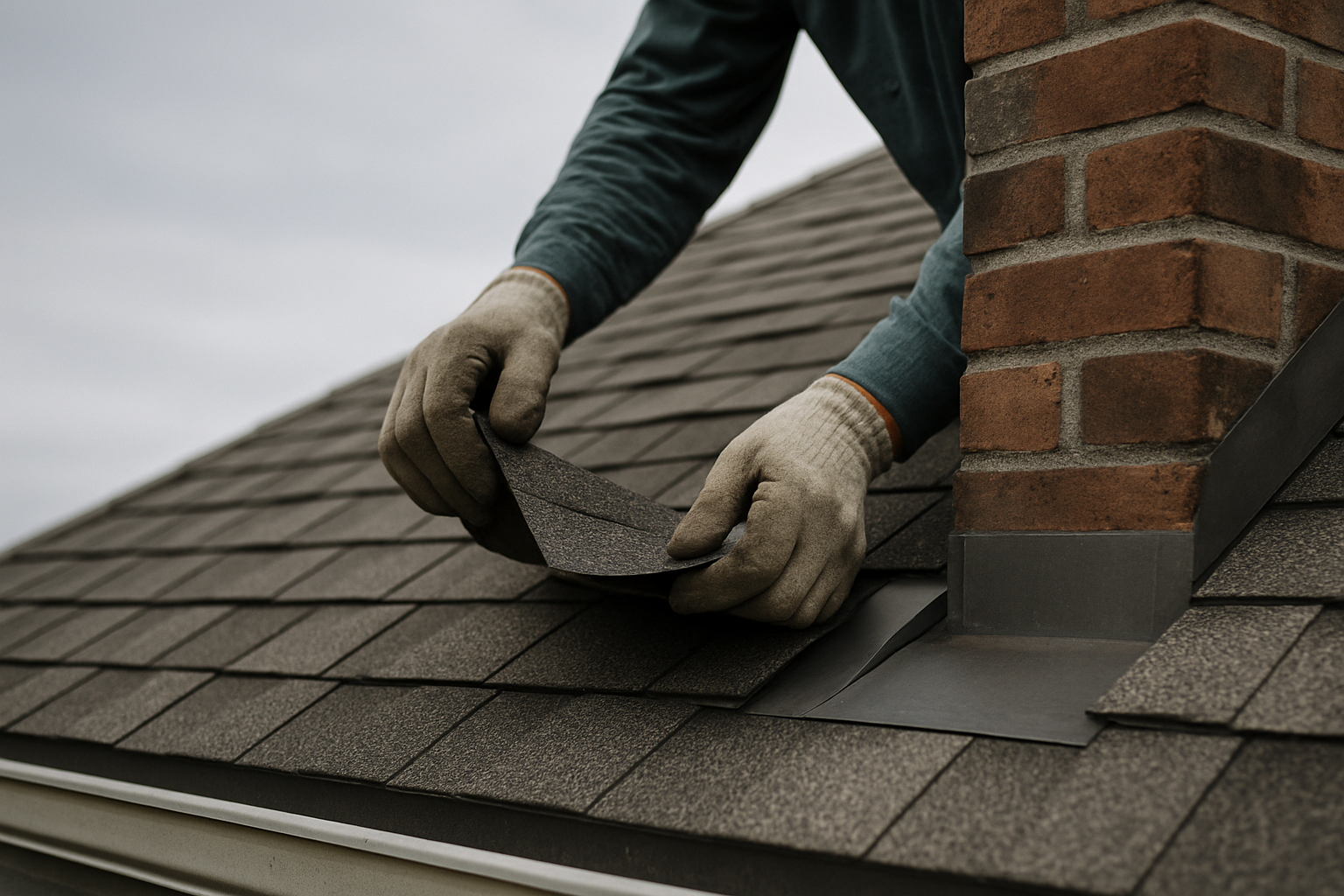
These are the low-end jobs because they are usually one detail and one visit. A cracked pipe boot, a handful of nail pops on a walkable slope, or a small sealant correction involves modest material cost and labor measured in hours. The critical variable is whether the surrounding shingles are still pliable. A new pipe boot can be slipped into place on a younger roof without disturbing the courses above. On an older, brittle roof, the same "small" repair can turn into a wider shingle replacement once the existing courses crack during lifting.
Wind-lifted shingle and drip edge repair
Wind-lifted shingles and loose drip edge are common after a nor'easter or a summer squall. When only a few shingles are involved and the roof is otherwise sound, this stays in the low-to-middle part of the range. The quote should state how many shingles will be replaced and how the color and granule texture will be matched against the aged field. If wind has lifted shingles across a large face, the job starts to look less like a hand repair and more like a storm damage claim.
Flashing and valley work
Flashing is where most roof leaks actually begin, even when the stain appears elsewhere. A roof flashing repair in Atlantic County, NJ quote should name the exact detail being replaced: step flashing, counter-flashing, chimney flashing, valley metal, or a pipe boot with its flashing. Material cost on a flashing repair is often modest, but labor is measured in hours because the installer must lift surrounding shingles, remove the failed metal, and re-bed the new piece without damaging the courses above. Pitch, height, and chase work are what push a flashing quote toward the upper end of the $400–$1,800 range.
Low-slope and membrane repair
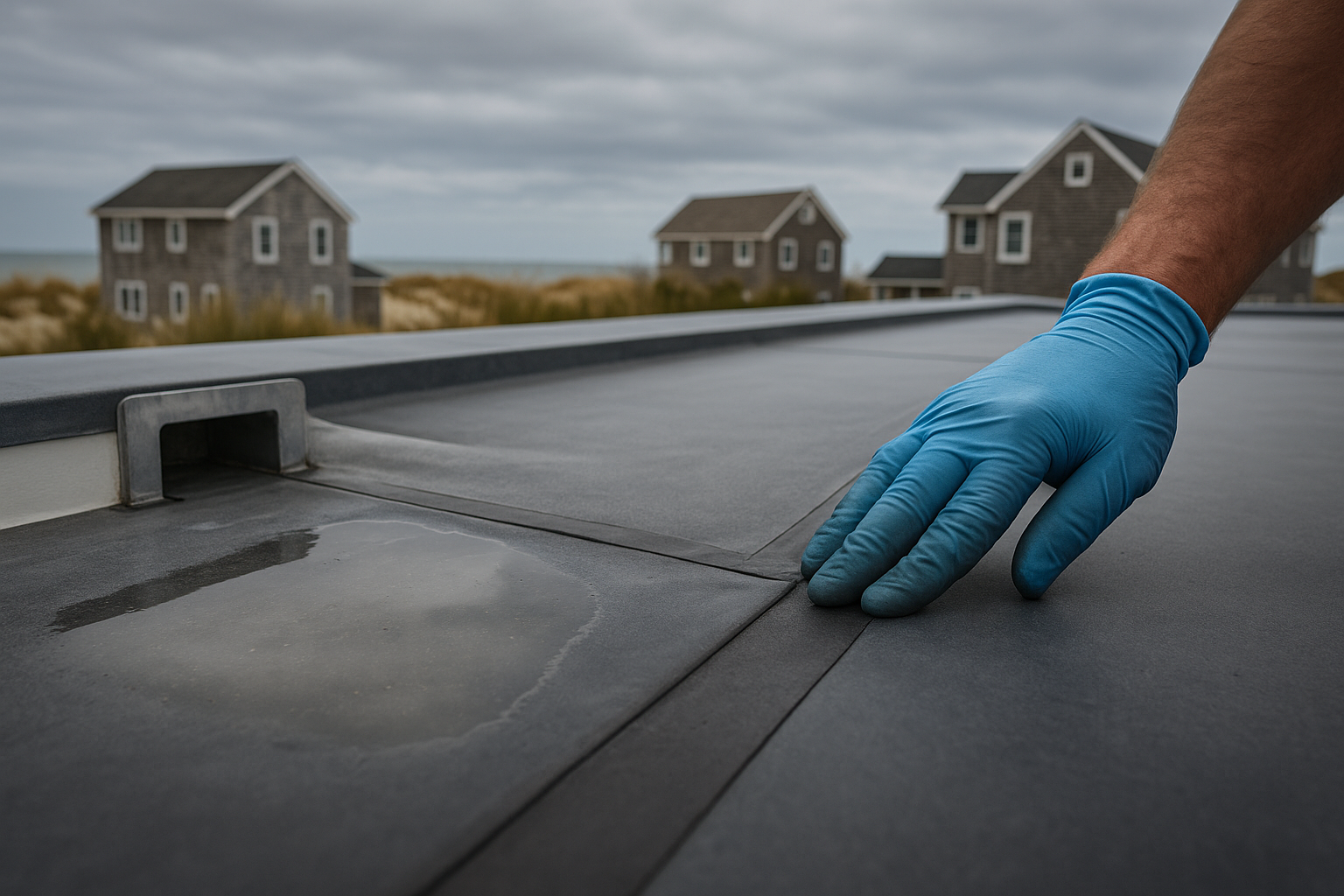
In the older neighborhoods of Atlantic City and Pleasantville, rear and porch roofs are frequently low-slope and need membrane work rather than shingle work. That is a different repair and a different material. A shingle roofer who quotes it as a shingle patch is pricing the wrong job. The low-slope and flat roof repair guide for shore and addition roofs covers what membrane repair actually involves and why seam condition matters more than the visible stain.
Storm and emergency repair
After a nor'easter or a summer squall, the two things that decide how well a repair goes are documentation and speed. Emergency work has a different cost shape than scheduled work: there is temporary stabilization—tarping what is open—and then there is the permanent repair. A written proposal should separate those two so you can see what you are paying for immediate protection versus lasting repair. HappyRoof photographs the damage, tarps what is open, and helps assemble a claim file an adjuster can work from.
What drives the cost: access, pitch, height, material matching, and decking
Within the $400–$1,800 band, five variables do most of the work. Knowing them helps you read why two quotes for the "same" leak can be far apart.
Access and staging on the barrier islands
On the island towns—Margate, Longport, and Brigantine—staging is often the challenge before the repair begins. Narrow lots, shared driveways, and summer parking restrictions mean a contractor has to plan access before planning the repair. That planning time and the labor of moving material and ladders onto a tight site add cost without adding any roofing material. The bayfront and barrier-island specification guide for Margate explains how coastal access and wind exposure change the specification.
Pitch and height
A walkable slope is faster and safer to repair than a steep roof. Once a roof is too steep to stand on, the crew needs staging, brackets, or lift access, and every trip up and down the ladder takes longer. Height matters the same way: a two-story chimney flashing job requires more setup than a one-story pipe boot. These are labor and safety costs, not material costs, and they are legitimate reasons for one quote to land higher than another.
Material matching and aged shingles
A repair on a five-year-old roof is easier to match than a repair on a twenty-year-old roof. Color lots fade, granule texture wears, and shingles change dimensions over time. Matching is a real line item when the contractor has to source a close color and blend the repair into the surrounding field. More importantly, aged shingles may not survive being lifted. If the existing material has lost granules and dried out, sliding new flashing underneath can crack the courses above the work area. That is exactly the situation where a quote should include replacing the surrounding shingles rather than pretending the patch will hold.
Decking exposure
The roofer cannot see the full condition of the deck until the repair opens the roof. A leak that has been running for months may have rotted the sheathing under the shingles. If the deck is soft in one bay, that bay needs to be replaced before new flashing or shingles can be fastened. If the deck is soft over a wide area, the job is no longer a repair at all. A useful quote names a decking line item or contingency and states the per-sheet or per-bay cost if rotten wood is found.
Emergency timing and mobilization
Emergency timing changes the cost equation because it changes how the crew is deployed. A scheduled repair happens during normal business hours, with a planned route and a full workday. An after-hours call for tarping means mobilizing someone outside the normal schedule, securing the opening, and returning later for the permanent repair. That is not a penalty; it is the cost of stopping water from entering the house before Monday. The key is that the emergency stabilization and the permanent repair should be separate line items so the price is not a mystery.
How to read a roof repair estimate line by line
The difference between a useful repair quote and a lump-sum number is whether you can see what you are paying for. HappyRoof states that it provides itemized written pricing before work starts, along with before-and-after photographs of the actual defect, a clear statement of what the repair does and does not address, and proof of current New Jersey licensing and insurance on request.
A useful itemized repair proposal should let you follow the job from defect to cleanup. Look for these elements:
- A written description of the defect and where water is actually entering, not just where the ceiling stained.
- Photographs of the actual defect on your roof, not a stock photo.
- Materials named by function: flashing, pipe boot, sealant, membrane, fasteners, drip edge.
- Labor shown separately from materials, so you can compare one quote to another.
- Access and staging if the roof is steep, high, or on a tight island lot.
- A decking contingency for wood that may be soft once the roof is opened.
- Cleanup and disposal, including a magnet sweep for nails if the work involves tear-off.
- Permit costs only if municipal permits are actually required for the scope.
A lump-sum quote is not automatically dishonest, but it is harder to verify. If the price is one number with no defect description, no material list, and no decking contingency, you cannot tell whether you are paying for a lasting flashing replacement or a temporary sealant patch. Itemized written pricing exists so that a homeowner can read the quote line by line and ask the contractor to defend any line that looks inflated or missing.
How to compare three repair quotes
Three quotes only mean something when they describe the same job. Before comparing totals, line the proposals up side by side and check whether each one names the same defect, the same material scope, and the same access plan.
- Defect: One quote may price a pipe boot replacement while another prices a sealant patch. The totals are not comparable because the work is not comparable.
- Decking: A quote with a decking contingency and a quote without one are not the same risk. The lower number may simply be the one that has not priced the rotten wood you will find once the roof is open.
- Access: On a steep or island lot, the quote that ignores staging is not cheaper; it is incomplete.
- Cleanup: A proposal that excludes disposal and nail sweep is lower by omission, not by efficiency.
A fair comparison starts with a single written defect description and asks each contractor to price that same scope. If a contractor will not put the scope in writing, the price is the least of your problems.
Two worked examples: a pipe boot and a chimney flashing
The clearest way to see the $400–$1,800 range at work is to follow two different repair classes through the same line-item logic.
Example one: cracked pipe boot on a walkable ranch
This is the low-end pattern. The defect is visible, the roof is walkable, and the material is modest. The proposal should name the pipe boot, state that the surrounding shingles will be lifted and re-bedded, and include a small decking contingency for the wood immediately around the vent. Because the shingles are young and pliable, the job is single-visit and lands near the bottom of the range. If the same pipe boot is on a two-story home with brittle shingles, the quote climbs because the surrounding courses must be replaced and the work is no longer a one-hour repair.
Example two: chimney flashing on a steep two-story home
This is the middle-to-upper pattern. The quote should name the failed detail—step flashing, counter-flashing, or both—and describe the chase work needed to re-bed the metal against the chimney. It should include staging for the height and pitch, a decking contingency for the area under the leak, and a cleanup line item. The material cost is still modest, but the labor is measured in hours and the access is measured in setup time. If the decking under the chimney is soft, the proposal should show that cost as a separate line item rather than folding it into a vague "repair" total.
These two examples are not price lists. They are the shape of an honest quote: the number moves because the scope, access, and decking exposure move, not because one contractor happened to pick a higher total.
When repeated repairs begin to exceed replacement economics
The repair-versus-replace question is not answered by the first leak; it is answered by the condition of the roof around the leak. Repairs in Atlantic County typically run $400 to $1,800, while a complete asphalt roof replacement on a typical Atlantic County home usually runs $9,000 to $25,000 and takes one to three working days. Those numbers make repair look like the obvious choice, and it often is. But repair stops making sense when the shingles themselves have gone brittle.
Older asphalt that has lost its granules and dried out cannot be lifted to slide a new piece of flashing underneath without cracking the courses above the work area. At that point every repair creates two new small problems at the edges of the patch, and each subsequent visit costs more while buying less time. The same logic applies when the deck under the leak is soft over a wide area rather than in one bay.
Use these four tests to decide:
- Remaining life. If the roof has five or more good years left, a repair is usually the right call. If it is near the end of its service life, repair dollars are buying months, not years. The Atlantic County roof lifespan and maintenance FAQ can help you estimate what is left.
- Spread of damage. One failed pipe boot is a repair. Wind-lifted shingles across three faces, multiple flashing failures, or leaks in several rooms suggest a system problem.
- Cumulative repair cost. Add up what you have spent on repairs in the last two or three years. If the total is approaching a meaningful fraction of replacement and the leaks are returning, the next dollar may be better spent on a new system.
- Decking condition. Soft decking found during a repair is a signal. One soft bay can be replaced; wide-area rot means the roof is no longer a sound substrate for a patch.
When the math points toward replacement, the asphalt shingle roof replacement in Atlantic County, NJ guide covers wind ratings, nailing, and underlayment so you can compare replacement quotes with the same discipline.
Storm damage: insurance path vs out-of-pocket repair path
After storm damage, a homeowner is choosing between two payment paths. The right one depends on the cause and scale of the damage.
The insurance path
If a nor'easter or summer squall caused the damage, the insurance path usually begins with documentation, not with a permanent repair. The roof should be photographed before anything is moved, open areas should be tarped to stop further damage, and the claim file should be assembled so the adjuster can work from it. HappyRoof photographs the damage properly, tarps what is open, and helps assemble that file. It can meet an adjuster, but it does not act as a public adjuster or legal advisor.
New Jersey law does not allow a contractor to absorb or waive a homeowner's insurance deductible. Any roofer who offers to "cover your deductible" is asking you to participate in a claim that is not what it appears to be. The deductible is the homeowner's portion of the claim, and it should be paid by the homeowner.
The out-of-pocket path
Small, non-storm repairs—a cracked pipe boot, a failed chimney flashing, a few wind-lifted shingles that predate the last storm—are usually paid out of pocket. In that path, the discipline is the same as any repair: get a written description of the defect, an itemized price, and a clear statement of what the repair does and does not address. The $400–$1,800 range still applies, and the same cost drivers—access, pitch, height, material matching, and decking—still move the number.
The New Jersey roof storm damage insurance claims guide explains how to document damage in the first 48 hours, what an adjuster is looking for, and the deductible rules to walk away from.
Red flags in a roof repair quote
A repair quote should make the work clearer, not vaguer. These are the signs that a quote deserves a second opinion or a harder set of questions.
A sealant-only patch with no flashing replacement
If the leak is at a chimney, valley, or pipe boot and the quote only calls for sealant, ask what happens when the sealant fails next season. Sealant is a temporary surface treatment; flashing is the water-shedding detail. A lasting repair usually requires replacing or re-bedding the flashing, not caulking over it.
No decking inspection or contingency
Any quote that opens a roof should account for what may be found underneath. If the proposal has no mention of decking and no per-sheet or per-bay price for rotten wood, the price is likely to change the moment the roofer finds the soft spot. A quote that cannot change without a surprise is not a quote; it is an opening bid.
A lump-sum price with no defect description
One number with no written defect, no photos, and no scope statement tells you nothing about what is being fixed. It also gives you nothing to hold the contractor to. Itemized written pricing exists precisely so that a homeowner can compare the work, not just the total.
No access plan for a steep or island lot
On a steep two-story roof or a narrow Margate lot, access is a real cost and a real safety issue. A quote that does not mention staging, parking, or how the crew will reach the work area may be underestimating the job—or planning to figure it out on your lawn.
Pressure to replace without showing you the photos
The site's stated standard is a free inspection with real photos of your own roof and an honest answer on whether it needs replacing. If a contractor insists the roof must be replaced but cannot show you photos of the damage or explain why a repair would not hold, slow the process down. You are entitled to see the evidence before you commit.
Frequently asked questions
How much does roof repair cost in Atlantic County, NJ?
Most roof repairs in Atlantic County fall between $400 and $1,800. The low end covers accessible single-detail work such as a cracked pipe boot, wind-lifted shingles, or drip edge. Larger flashing, valley, and emergency jobs climb toward the top of the range. An inspection is required to turn that range into a real price for a specific roof.
What does the low end of roof repair cover?
The low end covers straightforward, accessible, single-visit work: replacing a cracked pipe boot, resetting a handful of wind-lifted shingles, sealing and re-securing a section of drip edge, or correcting nail pops on a walkable slope. Material cost is modest and labor is measured in hours.
Why do flashing repairs cost more than a simple pipe boot?
Flashing work usually involves lifting surrounding shingles, removing failed step, counter, chimney, or valley metal, and re-bedding the new piece without damaging the courses above. Pitch, height, and chase work add labor. A pipe boot on a walkable roof is often a simpler single-detail job, so it sits lower in the range.
Can a repair be done while it is still raining?
Emergency tarping can often be done while it is raining to stop water from entering the house. A permanent shingle or membrane repair usually waits until the surface is dry so sealants, underlayment, and fasteners can bond properly. HappyRoof offers emergency tarping outside normal business hours.
Should I repair my roof or replace it?
Repair is the right call when the roof still has useful life, the damage is limited to one or two details, and the decking is sound. Replacement becomes the better math when shingles are brittle, damage is widespread, or repeated repairs are adding up without stopping the leaks. A free inspection with photos can give you the remaining-life answer.
Does homeowners insurance cover roof repair after storm damage?
Homeowners insurance may cover storm-related roof repair, but coverage depends on your policy, the cause of the damage, and your deductible. Document the damage before anything is moved, tarp open areas, and assemble a claim file. A contractor can photograph and document the damage and meet an adjuster, but it does not act as a public adjuster.
Get a written price before anything starts
The only way to turn the $400–$1,800 planning range into a number for your roof is to look at the actual defect. HappyRoof provides a free inspection with photos of your own roof, an honest answer on whether it needs replacing, and itemized written pricing before work starts. Call (609) 525-4521 to schedule it, and ask for proof of New Jersey licensing and insurance when the crew arrives.