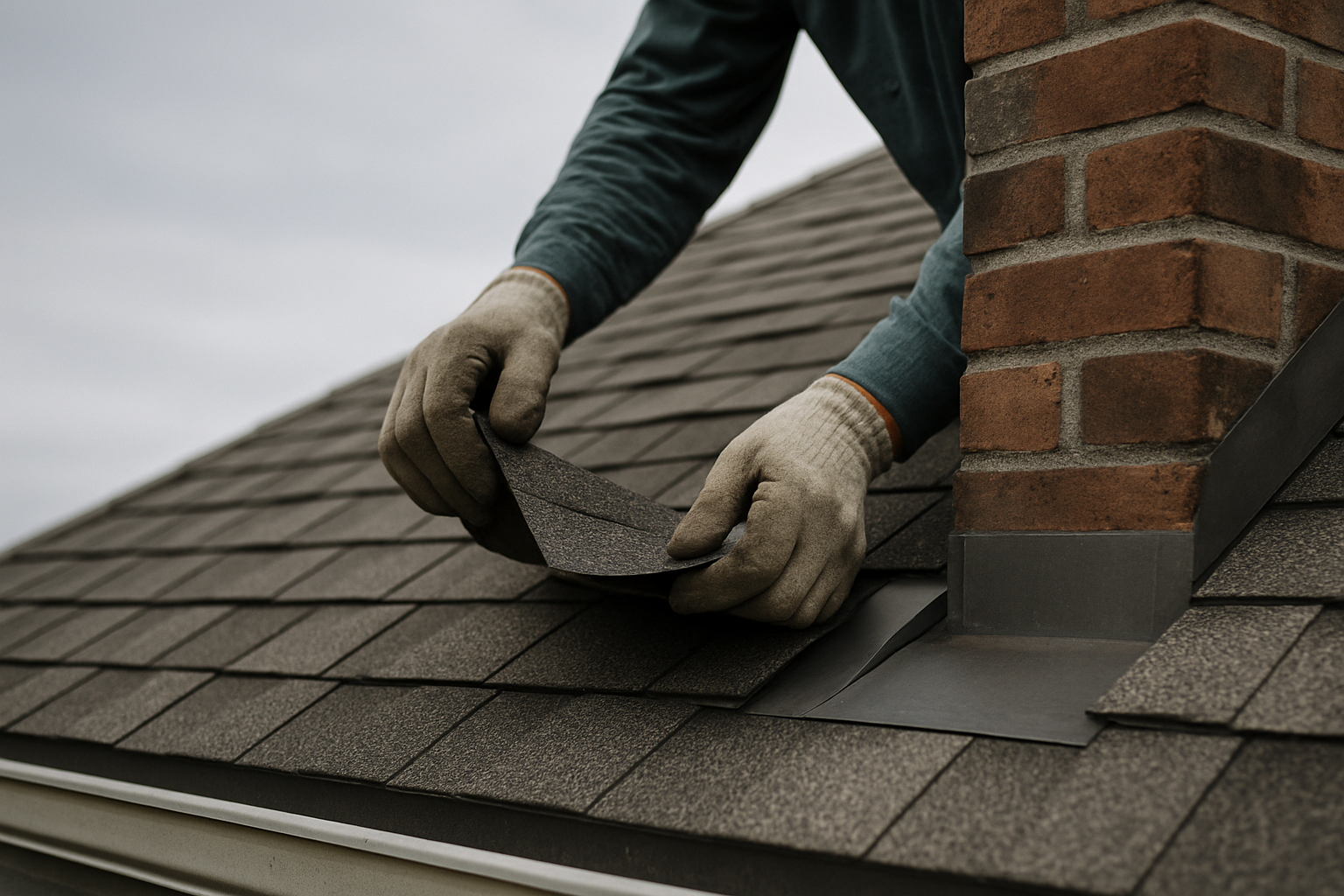
Drip edge installation Atlantic County NJ comes down to one detail: metal at the roof edge that carries water off the sheathing and into the gutter instead of letting it curl back onto the fascia. Missing or failed drip edge causes fascia rot and water behind the gutter, and older Atlantic County homes often never had it.
What drip edge does at the roof edge
Drip edge is the narrow metal trim that protects the lower edge of the roof, the eave. Its job is specific: it carries water off the sheathing edge and into the gutter rather than letting it curl back onto the fascia. Without that metal, water running off the shingle edge can cling to the underside of the shingle and run back against the building instead of falling cleanly into the gutter.
The reason this small detail matters is that roofs leak at edges, not in the open field. Shingles in the middle of a slope are doing the simplest job on the whole roof, which is shedding water downhill onto more shingles. Leaks happen at transitions, interruptions, and fasteners — and the eave is exactly that kind of interruption.
The same metal also protects the sloped edge that runs up a gable end, the rake. Both edges are interruptions in the roof plane, and both need a defined, protected termination rather than an exposed seam.
Where older Atlantic County homes typically need drip edge
Plenty of older Atlantic County homes never had drip edge installed. Adding it during a repair is inexpensive and eliminates a whole category of eave damage.
The practical consequence shows up in the fascia. The fascia is the vertical board behind the gutter. When water curls back off a bare shingle edge, it wets that board after every rain. Paint fails first, then the board darkens and softens. That is the failure drip edge prevents.
How missing drip edge causes fascia rot and gutter bypass
Water running off a bare shingle edge does not always fall straight down. It can curl back under the shingle and run down the face of the fascia. Repeated wetting is enough to start the rot cycle, and once the fascia softens, the gutter fasteners lose their bite. The gutter can sag or pull away, and the problem widens from a piece of trim to a structural repair.
There is a second, sneakier version of the same problem: gutter bypass. When the edge metal is missing, too short, or bent back, a portion of the water runs behind the gutter, between the gutter back and the fascia, while the gutter still appears to be working. The homeowner sees water leaving the downspout and assumes the eave is fine. Meanwhile, the back of the gutter and the fascia are wet after every storm. When HappyRoof diagnoses a leak near an exterior wall, drainage is one of the first things ruled in or out, because this exact pattern is a common source.
Drip edge as part of a roof repair
Not every drip edge problem requires a new roof. A loose or rusted section on an otherwise sound roof can often be fixed as a repair. Most roof repairs in Atlantic County fall between $400 and $1,800. The low end of that range covers straightforward, accessible work — and sealing and re-securing a section of drip edge is one of the examples on that list. These are single-visit jobs where the material cost is modest and the labor is measured in hours.
The scope depends on what the inspection finds. A roof repair in Atlantic County that re-secures a loose section of metal is a different job from replacing a rusted-through run, and a different job again from repairing the fascia and decking behind it. The written price comes after the inspection, not before.
Drip edge as part of a roof replacement
A full tear-off is the right moment to replace drip edge, for a simple reason: access. Drip edge is installed at the roof edge and is buried by the shingles, so you cannot remove and replace it correctly without opening the edge. A full roof replacement opens every edge at once, which makes new metal part of the normal sequence rather than a later reopening.
A tear-off is also the moment the decking can actually be seen. Nobody can know the condition of the sheathing until the old shingles come off. That is why a written proposal should answer the question: what is the per-sheet price if decking has to be replaced? It should also be clear who pulls the permit and who meets the municipal inspector.
Coastal and inland Atlantic County roofs fail differently
Atlantic County is three different roofing environments wearing one county name, and the roof edge shows the difference.
On the barrier islands — Atlantic City, Ventnor City, Margate City, Longport, and Brigantine — the governing factors are sustained wind, salt aerosol, and a housing stock that includes a lot of narrow attached and semi-attached buildings. Perimeter detailing, enhanced fastening, and corrosion-resistant metal earn their keep here. A drip edge that is correct in shape but wrong in material will fail early in salt air, so material and fastener choices belong in the written quote, matched to the house and its exposure.
In the older neighborhoods of Atlantic City and Pleasantville, repair calls frequently involve low-slope rear and porch roofs that need membrane work rather than shingle work — a different repair and a different material. The drip edge question is one part of a larger edge and drainage picture.
Storm season reinforces the same point. Hurricane season officially runs from June through November, and nor'easter season overlaps and extends well past it. In practice there are three peaks: late-summer tropical systems, the fall and winter coastal lows that stall offshore, and the spring wind events that finish off shingles already weakened over winter. Wind-driven rain at the roof edge is exactly the condition the edge detail exists to handle, and storm damage repair in Atlantic County calls often start at the same edges.
Signs of failed or absent drip edge you can check from the ground
You do not need to climb onto the roof to gather useful evidence. Stay on the ground and work through the list.
- Look for metal. An eave with drip edge shows a thin metal lip between the shingle edge and the fascia. Bare or painted wood directly behind the shingle line usually means no drip edge.
- Look at the fascia. Vertical staining, peeling paint, or dark streaks below the shingle edge are the classic signature of water curling back onto the fascia.
- Look for rust. On coastal homes, rust streaks or holes through the metal edge mean the flashing has reached the end of its life, even if it is still in place.
- Watch the gutter in rain. Water running behind the gutter, or a wet line between the gutter back and the fascia, means the edge metal is not delivering water into the gutter.
- Check the gable edge. Lifted shingles, exposed underlayment, or staining on the gable wall near the ceiling line point at an edge that is missing or failing.
The ground-level view is real evidence, but it is not the whole inspection. It cannot show the deck edge or the condition of the metal under the shingles. A free inspection with photos of the actual roof is the step that turns a suspicion into a written price.
What to have ready before an inspection
A little preparation makes the inspection faster and the written proposal more accurate.
- Note the edges you can see. Which eave or gable edge shows staining, rust, or lifted shingles, and which side of the house it is on.
- Note when you see water. Whether the fascia is wet after every rain, only after storms, or only when the gutter overflows.
- Have gutter history ready. Whether the gutters were cleaned recently, whether they sag or pull away, and whether water has ever run behind them.
- Know the last storm that caused trouble. A date helps connect the symptom to the weather pattern — wind-driven rain, ice, or a heavy downpour.
- Clear access where it is safe. Move vehicles, trash bins, and patio furniture away from the eave lines so a ladder can be set without obstruction.
None of this is required to book the inspection, but it shortens the diagnostic loop. The goal is to find the actual source of the water instead of patching the stain.
Licensed, insured, and manufacturer-certified installation
HappyRoof is a licensed and insured New Jersey contractor, and the installers are manufacturer-certified. The company provides free roof inspections with real photos of your own roof, an honest answer on whether it needs replacing, and a written price before anything starts. Emergency tarping and insurance claim help are also available.
Where HappyRoof installs drip edge in Atlantic County
HappyRoof serves every town in Atlantic County, New Jersey, from the barrier islands to the mainland and the Pinelands. That includes Atlantic City, Ventnor City, Margate City, Longport, Brigantine, Somers Point, Port Republic, Estell Manor, Egg Harbor Township, Galloway, Pleasantville, and the surrounding towns.
The coastal towns bring the salt-air and wind-driven-rain failures. The inland towns bring their own edge problems. Both end at the same place: the roof edge, where the drip edge either does its job or quietly stops doing it.
Frequently asked questions about drip edge installation Atlantic County NJ
What does drip edge do?
Drip edge is metal trim at the eave that carries water off the sheathing edge and into the gutter rather than letting it curl back onto the fascia. It gives the roof edge a defined termination so water sheds cleanly instead of wetting the fascia board behind the gutter.
Does my older Atlantic County home have drip edge?
Not necessarily. Plenty of older Atlantic County homes never had it, and a look from the ground for a metal lip between the shingle edge and the fascia is the first check. A photo inspection confirms what the ground view only suggests.
Can you add drip edge without replacing the whole roof?
In many cases, yes. Sealing and re-securing a section of drip edge sits at the low end of the typical $400 to $1,800 Atlantic County repair range. Whether a section fix is enough depends on the condition of the deck edge behind it, which an inspection confirms.
How much does drip edge repair cost?
Most roof repairs in Atlantic County fall between $400 and $1,800. The low end covers straightforward, accessible work such as sealing and re-securing a section of drip edge. The written price comes after an inspection of the actual roof, not before.
Is drip edge included in a full roof replacement?
Yes. A full tear-off is the correct time to install new drip edge, because the old metal comes off and the deck edge can be inspected. A written proposal should also answer the per-sheet price if decking has to be replaced, and who pulls the permit and meets the municipal inspector.
What happens if water runs behind the gutter?
The gutter catches most of the water, but the portion running behind it wets the back of the gutter and the fascia. Over time that leads to fascia rot and a sagging gutter. Drip edge that delivers water cleanly into the gutter is the standard fix.
Next step: get the roof edge looked at
The fastest way to know whether your drip edge is doing its job is to have the edge inspected with photos. Call HappyRoof at (609) 525-4521 for a free roof inspection, an honest answer on whether the roof needs replacing, and a written price before anything starts.