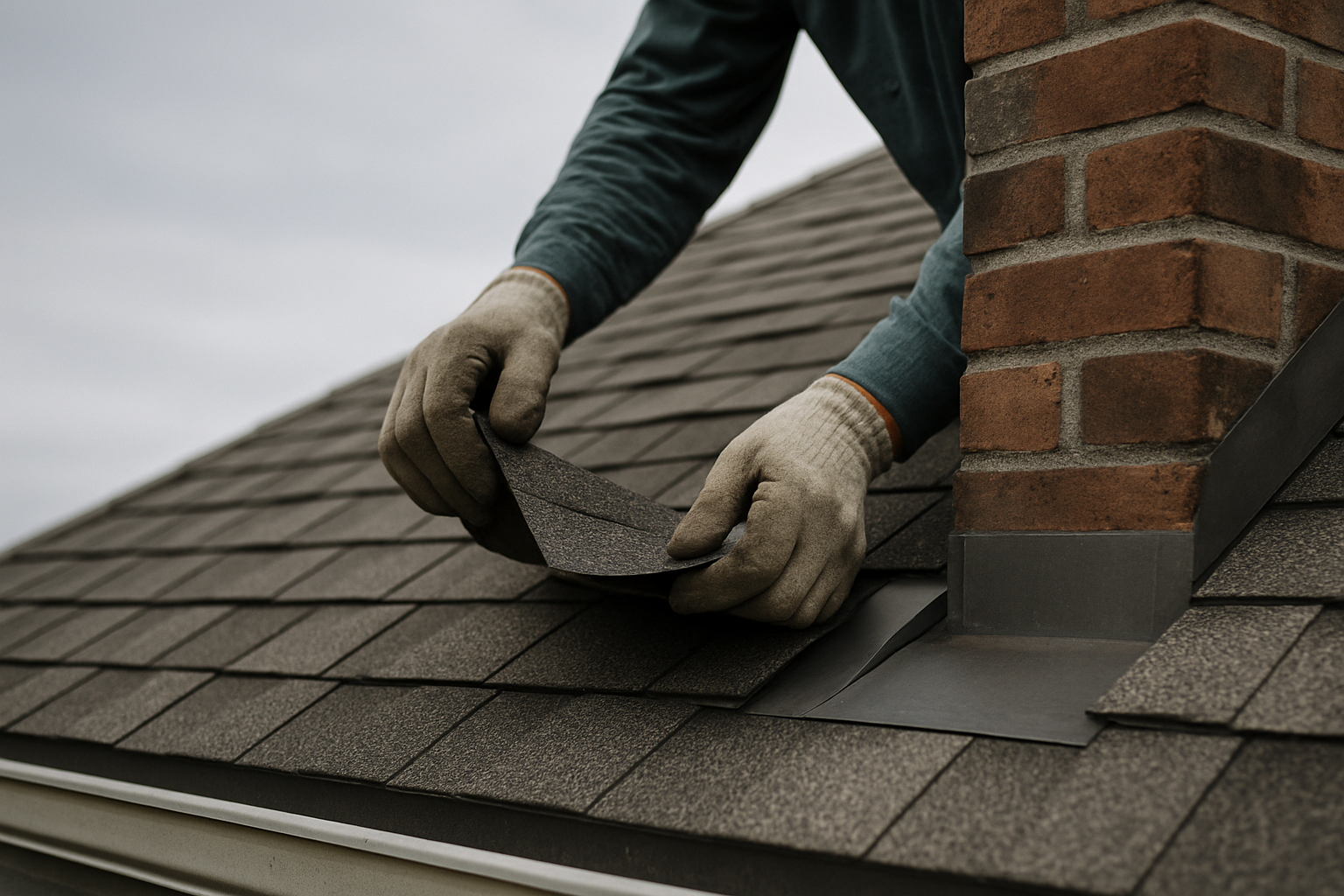
Roofing Egg Harbor Township NJ is a different discipline from barrier-island roofing. Away from direct salt spray, the dominant forces are tree cover, leaf-loaded valleys and gutters, moss on shaded slopes, and HOA rules that slow material changes. HappyRoof handles roof replacement, repair, gutter installation, and free photo inspections for suburban Atlantic County homes, with written pricing.
Inland roof conditions are not barrier-island roof conditions
Egg Harbor Township is an inland suburban township in Atlantic County, not a barrier-island community. That one fact changes what a roof is fighting and changes the order of priorities on a replacement or repair. On the islands, the recurring threats are direct salt spray, wind-driven rain against windward walls, and uplift at rakes and eaves. A few miles inland, those forces are moderated, but the roof inherits a different set of problems: tree canopy, leaf and pine-needle load from the Pine Barrens edge, moss on shaded slopes, and gutter runs that fill with organic debris long before they are challenged by rainfall.
The material priorities shift with the exposure. Salt corrosion still matters anywhere in Atlantic County, but it is not the first thing to look for on a wooded Egg Harbor Township roof. The first things are debris dams in valleys, blocked intake vents, moss holding moisture at the shingle lap, and fascia that has rotted behind a clogged gutter. A roof specified for a bayfront house in Margate is not automatically the right roof for a tree-lined lot in the township, and the reverse is just as true. If you are comparing notes with a neighbor on the water, the bayfront and barrier-island specification guide explains the opposite set of priorities.
| Condition | Barrier island, such as Margate | Inland suburban, such as Egg Harbor Township |
|---|---|---|
| Salt spray | Direct and constant | Moderate and less concentrated |
| Wind failure | Wind-driven rain at windward walls | Uplift still matters, but debris dams are the more common leak source |
| Debris load | Low | High: oak leaves, pine needles, twigs |
| Shade and moss | Low | High on tree-covered lots |
| Gutter stress | Heavy shore rain | Heavy shore rain plus leaf mass |
The township sits close enough to the shore that it still takes nor'easter wind and heavy rain, but far enough inland that salt-driven corrosion of fasteners and flashing is less aggressive than on the islands. The practical effect is that wind-rated fastening still matters, but the inspection should spend at least as much time on organic debris as on wind detail.
The result is a different failure mode. Wind-driven rain is still a factor in a nor'easter, but on a wooded lot the more common leak starts with a leaf dam. Water ponds behind the debris, works under the shingle lap, and travels along a rafter before it shows up on a ceiling several feet from the actual entry point. That is why inland leak diagnosis is a search for the source, not a patch over the stain.
Common suburban roof styles in Egg Harbor Township and their weak points
Suburban Atlantic County housing stock runs to a predictable set of geometries, and each one fails in a predictable place. Knowing the geometry tells the inspector where to look first and tells the homeowner which questions to ask a contractor.
| Roof style | Typical weak point |
|---|---|
| Two-story colonial | Multiple valleys, chimney flashing, roof-to-wall joints at the siding, ridge ventilation |
| Ranch or rambler | Long eaves, wide soffit, large shallow attic needing balanced ventilation |
| Split-level | Step flashing at plane changes, near-flat lower sections |
| Addition or dormer | Transition flashing between old and new, membrane on low-slope sections |
The two-story colonial is the classic Egg Harbor Township roof. It has multiple hips and valleys, at least one chimney, and a roof-to-wall intersection at the upper-story siding. The valley is the first place debris collects; the chimney is where step and counter flashing fail; and the ridge needs continuous ventilation because the attic is often finished or partly finished. A proper replacement is a complete tear-off with new underlayment and ridge ventilation, which is exactly the scope of a full architectural shingle replacement on a two-story colonial the company has completed in the township.
A long, low-slope ranch concentrates water at the eaves and puts a large, shallow attic under one roof plane. The soffit is the intake side of the ventilation system, and on a shaded lot it is also one of the first trim pieces to rot. Wide overhangs protect the walls, but they also hold more leaf mass at the eave.
Split-levels create roof planes at different heights. Every place a higher wall dies into a lower roof is a step-flashing joint, and those joints are among the most common leak sources in suburban work. The lower sections are often near-flat and need membrane rather than shingles.
Additions and dormers create transitions the original builder never had to detail. The seam between old roof and new, the dormer sidewalls, and the near-flat porch or sunroom roof are the classic failures. On a wooded lot, a dormer valley behind a tree line is a standing invitation for debris.
Across all of these geometries, the same handful of components fail first: pipe boots, skylight curbs, chimney step and counter flashing, drip edge and rake metal, and soffit and fascia. Those are the components a photo inspection should document whether the roof is being repaired or replaced.
HOA and municipal approval for roofing, siding, and gutter work
An exterior project on an Egg Harbor Township home can run through two approval tracks at once: the township construction office and, where a community association governs, the HOA's architectural review. They are separate processes with different decision-makers, and neither substitutes for the other.
| Approval track | Who decides | What they regulate | How it closes |
|---|---|---|---|
| Municipal permit | Township construction office | Building code compliance for the roof replacement | Municipal inspection, permit closed |
| HOA architectural review | Your community association | Colors, materials, siding style, exterior appearance | Written approval, kept with house records |
Permit requirements for a roof replacement vary by municipality, and where a permit applies the shape of the process is the same: application, permit issued, work performed, inspection by the municipal inspector, permit closed. Filing details and lead times vary, so the contractor should confirm them with the township construction office as part of the written scope. A contractor who suggests skipping the permit to save time is asking you to carry the risk at resale.
The HOA track is separate. Many suburban developments in the township have covenants that require architectural review before you change shingle color, roof material, siding style, or even gutter color. The township does not enforce HOA rules, and the HOA does not issue building permits. Where both apply, you need both.
The sequence on a typical job:
- Pull the HOA covenants and locate the architectural review form and the review calendar.
- Have the contractor prepare a written scope with material samples, colors, and product specifications.
- Submit the HOA application early; review runs on the association's calendar, which can be slower than the township's.
- The contractor files the municipal permit application with the township construction office.
- Once the permit is issued and any HOA approval is in writing, schedule the work.
- The work is performed, and the municipal inspector inspects it.
- The permit is closed. Keep the closed permit and the HOA approval with your house records for resale disclosure.
Skipping either approval has a cost. An unpermitted roof becomes a disclosure problem when you sell, and an insurance adjuster may ask whether the replacement was permitted. An HOA violation can result in a demand to change a roof or gutter color you just paid to install. Both are cheaper to prevent than to unwind.
The written scope should spell out who handles the permit filing, the inspection scheduling, and the close-out, plus the samples and specification language an HOA committee typically asks for. The homeowner owns the HOA application because the covenant is between you and your association. Get the approval in writing before any exterior color or material changes, and do not start work before the permit is issued. Siding and gutter work can carry the same two-track requirement, so the written scope should cover the whole exterior, not just the shingles.
Leaf load, ventilation, and gutters on wooded lots
On a wooded Egg Harbor Township lot, three systems fail as one: the roof valleys hold debris, the gutters back up, and the attic stops breathing. Treating any one of them alone leaves the other two to recreate the problem.
A valley is a leaf trap before it is a water channel. Pine needles and oak leaves pack into the valley, hold water against the valley metal, and keep shingle granules wet through every dew cycle. The leak that results usually shows up on the ceiling below the valley rather than at the gutter, which is why homeowners so often chase the wrong spot.
Moss grows where the roof stays damp, and on a tree-covered lot that is the north-facing or canopy-shaded slope. Moss lifts shingle edges, slows drainage, and accelerates granule loss. Removing it without addressing the shade and drainage is cosmetic; the moss returns because the conditions did not change.
A gutter on a wooded lot is a leaf-collection system first and a water channel second. If the gutter and downspout are sized for rainfall alone and not for the leaf mass, water backs up under the drip edge, rots the fascia, and wets the soffit. Gutters and downspouts have to be sized for rainfall plus leaf load, not rainfall alone.
Leaf load also attacks the attic from below the roof surface. Blocked soffit vents and leaf-covered ridge vents stall the intake-to-exhaust airflow that keeps a humid coastal attic dry. The result is condensation, damp insulation, and the frustrating symptom of wet insulation with no visible hole in the roof. That symptom is usually ventilation rather than a roof leak, and it is one of the first things to check on a shaded lot. The full picture is in the roof ventilation guide for Atlantic County.
The cycle runs on the seasons. Oak leaves drop in the fall, pine needles drop year-round, and the debris load peaks just as winter storms arrive. A gutter that was clear in August can be a dam by November. That is why a one-time cleaning is not a plan on a wooded lot; the system has to be built to carry the load, not to be rescued from it.
The fix on a wooded lot is coordinated. Clean and repair the valleys, size the gutters and guards for the leaf load, and restore balanced intake and exhaust ventilation in the same project. Doing them separately means the new gutter gets overloaded by the valley that was never cleared, or the new ventilation gets blocked again by the soffit that was never repaired.
Roof replacement Egg Harbor Township NJ: options that fit the township
Roof replacement in Egg Harbor Township NJ should begin with a full tear-off, not an overlay. The tear-off is the only way to inspect the decking for rot, replace underlayment that has outlived its usefulness, and correct flashing and ventilation that an overlay would hide. A recent township project was a complete tear-off with new underlayment and ridge ventilation on a two-story colonial; that is the standard scope, not an upgrade.
| Roof system | Where it fits on a suburban wooded lot |
|---|---|
| Architectural asphalt | Common on colonials and ranches; full tear-off with new underlayment, ice-and-water shield in valleys and eaves, and ridge ventilation |
| Metal, standing seam or exposed fastener | Sheds leaves and pine needles better than granular asphalt; suits steep shaded slopes |
| Flat membrane | For low-slope additions, porches, and dormers where shingles would pond water |
Architectural asphalt remains the most common choice on suburban homes. What separates a long-lived install from an early failure on a wooded lot is the detailing around it: valley metal that carries debris without leaking, ice-and-water shield at the eaves and valleys, drip edge and rake metal, and ridge ventilation sized to the attic. The asphalt shingle roof replacement guide for Atlantic County walks through wind ratings, nailing, and underlayment.
Metal deserves a harder look on tree-covered lots than it gets on the shore. A metal panel is a leaf-shedding surface rather than a debris-holding one, and on a steep slope under canopy it can stay clearer between cleanings than granular asphalt. Standing seam and exposed-fastener systems each have tradeoffs; the metal versus asphalt comparison for South Jersey homes lays them out.
The low-slope sections, porches, and dormer roofs need membrane and transition flashing rather than shingles. These are the sections that pond water and leak at the seam between old and new. They are usually repaired or replaced alongside the main roof so the transition flashing can be done correctly.
The choice of system should follow the site, not a brand pitch. Slope, tree cover, attic geometry, HOA constraints, and the condition of the decking all determine what is buildable. The inspection with photos is how that decision gets made, and the written proposal is where it gets priced.
Roof repair Egg Harbor Township NJ: diagnosing leaks on suburban homes
Roof repair Egg Harbor Township NJ is a diagnosis problem more than a patching problem. On a suburban lot, water can enter at a debris-packed valley, travel along a rafter, and stain a ceiling several feet away from the actual entry point. The repair that lasts is the one that finds the actual source instead of patching the stain.
Common suburban repairs include:
- Valley cleaning and valley metal repair after debris dams
- Chimney step and counter flashing replacement
- Pipe boot replacement at plumbing and exhaust penetrations
- Skylight and dormer flashing
- Limb-strike and storm damage, including emergency tarping
- Moss removal plus the drainage and ventilation corrections that keep it from returning
Flashing failures are the most misdiagnosed leaks on suburban roofs. A chimney, valley, or pipe boot can look fine from the ground and still be the source. The roof flashing repair guide for Atlantic County covers chimney, valley, and pipe boot leak diagnosis.
After a nor'easter, wind-lifted shingles and torn flashing are the common damage. The sequence is tarp first, document second, repair third. Emergency tarping stops the water while the damage is photographed and the claim is documented, and the same documentation supports the adjuster meeting later. On a wooded lot, add limb strikes to the storm list, because a falling branch can open the roof in a place the wind never touched.
The repair-versus-replace decision on an inland roof is different from the shore. A roof that is granule-free in the sun but has moss, packed valleys, and a failing gutter may be repairable if the underlying shingles and decking are sound. The honest answer comes from the photo inspection: if the decking is sound and the flashing is the problem, repair; if the shingles are exhausted and the decking is suspect, replace. No one should be selling a replacement before the roof has been walked.
Gutter installation Egg Harbor Township: moving leaf load and shore rain
Gutter installation Egg Harbor Township is not a one-size job. A downspout run that works on a cleared lot will choke on a wooded one. The requirement on a tree-lined property is seamless gutters, guards, and downspout runs that move Pine Barrens leaf load and heavy shore rain away from the foundation, sized together rather than picked off a shelf.
Seamless gutters run the length of the eave without the joints that leak and sag under wet leaf weight. Fewer seams means fewer places for a debris dam to start, and fewer places for a slow drip to go unnoticed against the fascia.
A guard has to shed what actually falls on the roof. Oak leaves and pine needles behave differently: a guard that catches needles becomes a mat, and a mat is a dam. The guard choice follows the tree species on the lot, not a catalog photo.
Downspout capacity is the second half of the gutter decision. Leaf load reduces the effective opening, so a downspout sized for clean water can underperform in leaf season. Discharge must move water well away from the foundation; a downspout that dumps at the corner is a foundation wetting system in disguise.
Gutters mount to fascia, and on a wooded lot the fascia is often the first piece of trim to rot behind a clogged gutter. A new gutter on rotten fascia fails early, so fascia repair and gutter replacement are one project rather than two. The seamless gutter sizing guide for Atlantic County covers rainfall and leaf load together.
Siding, soffit, and fascia: where roof work meets the walls
A roof replacement is the right moment to inspect what the roof drains onto. Soffit, fascia, and trim are the roof's drainage interface, and on a wooded lot they absorb the abuse of clogged gutters, wet shade, and overflowing valleys.
Fascia carries the gutter and takes the water when the gutter overflows. Rot here shows as gutter pull-away and peeling paint at the eave. Soffit is the intake side of the attic ventilation system; leaf load and wet shade rot it and block the vents at the same time. A soffit that cannot pass air means the new ridge vent has nothing to pull from. Siding, whether vinyl or fiber-cement, belongs in the same review because HOA color rules often apply to it as much as they do to the roof.
The practical rule is sequencing. If the fascia is being replaced, do it before or with the gutter, not after. If the soffit is being replaced, do it with the ventilation work. Sequencing them as one exterior project is cheaper than reopening the same eave twice, and it keeps the roof, gutter, and ventilation warranties from pointing at each other.
How to compare roofing companies Egg Harbor Township NJ
Roofing has a reputation problem, and in a suburban township where homes look alike, the low bid often wins and the homeowner finds out why later. When you are comparing roofing companies Egg Harbor Township NJ, the questions below separate a documented process from a promise.
- Is the contractor a licensed, bonded, and insured New Jersey contractor, and will they show you the documentation?
- Is the installation manufacturer-certified so the material warranty stays valid?
- Will the same people who inspect the roof be the ones who install it, or will the job be handed to a day-labor crew?
- Does the inspection come back with photos of your actual decking, flashing, and ventilation, including an honest answer if the roof does not need replacing?
- Is the price written and itemized before work starts?
- Does the scope include permit filing, municipal inspection close-out, and thorough cleanup?
- Does the contractor understand the difference between a bayfront roof and an inland wooded-lot roof?
These questions are not about brand loyalty. They are about whether the proposal you sign describes work that can be inspected, permitted, and cleaned up. In a township where HOA rules and municipal inspections both apply, the paper trail is part of the product.
The cheapest quote rarely survives contact with the decking. A contractor who cannot answer the permit and inspection questions up front is telling you who will own the problem later. A contractor who tells you the roof has years left instead of selling a replacement is the one worth keeping.
Roof inspection Egg Harbor Township: from photos to a written price
A roof inspection Egg Harbor Township should end with you knowing exactly where the roof stands, whether that means repair, replacement, or nothing at all. HappyRoof's process starts with a free inspection and ends with a closed permit, and nothing is priced until the roof has been walked and photographed.
- Call (609) 525-4521 or request a free inspection.
- An inspector walks the roof and photographs the decking, flashing, ventilation, and gutters.
- You receive a written report with those photos and an honest assessment of remaining life.
- If work is needed, you get itemized written pricing before anything starts.
- Permits and any HOA approval run in parallel; the work is scheduled only after they clear.
- The HappyRoof crew performs the work.
- The municipal inspector closes the permit, and you keep the record.
The photo report matters because it converts a vague "your roof is old" into evidence you can see: the granule loss on a shaded slope, the debris packed in a valley, the wet sheathing at the chimney, the blocked soffit vent. If the roof has years left, you hear that and keep the report. If it needs work, the written price is based on what was actually found, not on a square-footage guess from the street.
What to have ready before the inspection helps the diagnosis move faster, though none of it is required to schedule:
- The approximate age of the roof, if known
- Any HOA covenant language on exterior changes
- The locations of any interior water stains
- The history of past repairs, claims, or tarping
Service area: Egg Harbor Township and all of Atlantic County
HappyRoof serves Egg Harbor Township and every town in Atlantic County, from the barrier islands to the Pinelands. That includes Galloway, Hammonton, Mays Landing, Northfield, Linwood, Somers Point, Absecon, Pleasantville, Atlantic City, Ventnor City, Margate City, Longport, Brigantine, and the inland Pinelands towns where tree cover drives the work: Buena, Folsom, Egg Harbor City, Mullica Township, Port Republic, Estell Manor, and Weymouth Township.
The office is at 611 Doughty Rd, Pleasantville, NJ 08232, and is open Monday through Saturday, 7:00 AM to 7:00 PM. Emergency tarping is available outside those hours for storm damage.
Roofing Egg Harbor Township NJ: questions homeowners ask
Do I need a permit to replace a roof in Egg Harbor Township?
Whether a permit is required, and the lead time for it, is confirmed with the township construction office as part of the written scope. Where a permit applies, the sequence is the same: application, permit issued, work performed, municipal inspection, permit closed. A licensed contractor should handle the filing and close-out as part of the job.
Does Egg Harbor Township require HOA approval for a new roof?
The township does not issue HOA rules; your community's covenants do. If an HOA governs your development, exterior changes such as shingle color, roof material, siding, and gutter style may need architectural review before work starts. Check the covenants, get the approval in writing, and have the contractor supply material samples and a written scope for the application.
How does heavy leaf load actually damage a roof?
Debris packs in valleys and gutters, holding water against shingles and valley metal, promoting moss and granule loss, and backing water under the drip edge into the soffit and fascia. Blocked soffit and ridge vents also stall attic airflow, which invites condensation in a humid coastal climate. The damage is usually slow and hidden until a ceiling stains.
What roof system works best on a wooded Egg Harbor Township lot?
There is no single answer. Architectural asphalt after a full tear-off is common on suburban homes; metal sheds leaves and pine needles well on steep shaded slopes; flat membrane suits low-slope additions and dormers. The right choice follows slope, tree cover, attic geometry, HOA constraints, and decking condition, which is why the inspection comes before any material recommendation.
What does the free roof inspection actually include?
Photos of your actual roof, including decking, flashing, ventilation, and gutters, plus an honest assessment of remaining life. If the roof does not need replacing, you hear that and keep the report. If work is needed, you get itemized written pricing before anything starts. The inspection is the basis for every proposal and carries no obligation.
How long does a roof replacement take in Egg Harbor Township?
Duration depends on roof size, tear-off complexity, decking repairs, weather, and the township inspection schedule. The written proposal includes the work sequence and scope, while the permit and any HOA review run on their own calendars. A responsible contractor will not promise a completion date before the decking is opened and inspected.
The next step is a free inspection with photos of your own roof. Call (609) 525-4521 or write to hello@gohappyroof.com to schedule it, and get an honest answer on whether your Egg Harbor Township roof needs repair, replacement, or nothing at all.
Frequently asked questions
Do I need a permit to replace a roof in Egg Harbor Township?
Yes. New Jersey requires a construction permit for a roof replacement, and the requirement is not optional. Egg Harbor Township runs its own construction office, so filing details and lead times vary, but the sequence is the same: application, permit issued, work performed, municipal inspection, permit closed. A licensed contractor should file and close the permit as part of the job.
Does Egg Harbor Township require HOA approval for a new roof?
The township does not issue HOA rules; your community's covenants do. If an HOA governs your development, exterior changes such as shingle color, roof material, siding, and gutter style may need architectural review before work starts. Check the covenants, get the approval in writing, and have the contractor supply material samples and a written scope for the application.
How does heavy leaf load actually damage a roof?
Debris packs in valleys and gutters, holding water against shingles and valley metal, promoting moss and granule loss, and backing water under the drip edge into the soffit and fascia. Blocked soffit and ridge vents also stall attic airflow, which invites condensation in a humid coastal climate. The damage is usually slow and hidden until a ceiling stains.
What roof system works best on a wooded Egg Harbor Township lot?
There is no single answer. Architectural asphalt after a full tear-off is common on suburban homes; metal sheds leaves and pine needles well on steep shaded slopes; flat membrane suits low-slope additions and dormers. The right choice follows slope, tree cover, attic geometry, HOA constraints, and decking condition, which is why the inspection comes before any material recommendation.
What does the free roof inspection actually include?
Photos of your actual roof, including decking, flashing, ventilation, and gutters, plus an honest assessment of remaining life. If the roof does not need replacing, you hear that and keep the report. If work is needed, you get itemized written pricing before anything starts. The inspection is the basis for every proposal and carries no obligation.
How long does a roof replacement take in Egg Harbor Township?
Duration depends on roof size, tear-off complexity, decking repairs, weather, and the township inspection schedule. The written proposal includes the work sequence and scope, while the permit and any HOA review run on their own calendars. A responsible contractor will not promise a completion date before the decking is opened and inspected.