A complete asphalt roof replacement on a typical Atlantic County home usually runs $9,000 to $25,000, and the honest price is a range until someone sees the deck. The number moves with tear-off layers, sheathing condition, flashing, pitch, access and permits. Read a quote as line items, not as a single price.
The number to plan around, and why it stays a range
Replacing a roof is the largest single repair most Atlantic County homeowners ever authorize, and almost nobody does it twice in the same house. That means you are making a five-figure decision without practice. The figure to plan around is the one HappyRoof publishes: a complete asphalt roof replacement on a typical Atlantic County home usually runs $9,000 to $25,000 and takes one to three working days.
The spread is not a hedge and it is not a negotiating position. It is the honest shape of a roof price before the old material comes off. The shingles you can see are the top layer of a system. Below them sit the underlayment, the deck sheathing, the flashing and the ventilation, and each of those can be in very different condition from the house next door.
Two houses on the same street can land at opposite ends of the range for reasons that have nothing to do with markup. One has a single layer of shingles, sound plywood and a walkable pitch. The other has two layers, soft sheathing at the eaves, three pipe boots, a chimney with failed counter-flashing and a steep rear slope over a finished room. The second roof costs more to do correctly, and a quote that hides that cost is not cheaper — it is incomplete.
That is the argument for an itemized written proposal. The total at the bottom is the last number you should look at. The line items above it are what let you compare three bids and tell a thorough proposal from a cheap one.
The word "typical" is doing real work in that range. It describes a single-family home with a single existing layer, sound decking, a manageable pitch and ordinary access. A metal roof, a flat membrane roof, a barrier-island house with no staging area, or a roof with two layers and failed flashing sits somewhere else in the conversation. The range is a planning number, not a quote for your specific street.
There is also a difference between an estimate and a quote. An estimate is a considered range based on what is visible from the ground. A quote is a fixed, written number attached to a defined scope. A contractor who cannot separate those two things is asking you to treat a guess as a contract.
Seven things that move the price
The cost of a roof replacement is not one decision. It is a stack of seven variables, and every one of them appears as a line item on an honest quote.
1. Roof size, measured in squares
Roofing is measured in squares. One square is 100 square feet of roof surface. Roof surface is not the same as the house's floor area: a roof is sloped, so its actual area is larger than the footprint beneath it, and overhangs, dormers and hips add more. A larger roof takes more shingles, more underlayment, more fasteners and more labor, so the square count is the baseline multiplier for everything else on the quote.
The square count is also where two bids can silently describe two different roofs. When you compare estimates, check that they are priced against the same square count. A bid that appears lower because it undercounts the roof is not a savings; it is an arithmetic error you will discover in a change order after the job has started.
Roof size matters twice: it drives both material and labor. Material scales roughly with area, but labor does not scale down on a small roof the way buyers expect. A small roof still needs the same setup, the same permit, the same trip to the dump and the same crew mobilization, so the per-square cost on a small, steep, detailed roof can be higher than on a large, simple one.
2. Pitch and height
Pitch is the steepness of the roof, and it changes the labor more than most homeowners expect. A low, walkable pitch is fast to work. A steep pitch needs staging, roof jacks or scaffolding, and slower, safer work practices, and it generates more material waste because shingles cut at hips, valleys and rakes do not all get used.
Height and the number of stories add a second layer of cost. Material has to be carried or hoisted, access to the eaves is harder, and the crew works more slowly when the fall hazard is real. A steep second-story roof over a finished interior is one of the most expensive common configurations in the county because the work is slower and the consequence of a dropped tool or a missed nail is higher.
Pitch also changes which details matter. The steeper the roof, the more water runs away from the field of shingles and toward the valleys, eaves and penetrations — which is another way of saying that a steep roof with old flashing is a more expensive roof to make watertight than a shallow roof with the same shingles.
3. Existing layers: one, two, or overdue for tear-off
New Jersey's adopted building code limits a roof to two layers of covering. That single sentence has a direct effect on your estimate. If the roof already has two layers, a full tear-off is the only legal path, and the removal labor and disposal are mandatory line items. If the roof has one layer, an overlay is technically possible — and some contractors will push it because it is cheaper and faster.
The catch is that an overlay does not remove the old roof; it defers it. Once the second layer is on, the next roof must be torn off no matter what, so the overlay does not avoid the cost of removal. It adds the weight of an extra layer to the bill and hides the deck beneath it. We return to this in full below, but the short version is: the number of existing layers is a price driver you can see before anyone climbs a ladder, and it belongs on every quote.
4. Decking condition under the shingles
Decking — the plywood or OSB sheathing that the shingles are fastened to — is the line item that most often changes a roof price after work begins. You cannot fully know its condition until the old shingles and underlayment are off. Soft spots, rot at the eaves, delamination around old leaks and damage from past storm-driven water all hide under a roof that looks fine from the ground.
The warning signs are visible from the attic or the roofline if someone looks: a sagging or wavy roof line, decking that flexes when walked, or daylight visible through the roof deck when you look up from the attic. None of those signs gives you a sheet count, but they tell you the contingency line is likely to be exercised.
This is why a full tear-off matters and why a written quote should state a per-sheet rate for any decking that gets replaced. The rate turns an unknown into a predictable calculation: you still do not know how many sheets until the roof is open, but you know exactly what each one costs. A bid with no per-sheet rate is asking you to negotiate the most common change order at the worst possible moment.
5. Flashing and detail work
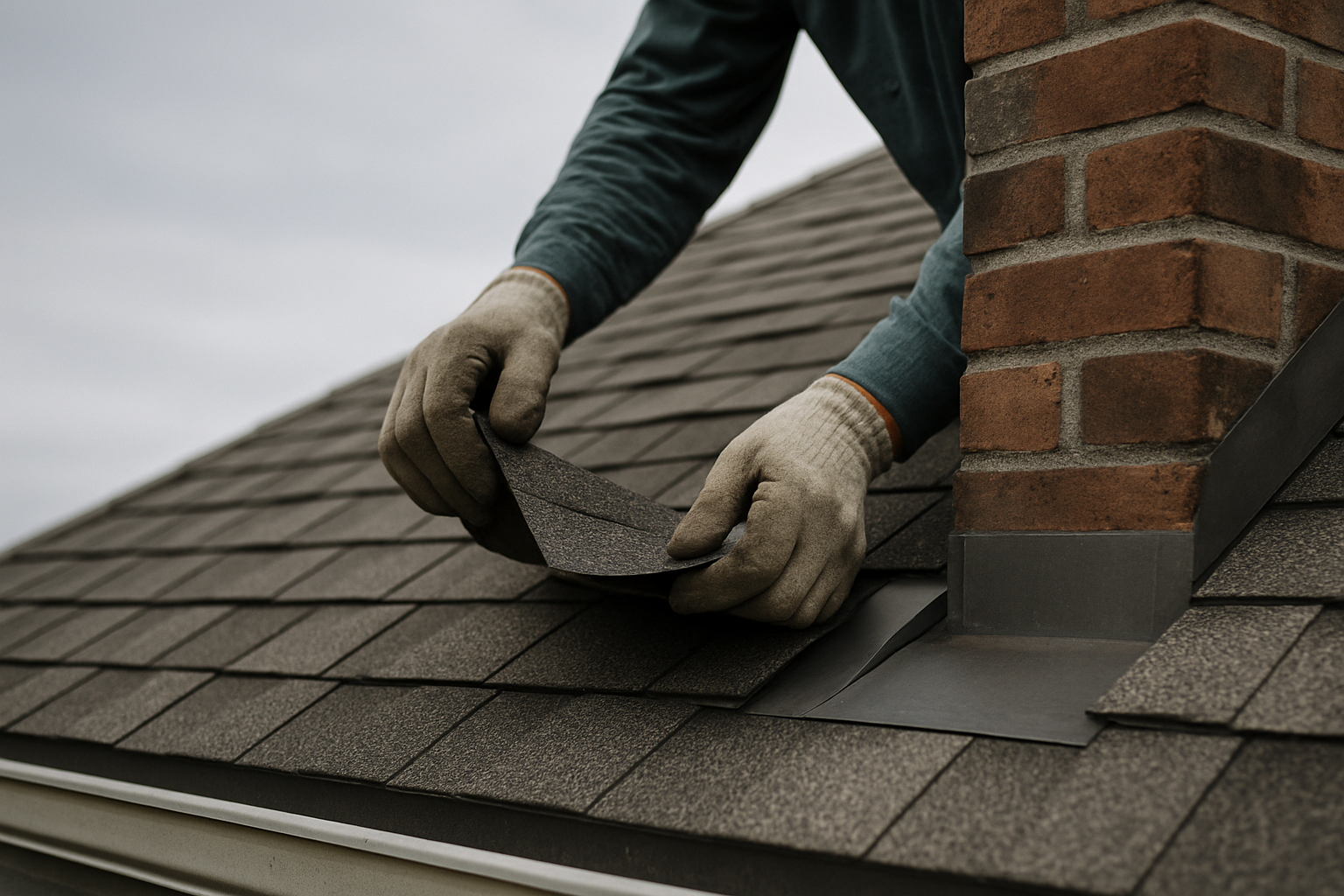
Flashing is where roofs leak first, and it is also where a cheap quote quietly saves money by leaving the old metal in place. Chimneys, sidewalls, valleys, pipe boots, drip edge and rake metal are all penetration points and terminations that need to be detailed correctly for a coastal climate.
A thorough quote itemizes flashing work by location and states that it is replaced, not reused. Reusing old flashing under a new roof is one of the most common ways to produce a low number that costs far more later, because the new shingles are only as watertight as the metal underneath them. The correct question to ask about the flashing line is the same one you ask about roof flashing repair: where, exactly, is the water trying to get in, and what is being replaced to stop it?
The number of flashing details is not uniform. A simple gable roof with no penetrations has very little flashing. A roof with a chimney, two sidewalls, a valley and three plumbing vent pipes has a flashing bill that is a meaningful part of the total. That is why a quote that says "flashing as needed" is not an itemized quote at all.
6. Access and staging
Where the crew can stage materials and dispose of debris changes the price. A suburban lot with a wide driveway and clear side access is a different job from a narrow barrier-island property where there is often no driveway to stage from and materials have to move through a side alley or over a neighboring easement.
Landscaping, fences, decks and the distance from the street to the roof all add time. A quote that ignores access is guessing, and on the barrier islands in particular — Atlantic City, Ventnor City, Margate City, Longport and Brigantine — access planning is a real cost driver, not a footnote. Two identical roofs can carry different prices because one crew sets up on a driveway and the other spends half a day moving material by hand.
Access also affects cleanup, which affects the disposal line. If a dump trailer cannot reach the house, debris has to be carried or staged differently, and that time shows up in the tear-off and disposal lines.
7. Material tier and coastal fastening
The reference price range describes architectural asphalt shingles on a typical Atlantic County home. Within that tier, the correct shingle for your street depends on exposure: a roof that was specified for a subdivision in central New Jersey is not specified for a bayfront house in Margate, and it should be built accordingly.
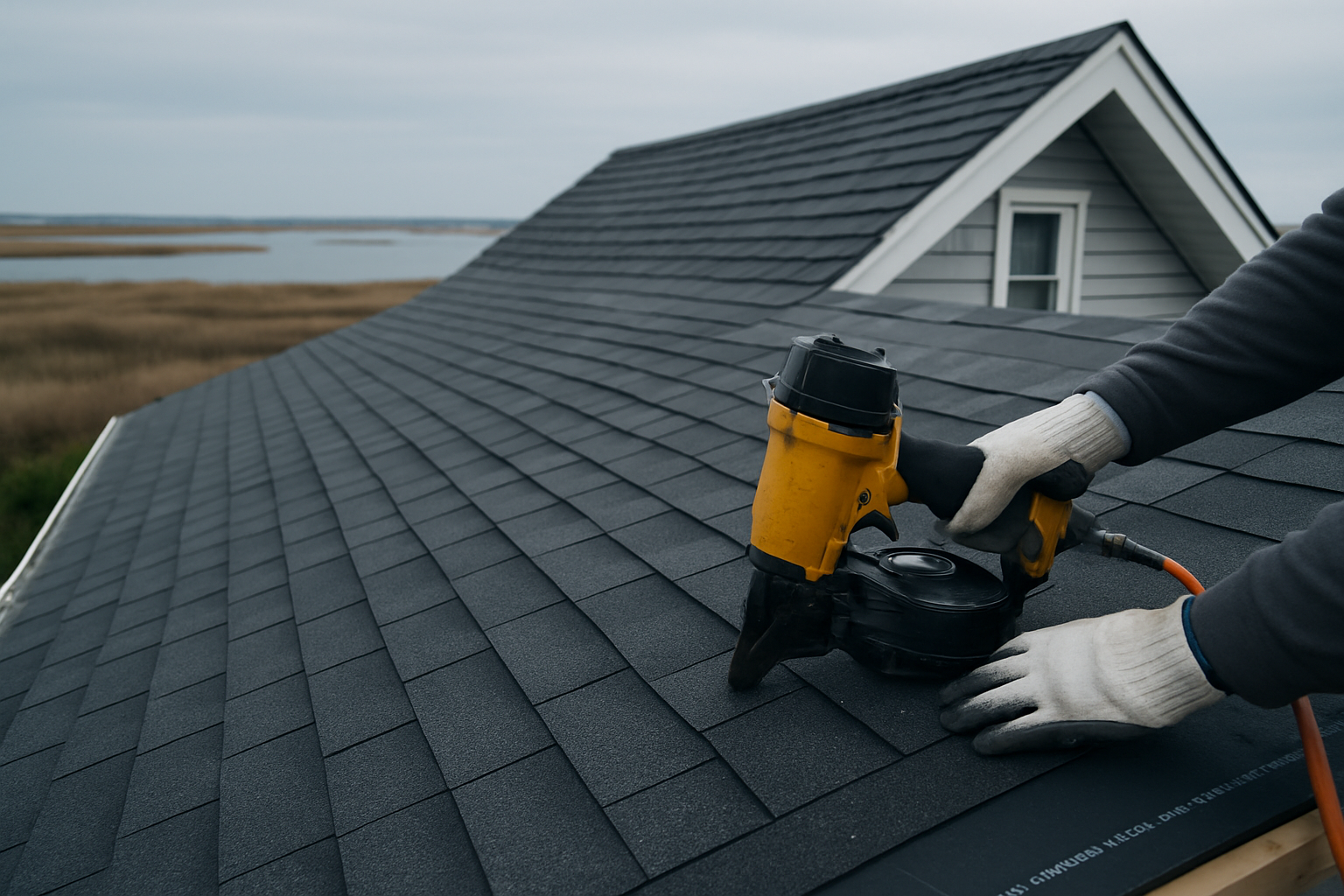
For asphalt, that means wind-rated shingles and enhanced nailing patterns chosen for the exposure your specific street gets. Metal and flat membrane are separate material conversations with different prices and different detailing. If you are weighing standing seam metal against architectural asphalt shingles, the decision changes your number more than any other single line item. The wind-rated nailing, underlayment and fastening details for asphalt are covered in the asphalt roof replacement guide.
Material choice is not just a question of price per square. It changes the underlayment, the fastening schedule, the flashing details and, on the shore, the corrosion resistance of every piece of metal that touches salt air. A cheap material on a coastal house is not a saving; it is a shorter interval to the next replacement.
The line-item quote: what should actually be on it
A roof estimate that is one number at the bottom is not an estimate; it is a guess with a signature line. The written, itemized proposal is the document that lets you compare bids honestly and protects you from the classic day-of surprise.
Here is the shape of a complete line-item quote and what each line should tell you.
| Line item | What drives the cost | What to look for in writing |
|---|---|---|
| Tear-off and disposal | Number of layers, pitch, access, dump fees | Stated separately; haul-away of every scrap included |
| Decking and sheathing repair | Rot, delamination, soft spots found at tear-off | A per-sheet rate written before work starts |
| Underlayment and ice-and-water shield | Eaves, valleys, penetrations, code requirements | Material and coverage areas listed, not lumped as "misc" |
| Flashing | Chimneys, sidewalls, valleys, pipe boots, drip edge | Replaced, not reused; locations itemized |
| Ridge ventilation | Intake and exhaust balance, existing vent condition | Itemized, with intake and exhaust both addressed |
| Permit and municipal inspection | Municipality and township schedule | States who pulls the permit and who meets the inspector |
| Cleanup and nail sweep | Lawn, beds, driveway, landscaping | Included as a line; magnet sweep stated |
The discipline of the line item is the point. An itemized proposal covering tear-off, materials, permits, disposal and cleanup gives you the same information before the job that a cheap bid hides inside the word "installation."
Decking deserves special attention because it is the only line that legitimately changes after the contract is signed. Everything else — the tear-off, the underlayment, the flashing, the permit, the disposal — is knowable before the first shingle comes off. A contractor who will not state a per-sheet decking rate is asking you to sign an open-ended check. HappyRoof's written pricing separates labor, materials, disposal and the per-sheet rate for any decking it replaces, so the one genuine unknown has a defined cost attached to it.
Underlayment and ice-and-water shield are the line items most buyers have never priced, and they are not optional in this climate. The barrier against water that gets past the shingles goes at the eaves and in the valleys, and in a county with nor'easters and ice, skimping here means the new deck starts absorbing water on day one. A quote should say what is being installed and where, not just that "felt" is included.
Ridge ventilation belongs on the quote for the same reason: a roof that is re-shingled without balancing intake and exhaust will hold heat and moisture against the underside of the new deck and shorten the life of everything you just bought.
Tear-off versus overlay: the cheaper roof that is not cheaper
An overlay means nailing new shingles directly over the existing ones. It is cheaper because nobody has to remove and haul away the old roof, and some contractors push it hard for exactly that reason. It is the single most common way to make a roof price look low.
Here is the honest comparison.
| Factor | Full tear-off | Overlay |
|---|---|---|
| What gets removed | Old shingles, underlayment and damaged flashing down to bare deck | Nothing; new shingles go over the old layer |
| What the crew can inspect | Every square foot of sheathing | Nothing beneath the old shingles |
| New Jersey code | Allowed any time; required once two layers exist | Allowed only when the roof has one existing layer |
| Cost now | Higher | Lower |
| Cost later | No deferred removal | Full tear-off required next time, plus the added weight of a second layer |
New Jersey's adopted building code limits a roof to two layers of covering. That limit is not a preference; it is the rule that decides whether an overlay is even legal on your house. Once a second layer is on, the next roof has to be a full tear-off no matter what.
The financial trap is the deferral. An overlay does not avoid the cost of removal. It moves that cost to the next owner or to your future self, and it adds the weight of an extra layer in the meantime. Weight matters because the deck and framing were sized for a roof, not a roof wearing another roof.
There is also a diagnostic cost nobody puts on the quote. An overlay hides the deck, so rot that would have been caught and replaced at a per-sheet rate during a tear-off instead keeps spreading under two layers of shingles until it becomes visible from inside the attic. By then the repair is no longer a sheet of plywood; it may be a rafter or a section of deck with water damage in the ceiling below.
The honest position is simple: if you are putting a new roof on a home you intend to keep, the full tear-off is the correct baseline, and an overlay should be justified, not sold as the default.
Permits and disposal in Atlantic County
New Jersey requires a construction permit for a roof replacement, and the requirement is not optional or negotiable based on how busy the township is. Each Atlantic County municipality runs its own construction office, so filing details and lead times vary between, say, Egg Harbor Township and Atlantic City, but the shape of the process is the same: application, permit issued, work performed, inspection by the municipal inspector, permit closed.
A permit is a cost, a schedule item and a piece of paper that matters when you sell the house. It should be a line on your quote, and it should name who does what. HappyRoof pulls the municipal permit and schedules the township inspection as part of the job, not left to you. If a bid says the permit is "your responsibility," add the cost of your own time, a trip to the municipal office and the risk of a missed inspection to the bottom of that bid.
The permit is also part of doing the roof on the record. An unpermitted roof is a title problem at sale and a code problem at inspection, and "saving" the permit fee is not a saving in any useful sense of the word. The line item exists so the roof has a paper trail from the day the shingles come off to the day the inspector signs it closed.
Disposal is the line most first-time buyers forget. A full tear-off produces tons of old shingles, felt and nails, and all of it has to be hauled. Disposal cost depends on the number of layers coming off, the size of the roof and the access to the dump trailer. A written quote should include disposal rather than bury it, and it should state that every scrap of old roofing is hauled away.
The magnet sweep is part of the same discipline. Landscaping tarped, a magnet run over the yard and driveway for nails, and every scrap of old roofing hauled away before the crew leaves. That is a cleanup line, not a favor, and a bid that does not mention it is a bid that may leave you finding nails with a lawnmower tire in the spring.
How to compare three estimates without buying the cheapest
The cheapest roof bid is not the one with the lowest total. It is the one that describes the same roof as the other two, with the same scope, in writing. Comparing totals alone rewards the contractor who left the most out.
Compare the line items first. Does each quote address the same tear-off, the same decking contingency, the same flashing, the same permit and the same disposal? If one bid is lower because it omits the permit or reuses the old flashing, it is not lower — it is a different job.
Ask three questions of every written estimate:
- What is the per-sheet price if decking has to be replaced? A bid without a stated rate turns the most common change order into a negotiation at the worst possible moment.
- What ventilation work is included, and does it balance intake with exhaust? A roof that is re-shingled without balancing roof ventilation will carry heat and moisture into the new deck and shorten its life.
- Who pulls the permit and who meets the municipal inspector? A quote that leaves the permit to you is handing you the liability and the legwork.
Then check the warranty language. A manufacturer's material warranty and a workmanship warranty are two different documents, and a bid that quotes only one is telling you half the story.
Finally, look at what the quote says about the crew. A roof is a system installed by people, and the people who inspect should be the people who install. A bid that cannot tell you who is doing the work is a bid where the installer is the variable, and the installer is the one variable no line item can fix after the fact.
For a roof damaged in a nor'easter or a summer storm, the comparison has one extra step: the insurance claim. New Jersey roof storm damage insurance claims have their own rules for documentation, deductibles and adjuster meetings, and the estimate you compare is often the estimate your insurer reviews. Never let anyone offer to absorb or waive a deductible in New Jersey — it is not lawful.
Material warranties versus workmanship warranty in writing
There are two warranties on a new roof, and they cover different failures.
The material warranty comes from the manufacturer and covers the shingle or membrane itself: defects in the material, and the performance the manufacturer rated it for. That warranty typically stays valid only when the installation follows the manufacturer's specification — which is why manufacturer-certified installation matters. A shingle warranty is worthless if a careless install voids it before the first storm.
The workmanship warranty covers the labor. It is the installer's promise that the roof was put on correctly: the flashing lapped the right direction, the nailing pattern held, and the details were done the way the specification says. This warranty is only as good as the paper it is written on, which is why it should be a workmanship warranty in writing rather than a vague "lifetime guarantee" spoken at the kitchen table.
HappyRoof's position on the material side is stated plainly: manufacturer-certified installation, so the shingle warranty you are paying for stays valid. The workmanship side is the installer's own promise, and it belongs in the written proposal, not in a handshake. When you compare bids, ask which manufacturer the material is certified for and what the workmanship warranty says in writing. A contractor who cannot produce either answer has just told you which line item was cut.
Coastal reality: the three Atlantic County environments
Atlantic County is three different roofing environments wearing one county name, and the environment is part of the price.
On the barrier islands — Atlantic City, Ventnor City, Margate City, Longport and Brigantine — the governing factors are sustained wind, salt aerosol, and a housing stock that includes a lot of narrow attached and semi-attached buildings with low-slope rear sections. Perimeter detailing, enhanced fastening and corrosion-resistant metal earn their keep here, and access planning matters because there is often no driveway to stage from. A bayfront and barrier-island specification guide explains why the fastening schedule matters more than the shingle color.
On the mainland, the loads are different. Wind is still real, but the roof also has to handle wet leaves, ice at the eaves and the usual subdivision geometry. The correct underlayment and a proper ice-and-water shield at the eaves and valleys do more work here than they would in a dry climate, and they do it quietly until the first winter freeze.
In the Pinelands-adjacent towns, the Pine Barrens leaf load is its own problem. Leaves collect in valleys and behind chimneys, hold moisture against the flashing and feed the rot that shows up later as a decking line item. A roof specified for central New Jersey does not anticipate that leaf load; a roof specified for Atlantic County does.
The environment does not just change which material you choose. It changes which line items are non-negotiable, and it is why an estimate should be built for your street rather than pulled from a regional average.
Common mistakes that cost more later
Buying the bottom-line number. A total with no line items cannot be compared, and the bid that wins on total is usually the one that omitted the permit, the disposal or the decking contingency.
Accepting reused flashing. Flashing is where roofs leak first, and old metal under new shingles is a future leak with a fresh warranty on top of it. Require flashing replacement by location.
Treating decking as a surprise. The deck is the one legitimate unknown in a roof replacement. A per-sheet rate in writing converts it from a surprise into a calculation.
Confusing the two warranties. The manufacturer's material warranty and the installer's workmanship warranty cover different failures. Get both, and get the workmanship one in writing.
Skipping the permit. A roof replacement in New Jersey requires a permit. An unpermitted roof is a title problem at sale and a code problem at inspection, and skipping the permit fee is not a saving.
Choosing an overlay to save money. An overlay defers the tear-off cost, hides the deck and adds weight. Once the second layer is on, the next roof must be torn off regardless.
Comparing estimates before the inspection. A phone quote is a range, not a contract. The honest number appears only after someone walks the roof, checks the attic and writes down what is actually there.
Frequently asked questions
How much does a roof replacement cost in Atlantic County, NJ?
A complete asphalt roof replacement on a typical Atlantic County home usually runs $9,000 to $25,000. The range reflects roof size, pitch, existing layers, decking condition, flashing and access. Metal and flat membrane systems are separate price conversations. A firm number requires an inspection, because the deck under the shingles is only visible after tear-off.
Do I need a permit to replace my roof in New Jersey?
Yes. New Jersey requires a construction permit for a roof replacement. Each Atlantic County municipality runs its own construction office, but the process follows the same shape: application, permit issued, work performed, municipal inspection, permit closed. A thorough contractor pulls the permit and schedules the inspection as part of the job.
Can I put new shingles over my old roof instead of tearing off?
New Jersey's adopted building code limits a roof to two layers of covering. An overlay is cheaper because nothing is hauled away, but it defers the tear-off cost rather than avoiding it and adds the weight of a second layer. Once two layers exist, the next roof must be a full tear-off no matter what.
What happens if you find rotten plywood under my shingles?
A full tear-off lets every square foot of sheathing be inspected before new material goes down. If decking is soft or rotten, it is replaced at a per-sheet rate that should be written into the quote before work starts, so the added cost is predictable instead of a surprise.
Why can't a contractor quote a firm roof price over the phone?
Because the biggest cost drivers — decking condition, existing layers, flashing details, pitch and access — are only visible on site, and some are only visible after tear-off. An itemized written estimate with a stated per-sheet decking rate is the honest alternative to a guess dressed up as a firm number.
What is the difference between a material warranty and a workmanship warranty?
The manufacturer's warranty covers the shingle or membrane and typically stays valid only with manufacturer-certified installation. The workmanship warranty covers the installer's labor and should be stated in writing. Ask for both before signing, and do not accept a spoken "lifetime" promise as a substitute.
Next step
The only number that matters for your house is the one produced after an inspection. HappyRoof offers a free inspection with photos of what is actually found, and every estimate is fixed in writing before a single shingle comes off. Call (609) 525-4521 to schedule it.