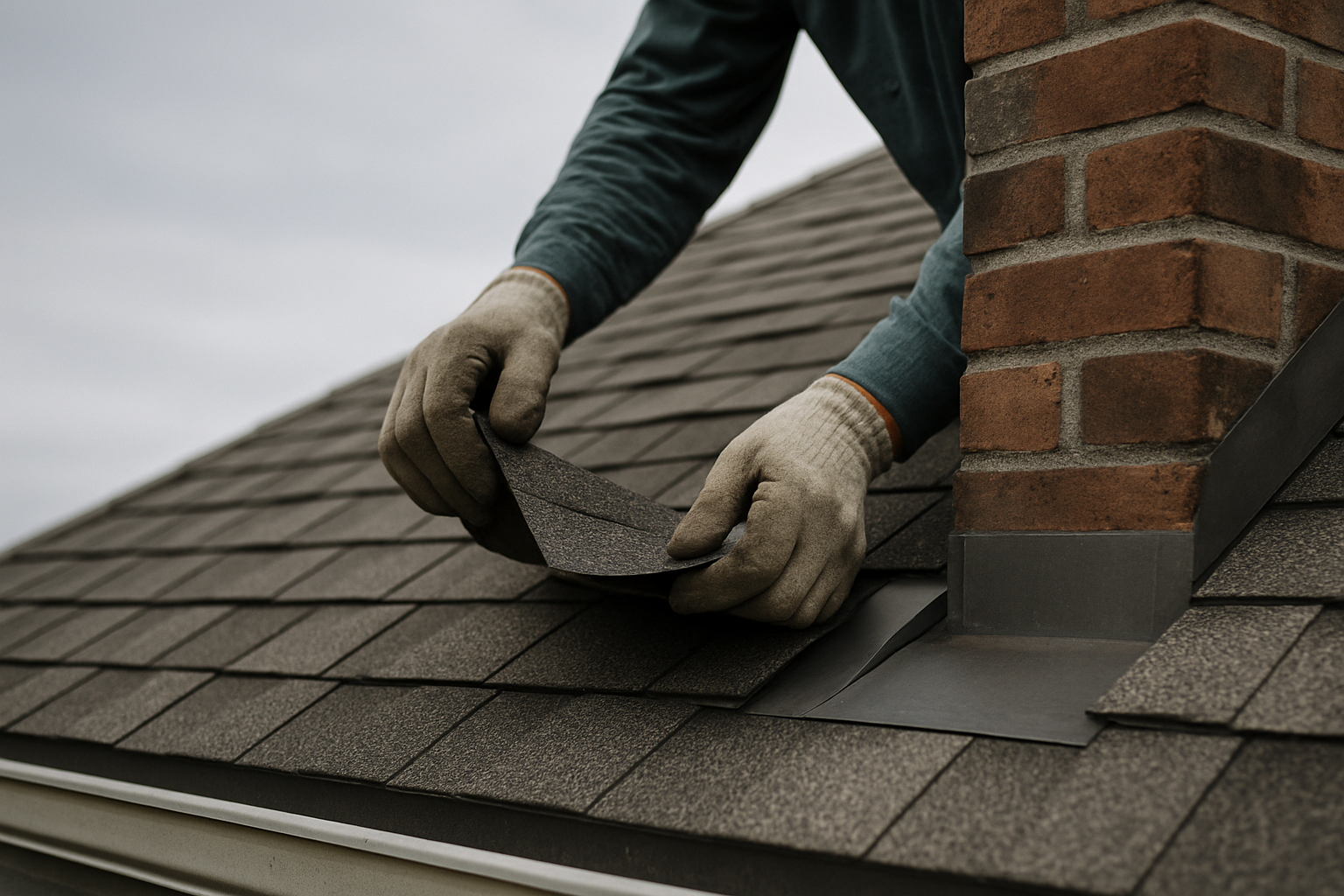
Wind damage roof repair in Atlantic County NJ fixes what nor'easter uplift leaves behind: creased or torn shingles, broken seal strips that no longer reseal, and flashing or edge metal that lets wind-driven rain under the roof. Repair replaces only damaged material; full replacement is the call when seal failure is widespread or decking is exposed.
Most storm-damage pages stop at the claim. This one is about the roof itself: what the wind did to the shingle, how to tell a repairable lift from a torn shingle that has to come out, and where wind-driven rain actually enters a coastal New Jersey roof.
Creased, lifted, and torn shingles are not the same repair
Wind does not damage every shingle the same way, and the repair decision changes with the failure mode. Missing shingles are obvious from the ground. The more expensive mistakes are the ones that look normal from a ladder: a lifted shingle with a broken seal strip, or a creased shingle that has been folded enough times to fatigue the mat.
| Failure mode | What it looks like | What actually failed | Repair action |
|---|---|---|---|
| Lifted shingle | Tab edge is no longer bonded; the shingle can be raised with light hand pressure | Factory adhesive seal strip has released | Resecure the tab mechanically or replace the shingle if it is creased or stretched |
| Creased shingle | A visible fold line or bent tab, usually without a full tear | The shingle mat has been flexed past recovery | Replace the individual shingle |
| Torn shingle | A split or missing tab, often at the nail line or along a fold | The material has torn from repeated uplift | Replace the shingle and inspect the underlayment beneath it |
| Missing shingle | Bare exposure where a tab used to be | The shingle tore away, often leaving fastener points exposed | Replace the shingle and check the deck, underlayment, and adjacent tabs |
A lifted shingle is the only mode on that table that is sometimes a repair rather than a replacement. The reference material on this site puts it plainly: the factory adhesive seal along the shingle's lower edge activates once from sun exposure and does not activate again. A shingle that has been lifted and dropped back down is a loose flap held only by its nails. It will not reseal itself.
That is why wind uplift shingle seal failure is the failure mode adjusters and homeowners both miss most often. The shingle is still on the roof, still the right color, and still roughly where it belongs. But every subsequent gust can get under it. Once a corner lifts, wind-driven rain works underneath and levers the shingle further, which widens the failure and lets water reach the underlayment or deck.
Wind uplift and the one-time seal strip
Wind uplift is not simply wind blowing across the roof surface. Uplift is the pressure difference created when moving air passes over a roof and lowers the pressure above the shingle tabs relative to the air trapped beneath them. On a roof with intact seal strips, the shingle assembly resists that lifting force as a connected surface. When a seal strip releases, the shingle becomes an individual tab, and the wind can work it like a lever.
The seal strip matters more than most homeowners assume. The adhesive is heat-activated during the first warm days after installation, bonding the underside of one shingle to the top of the course below. It is a one-time mechanical and adhesive connection. Once it breaks, it does not re-bond on its own, and a shingle that has been lifted for any length of time has likely also been flexed at the nail line.
Shingle wind-resistance ratings are useful, but they are not a coastal guarantee. A manufacturer's wind-resistance classification is a laboratory uplift benchmark. It assumes an intact seal strip, correct nail placement, correct nail count, and a sound deck. In Atlantic County, the real-world condition is different: a nor'easter can hold the same elevation of the same house under load for two or three days. The reference material on this site states that a shingle that would survive a brief gust can fail after forty hours of continuous lifting force working the same adhesive seal.
For a homeowner, that means the wind rating only matters if the installation matches the manufacturer's high-wind instructions for the exposure at the specific address. The right nail pattern, the right nail type, and a clean seal course are part of the wind-resistance system. A high-wind-rated shingle nailed high, underdriven, or installed over debris does not perform to its rating.
Where nor'easter wind-driven rain actually gets in
Nor'easter roof damage in NJ tends to follow the same few entry paths. Wind-driven rain is not the same as ordinary rainfall. It is rain moving nearly horizontally, driven into joints, overlaps, and flashing laps that would shed normal rain without leaking.
Rake edges
The rake edge is the sloped edge of the roof that runs from eave to ridge. Wind hits it from the side and gets under the outer shingle overhang. Once a rake shingle lifts, every gust drives water underneath and peels the shingle back toward the field of the roof. Repair usually involves resecuring or replacing the lifted rake shingles and checking the rake metal and drip edge for wind damage.
Ridge
The ridge is the highest horizontal line of the roof, and it takes more sustained wind than almost any other detail. Wind-driven rain can be pushed under ridge caps and into the laps where ridge shingles meet field shingles. Repair includes resetting or replacing ridge caps, checking the ridge course, and confirming that ridge ventilation is still correctly fastened.
Eaves
The eave is where the roof drains, but in a wind-driven storm it is also where horizontal rain can be driven back up under the starter course and the first course of shingles. A lifted starter strip or a loose drip edge lets water enter at the lowest, most visible part of the roof. Repair focuses on the starter course, drip edge, and underlayment at the eave line.
Flashing
Flashing is the most common wind-driven rain entry point after the shingles themselves. Step and counter flashing at sidewalls, chimney flashing, valley metal, and pipe boots are all laps, and wind-driven rain is designed to find laps. Coastal salt air compounds the problem by corroding thin flashing metal and fastener heads, so repairs on the barrier islands often involve replacing rusted metal rather than correcting an installation error. Where wind has opened a flashing lap, the repair is covered by the same discipline as any other leak: find the actual source instead of patching the stain. The companion page on roof flashing repair in Atlantic County NJ walks through chimney, valley, and pipe boot diagnosis in more detail.
Roof wind damage inspection in Atlantic County
A roof wind damage inspection Atlantic County has to be more than a walk around the yard with binoculars. Uplift damage is invisible from the ground. The inspection needs to get onto the roof or to the eaves and test the seal course, look at the rake and ridge laps, and document what is actually loose.
A useful wind damage inspection covers:
- Seal strips along the lower edges of field shingles, tested by hand where safe
- Rake and ridge shingles for lifted laps and exposed fasteners
- Flashing laps at sidewalls, chimneys, valleys, and pipe boots
- Drip edge and rake metal for wind deflection or corrosion
- The starter course at the eaves
- The deck and underlayment wherever a shingle is missing or a leak has already reached the interior
- The attic side of the roof, where daylight, water staining, or wind-driven debris may show entry points
The inspection should produce photos of the actual conditions, not stock photos. HappyRoof states that its inspections include real photos of the homeowner's own roof and an honest remaining-life assessment even when the answer is that no replacement is needed. That distinction matters after a storm, because a wind event can expose damage that has nothing to do with the storm, or it can reveal that a roof near the end of its life simply failed early.
Emergency tarping before wind repair
Emergency tarping before wind repair is not a repair. It is a temporary closure that stops water and wind from turning a damaged roof into a damaged ceiling, insulation, and wall cavity while the actual repair is scheduled, documented, and approved.
Tarping is appropriate when the roof is open enough to admit water: missing shingles over living space, a torn section of deck, a lifted field of shingles, or a flashing lap that is allowing wind-driven rain into the house. The tarp is secured to prevent wind from getting under it, because a poorly secured tarp becomes a sail and can do more damage than the original opening.
The sequence matters. If the roof is actively leaking, temporary protection should come before non-emergency repairs. HappyRoof lists emergency tarping as part of its storm and wind damage response. The storm damage page also states same-day service, but the site's contact hours are Monday through Saturday, 7:00 AM to 7:00 PM, with emergency tarping handled outside those hours. That is not a guaranteed response time, and it is not a 24/7 service claim; it is the company's stated service window.
Tarping also supports the insurance file. Photograph the roof before tarping, photograph the tarped area after, and keep a record of when the opening was covered. That timeline is part of the documentation that shows the homeowner took reasonable steps to prevent further damage.
Documentation needed for insurance before repair
This page is about the physical repair, not the claim, but the two are connected. A repair done before the damage is documented can make the claim harder to settle. The insurer needs to see what the wind did, not what the roofer already fixed.
Before non-emergency wind repair begins, the homeowner should have:
- Date-stamped photos of the exterior damage from multiple angles
- Close-up photos of lifted tabs, creased shingles, missing shingles, and opened flashing laps
- Photos of the same areas from the ground and from the roof where safe
- Interior photos of any ceiling stains, wet insulation, or water entry
- The insurance claim number and adjuster contact, if a claim has been opened
- An itemized written repair estimate that separates storm damage from pre-existing conditions
Keep damaged materials until the claim is settled. A torn shingle, a corroded flashing section, or a lifted tab can be evidence of the failure mode, and the adjuster may want to see it before it goes into the dump trailer.
The detailed claim process is covered in the companion article on New Jersey roof storm damage insurance claims, including documentation, deductibles, and adjuster meetings. One legal line is worth repeating here because it comes up after every storm: New Jersey law does not allow a contractor to absorb or waive a homeowner's deductible. Any contractor offering to "handle" the deductible is inviting the homeowner into a problem, not solving one.
Repair or full replacement after a wind event
The repair-versus-replacement decision after wind damage is a threshold question, not a preference. A handful of lifted shingles on an otherwise sound roof is a repair. A roof where the seal course has failed across most of the field is a different situation.
Repair is usually the right call when:
- The damage is isolated to a few shingles, one rake, one flashing lap, or one pipe boot
- The surrounding shingles still have a functioning seal course
- The deck and underlayment are dry and sound
- The roof has meaningful remaining life
- The failure was mechanical, not age-related
Replacement becomes the right conversation when:
- Seal failure is widespread across multiple slopes
- Wind has exposed decking or saturated the underlayment
- Creased or torn shingles cover a large percentage of the roof
- The roof was already near the end of its life before the storm
- The cost of repairing the damage approaches the cost of replacing the failing surface
The reference material on this site states that most roof repairs in Atlantic County fall between $400 and $1,800, with the low end covering accessible single-visit work such as resetting a handful of wind-lifted shingles. That is a general repair range, not a wind-damage quote. A quote requires an inspection of the specific roof.
The honest remaining-life question is the one that prevents a bad decision. HappyRoof's stated inspection position is that if the roof has ten good years left, the homeowner should hear that too. After a storm, that same discipline means not selling a full replacement for isolated wind damage, and not patching a roof that has already lost its seal course. When the threshold has clearly crossed into replacement, the page on asphalt shingle roof replacement in Atlantic County NJ covers wind ratings, nailing, and underlayment in the detail a coastal replacement should have.
How wind exposure changes from Margate to Galloway
Atlantic County is small enough to be served as one area, but wind exposure changes sharply within it. The same storm does not hit a bayfront house in Margate and an inland house in Galloway the same way.
On the barrier islands, the dominant failure mode is mechanical. Sustained ocean wind works at shingle edges until the factory adhesive strip lets go, and salt aerosol accelerates corrosion of fastener heads and thin flashing metal. The reference material on this site names Ventnor City, Margate City, Longport, Brigantine, and Atlantic City as places where repairs often involve metal that has rusted through rather than any installation error. A roof specified for a subdivision in central Jersey is not specified for a bayfront house in Margate, and the repair approach has to account for that.
Bayfront homes add another variable: wind-driven rain arriving across open water. The same wind speed feels different when the rain is moving horizontally across a bay and hitting one elevation of the house for hours. Bayfront and barrier-island repair work tends to be detail-heavy: rake laps, flashing laps, and ridge caps get more attention than they would inland. The bayfront and barrier-island specification guide covers that exposure in more detail.
Inland Galloway and Hammonton homes still get nor'easter wind, but the failure profile is different. There is less salt aerosol, so fastener and flashing corrosion is slower. The more common companion problem is organic: Pine Barrens leaf load, pine needles, and debris that hold moisture against the roof and gutters. Wind damage inland is more likely to be isolated to the windward rake, a lifted ridge course, or a tree-branch strike than to be a whole-roof seal failure. The repair threshold reflects that: inland homes more often justify a targeted repair, while barrier-island homes need a closer look at whether the seal course is failing across the whole elevation.
The repair process from inspection to magnet sweep
Wind repair is a sequence, not a single visit. Each step has a purpose, and skipping one step tends to show up later as a leak.
- Inspect and document. The roofer gets on the roof, tests the seal course, photographs the damage, and identifies every failure mode.
- Tarp if needed. If the roof is open or actively leaking, the damaged area is covered before water does more work inside.
- Write the repair scope. The estimate separates storm damage from pre-existing wear, lists what gets repaired, and identifies any areas where the deck or underlayment must be opened.
- Coordinate the claim. If a claim is open, the roofer's photos and written scope go to the adjuster before non-emergency work starts.
- Perform the repair. Shingles are resecured or replaced, flashing laps are reworked, corroded metal is replaced, and any wet underlayment or deck section is addressed.
- Check the surrounding seal course. The repaired area is only as good as the shingles around it. Adjacent tabs that lifted in the same event need to be caught now, not after the next storm.
- Clean up. The site is swept, including a magnet sweep for nails and fasteners, so the repair does not leave a puncture hazard in the yard or driveway.
- Final photos. The completed repair is photographed for the homeowner's records and, if applicable, the insurance file.
The crew that diagnoses the damage and the crew that repairs it should be the same people whenever possible. A repair handed from an inspector to a different crew loses the judgment that came from the roof walk, and the fix becomes a work order instead of a diagnosis.
What to have ready before you call
A wind damage repair call goes faster when the homeowner has a few things ready.
- Photos of the roof from the ground, especially any missing or lifted shingles
- The date and approximate time of the storm that caused the damage
- Any interior signs: ceiling stains, wet insulation, water in the attic
- The roof's approximate age and any known repair history
- The insurance claim number and adjuster contact, if a claim is open
- Access notes: locked gates, dogs, fragile landscaping, or roof sections that are unsafe to walk
None of that replaces the roofer's inspection, but it shortens the first call and helps the roofer bring the right material and safety equipment for the job.
Frequently asked questions about wind damage roof repair in Atlantic County
How do I tell creased, lifted, and torn shingles apart?
A lifted shingle is still intact but no longer bonded at the lower edge; you can raise the tab with light pressure. A creased shingle has a visible fold or bend line without a full tear. A torn shingle is split or missing material, often at the nail line. Lifted shingles can sometimes be resecured; creased and torn shingles are replaced.
Can a lifted shingle be resealed, or does it need replacing?
The factory adhesive strip activates once from sun exposure and does not reactivate. A lifted shingle will not reseal itself. If the shingle is intact and not creased or stretched, it can be mechanically resecured; if it is creased, torn, or fatigued at the nail line, it is replaced. The surrounding seal course is then checked so the repair does not leave a loose neighbor.
Does a nor'easter cause different roof damage than a hurricane?
Yes. A hurricane may pass through in hours, but a nor'easter can sit off the coast for two or three days, driving sustained onshore wind and rain into the same elevations without pause. That duration is what defeats seal strips. A shingle that would survive a brief gust can fail after forty hours of continuous lifting force working the same adhesive seal.
How soon should a wind-damaged roof be tarped?
If the roof is open or actively leaking, tarping should happen before non-emergency repairs. The purpose is to stop water and wind from turning roof damage into interior damage. The roof should be photographed before tarping, and the tarped area documented afterward, because that timeline supports the insurance file.
Will insurance cover wind damage roof repair in Atlantic County?
Many Atlantic County homeowner policies cover wind damage, but coverage depends on the policy, the cause, and the documentation. The homeowner should photograph the damage before repair, keep damaged materials, and coordinate with the adjuster. New Jersey law does not allow a contractor to absorb or waive the deductible.
When does wind damage mean a full roof replacement?
Replacement is the conversation when seal failure is widespread across multiple slopes, wind has exposed decking, or the roof was already near the end of its life. Isolated lifted or missing shingles on a roof with a sound seal course are usually a repair. The honest answer requires an inspection of the specific roof, not a count of missing tabs from the ground.
If your roof took wind during the last nor'easter and you want to know whether the seal course is still holding, start with a free inspection and photos of the actual damage before committing to a repair or a replacement.