Roofing Atlantic City NJ means specifying for sustained ocean wind, salt aerosol, and a housing stock full of low-slope rear sections. Wind lifts shingle edges and drives water underneath; salt corrodes fasteners and flashing early; flat membrane sections fail at seams and penetrations. Material, fastening, and flashing choices matter more here than almost anywhere else in the county.
Why roofing Atlantic City NJ fails differently
Atlantic City is a barrier island, and that single fact changes the roofing specification before you choose a material. The governing factors are sustained ocean wind, salt aerosol, and a housing stock that includes narrow attached and semi-attached buildings with low-slope rear sections. A roof that was specified for a subdivision in central Jersey is not specified for a house a few blocks from the ocean.
Wind uplift is the primary mechanical stressor. On the barrier islands, the dominant failure mode is mechanical rather than age-related: sustained ocean wind works at shingle edges until the factory adhesive strip lets go. Once a corner lifts, every subsequent gust drives water underneath and levers the shingle further. The failure is progressive. A small lifted corner becomes a larger peeled area over repeated nor'easters, and water that gets underneath moves sideways faster than the shingle above can shed it.
The distinction that matters for Atlantic City homeowners is that this is not only about peak storm gusts. Sustained wind matters more than a single gust because it keeps working the same edge for hours. Coastal wind also arrives from different directions across the year, so a roof can be tested on multiple exposures rather than one prevailing side. Corners, ridges, and rakes take negative pressure that pulls upward, while field shingles take a different load. A roof can look intact from the street and still be lifting at the windward corners where the next leak will start.
Salt air is the quiet second stressor. Salt aerosol corrodes fastener heads and thin flashing metal years ahead of the inland schedule. In Atlantic City, repair work often means replacing metal that has simply rusted through rather than correcting an installation error. The corrosion does not announce itself until a fastener head fails, a pipe boot splits, or a piece of step flashing opens a seam. By then, water has usually been entering for months.
Wind and salt compound each other. Wind lifts the edge; salt has already weakened the metal that was supposed to hold it down. A fastener with a corroded head has less clamp, and a shingle with less clamp releases its adhesive strip sooner.
Freeze-thaw cycling adds a third, slower stress. Coastal Atlantic County moves across the freezing line through the winter, and water that has worked into a seam or a fastener hole expands when it freezes. The cycle widens small openings into actual entry points.
That combination is why Atlantic City roofing work defaults to perimeter detailing, enhanced fastening, and corrosion-resistant metal. These are not upgrades for a premium job; they are the baseline for the environment.
Common Atlantic City roof types and their failure modes
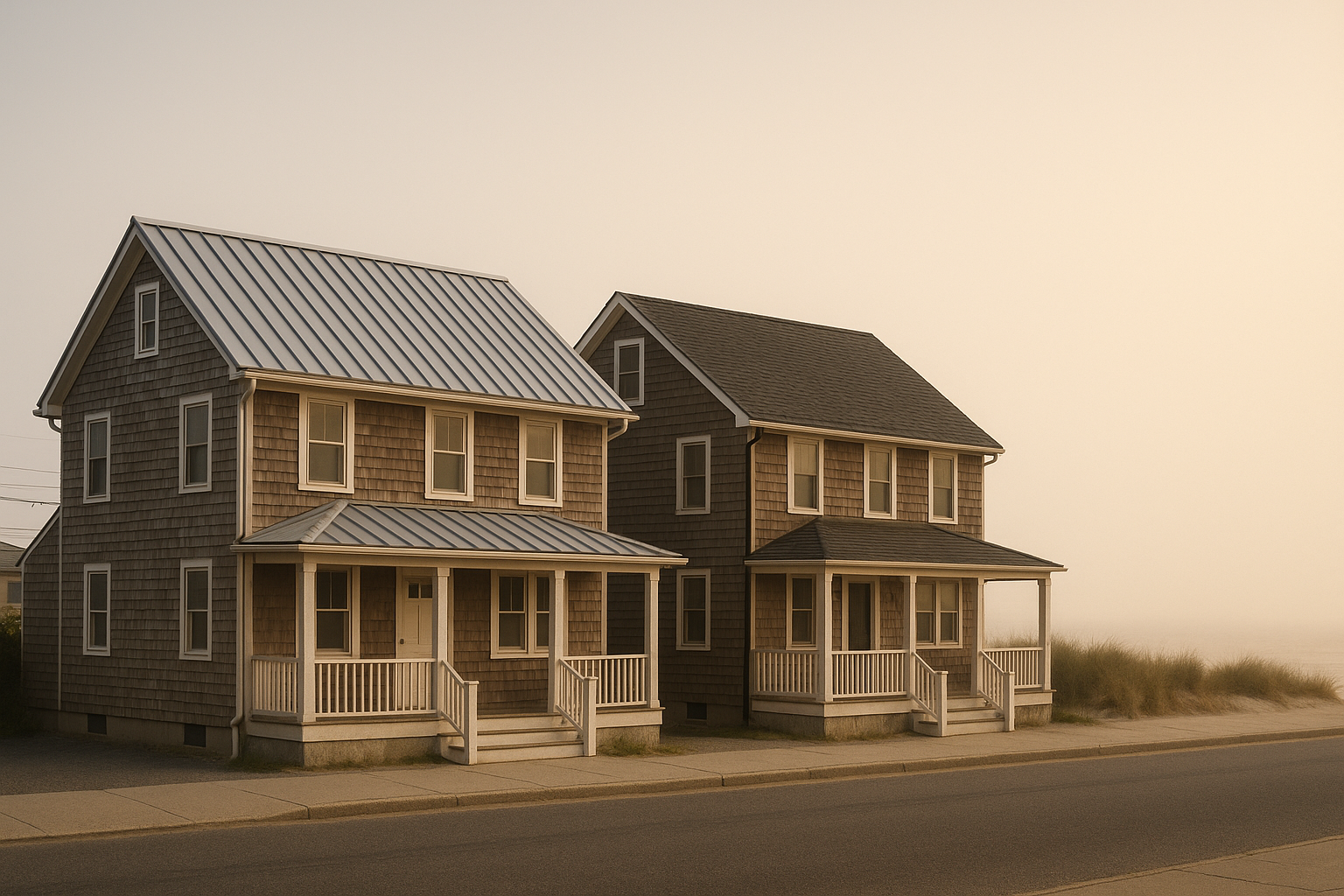
Atlantic City's residential stock is not one roof system. Many homes combine a pitched shingle roof on the front with a low-slope membrane section on a rear addition, bay, or porch. Attached and semi-attached rows share walls, which means the flashing between properties works harder than it does on a detached house, and a failure on one side can wet two homes.
| Roof type | Where it appears in Atlantic City | Primary coastal failure mode | What fails first |
|---|---|---|---|
| Pitched architectural asphalt shingles | Main roof planes on single-family homes and attached rows | Wind works shingle edges until the adhesive strip lets go, then drives water underneath | Lifted shingle corners, corroded fastener heads |
| Low-slope flat membrane | Rear additions, bays, porches, and top sections of attached buildings | Seams and penetrations open under wind and standing water | Perimeter flashing, seam details, pipe boots |
| Metal roofing | Coastal re-roofs where corrosion resistance is the priority | Corrosion at exposed fasteners and thin flashing | Fastener heads, flashing metal, panel laps |
| Flashing and penetrations (all systems) | Chimneys, party walls, valleys, pipe boots, drip edges | Salt aerosol rusts thin metal through; wind works lifted flashing | Step and counter flashing, valley metal, drip edge |
Pitched asphalt shingle roofs are the most common system in Atlantic City and across the county. The reason is straightforward: wind-rated architectural shingle lines handle coastal exposure well for the price. The failure mode to watch is mechanical. The shingle field rarely wears out first; the edges lift, the adhesive strip releases, and wind-driven rain finds the underlayment. A roof that looks intact from the street can be quietly peeling at the windward corners, and by the time the leak is visible inside, the damage has usually spread beyond a single shingle.
Low-slope flat membrane sections are the part of the Atlantic City housing stock people forget about until they leak. Many narrow attached and semi-attached buildings carry low-slope rear sections that cannot drain like a pitched roof. Membrane systems fail at the details: seams, penetrations, and the perimeter where the membrane meets a wall or a shingle slope. In a coastal exposure, the wind tests those details every season. The specification for these sections is a membrane system with correctly detailed terminations, not a leftover patch. For more on these sections, see low-slope and flat roof repair for shore and addition roofs in Atlantic County.
Metal roofing appears on Atlantic City homes where corrosion resistance is the deciding factor. Corrosion-resistant metal earns its keep here, but only if the fasteners and flashing are equally corrosion-resistant. An exposed-fastener panel roof with inland-grade fasteners will fail at the fasteners before the panels do. Standing seam systems conceal the fasteners, which removes the most predictable corrosion point.
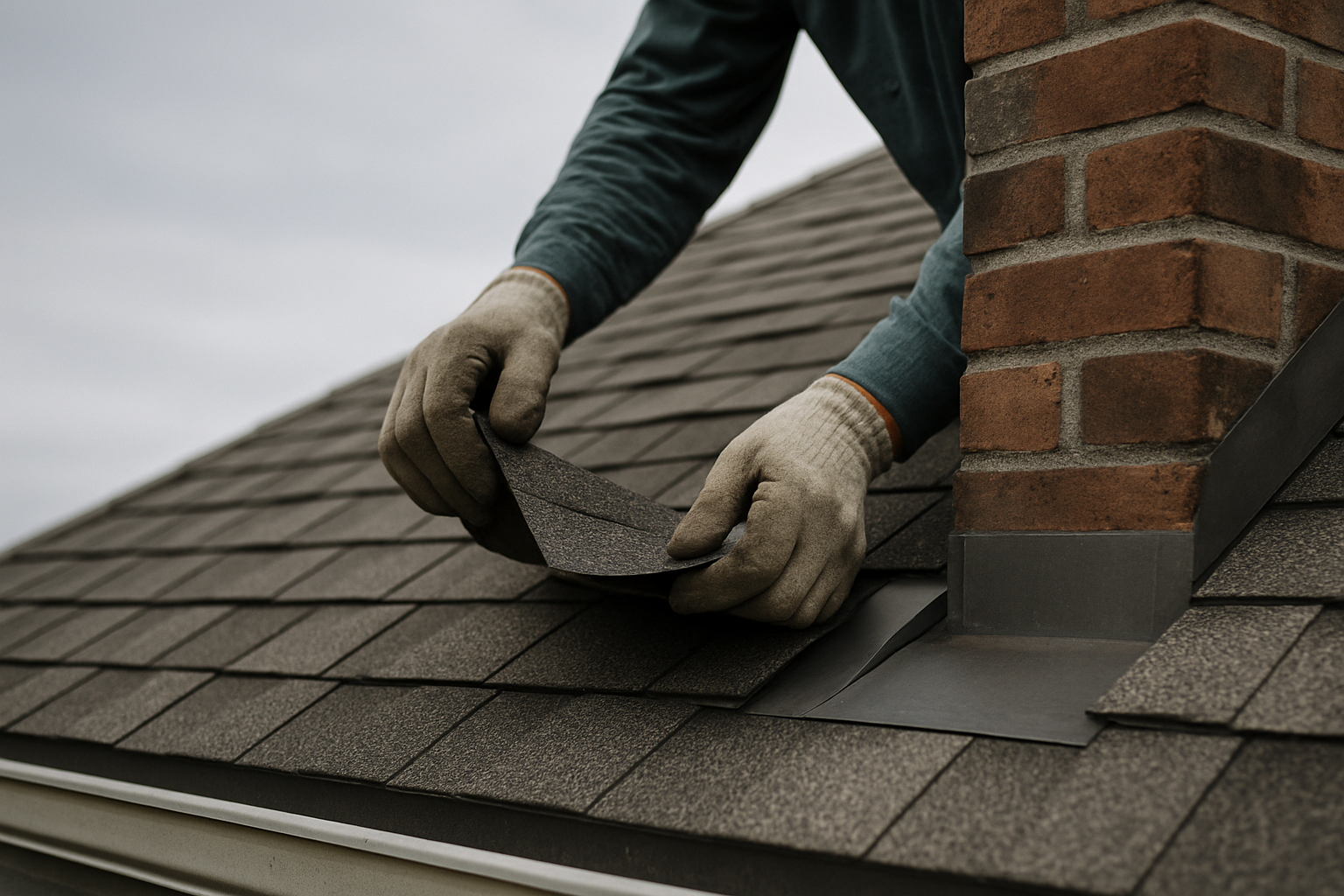
Flashing and penetrations are the shared weak link across every system above. Step and counter flashing, valley metal, pipe boots, and drip edge are all thin metal exposed to salt aerosol. In Atlantic City, a common repair call is not a missing shingle but flashing that has rusted through. That is why coastal roof repair in Atlantic City often means replacing the metal, not patching the stain below it. See roof flashing repair in Atlantic County for chimney, valley, and pipe boot leak diagnosis.
Material choices for roofing near ocean NJ
Near-ocean material selection is a decision about two properties: wind resistance and corrosion resistance. Price, appearance, and lifespan all follow from those two.
Architectural asphalt shingles. For an average Atlantic County home, most complete asphalt replacements cost between $9,000 and $25,000. The spread tracks square footage, roof pitch, the number of stories, valleys and penetrations, how much decking needs replacing, and whether the old roof is one layer or two. That range is the general guidance roof replacement Atlantic City NJ homeowners should use as a starting point, not a quote. The reason architectural shingles dominate is the price-to-performance ratio, and the wind-rated lines are what belong on an Atlantic City exposure. The specification has to go beyond the shingle itself: enhanced fastening, underlayment, ice-and-water shield at eaves and valleys, and perimeter detailing determine whether the wind-rated shingle actually performs. For the full specification, see the asphalt shingle roof replacement guide for Atlantic County.
Standing seam metal. Corrosion-resistant metal is the strongest answer to salt aerosol because it removes the exposed fastener that most commonly corrodes. Standing seam systems also handle wind better than exposed-fastener panels because the panel-to-panel connection is continuous and the fasteners are concealed. Metal is not automatically the right choice for every Atlantic City roof. Low-slope rear sections and the complex geometry of attached rows can make a membrane more practical. But for an exposed, steep, windward roof plane, metal is the material that best matches the environment. See standing seam and exposed-fastener metal roofing in Atlantic County.
Flat membrane. The low-slope sections need a membrane system specified for the wind and salt exposure. The key decisions are the membrane type, the seam method, and how the perimeter and penetrations are terminated. A correctly detailed membrane will still be compromised if the perimeter metal is not corrosion-resistant, because the flashing is where salt aerosol concentrates.
The comparison that matters. For most Atlantic City homeowners, the real decision is metal versus wind-rated architectural asphalt on the pitched sections, with a correctly detailed membrane on the low-slope sections. Wind-resistant roofing in Atlantic County is a specification, not a single product line. See standing seam metal vs. architectural asphalt shingles for South Jersey coastal homes.
Whatever the system, the material warranty belongs to the manufacturer. HappyRoof installs to manufacturer-certified standards, but the warranty document is the manufacturer's, not a roofing contractor's promise.
| System | Best fit in Atlantic City | Coastal risk it addresses | What the spec must include |
|---|---|---|---|
| Wind-rated architectural asphalt | Pitched main roofs on most homes | Wind uplift on shingle edges | Enhanced fastening, underlayment, ice-and-water shield, perimeter detailing |
| Standing seam metal | Exposed, windward roof planes | Salt corrosion of fasteners and flashing | Corrosion-resistant panels, concealed fasteners, compatible flashing |
| Flat membrane | Low-slope rear sections and additions | Wind at seams and penetrations | Correctly detailed terminations, corrosion-resistant perimeter metal |
Flood zones and permitting in Atlantic City: what to verify
Flood-zone status in Atlantic City is a mapping and building-code question, not a roofing opinion. Whether your block falls in a flood zone, and what that means for a roof project, is determined by FEMA mapping, the city construction office, and the specifics of your building, not by a contractor who has not seen your property records.
Before you sign a roof replacement contract, verify these four items:
- Your flood zone designation and elevation documents. If you have an elevation certificate or a flood insurance declarations page, have it ready. The city construction office can confirm the current designation for your property. Do not rely on a verbal statement from a salesperson.
- Whether the project requires a municipal permit. Permitting is local. Confirm with Atlantic City whether your scope requires a permit, and get the answer in writing in the proposal. The question to settle is not just whether a permit is required but who pulls it and who meets the municipal inspector.
- Whether the roof scope changes the building's elevation or enclosure. Some repair-and-replace scopes are like-for-like; others add insulation, change the deck, or alter the roofline. Ask the building official whether your scope triggers any flood-zone review. That is a question only the municipality can answer for your specific property.
- How a roof replacement interacts with your insurance. Confirm with your agent how the roof project affects your policy, and get any deductible questions answered in writing before work starts.
The permitting workflow should be explicit in the written proposal. If the proposal does not state who pulls the permit and who meets the inspector, ask before work starts. A contractor that is vague about permitting on a coastal property is vague about the part of the job that protects you legally.
Storm damage and insurance documentation in Atlantic City
Atlantic City roofs take storm damage from two directions: nor'easters and hurricane remnants. The typical damage is wind-lifted shingles and reworked flashing, not a single catastrophic tear-off. That pattern matters for insurance because the damage is often incremental and easy to mischaracterize if it is not documented.
The documentation workflow, in order:
- Protect the building first. Emergency tarping stops water from entering while you assess the damage. HappyRoof provides emergency tarping for storm events.
- Photograph before anything moves. Document lifted shingles, exposed underlayment, displaced flashing, and any interior staining before repairs or cleanup disturb the evidence. The photos are what tie the damage to the event.
- Report the claim promptly. Delays create questions about whether the damage predated the storm. Report, then get the inspection scheduled.
- Get an itemized written scope. A scope that lists the damaged sections, the repair or replacement approach, and the coastal-appropriate materials gives the adjuster something concrete to review.
- Meet the adjuster with documentation. HappyRoof provides insurance claim help, including documentation of the roof condition, so the claim can be reviewed against what was actually found.
Two Atlantic City cautions. First, treat any offer to absorb or waive a deductible as a warning sign. Second, after a major storm, out-of-area crews appear quickly. A local Atlantic County contractor is easier to hold accountable than a crew that leaves the county after the next storm. For the full claim workflow, see New Jersey roof storm damage insurance claims.
What an Atlantic City roof inspection includes
The inspection is the part of the process that should come before any decision about repair or replacement, and it should be free, photographed, and honest about remaining life.
HappyRoof's process:
- Schedule the free inspection. Call (609) 525-4521. The inspection is free and comes with photos of what is actually found.
- The inspector walks the roof and documents it. The inspection is documented with photos of what is actually up there.
- You get the photos and an honest assessment. If the roof has ten good years left, you hear that, and you keep the report. If it needs a repair, you get a repair scope. If it needs replacement, you get an itemized written proposal before anyone picks up a nail gun.
- The proposal specifies for Atlantic City. For a replacement, the written proposal should address wind-rated material, enhanced fastening, corrosion-resistant flashing, and the low-slope sections, not a generic spec.
- Permitting and access are settled in writing. On Atlantic City's attached and semi-attached rows, access planning matters because there is often no driveway to stage from. The proposal and schedule should account for how materials get to the roof and how the property is protected.
An Atlantic City roof inspection should feel like a diagnostic, not a sales call. The point is to find the actual source of any problem instead of patching a stain, and to tell you the truth about whether the roof needs work at all.
What's included and what's not
Included in HappyRoof's Atlantic City work:
- Free roof inspection with photos of what is actually found
- Itemized written pricing before work starts
- Roof replacement
- Roof repair for leaks, missing shingles, and failed flashing
- Storm and wind damage repair with emergency tarping
- Insurance claim help and documentation
Not included, and worth saying plainly:
- HappyRoof provides insurance claim help, but the claim is yours.
- A binding price for your home requires an inspection. The $9,000 to $25,000 Atlantic County range is general guidance, not a quote for your square footage and pitch.
- Material warranties belong to the manufacturer. HappyRoof installs to manufacturer-certified standards, but the warranty document is the manufacturer's.
Scheduling and lead times: what drives them
HappyRoof does not publish a fixed lead time for Atlantic City work because the honest answer depends on four things.
Weather windows. Coastal roofing is weather-dependent. A tear-off cannot be left open overnight if rain is forecast, so crews schedule around windows rather than dates. Barrier island wind also limits when materials can safely be staged and hoisted.
Access and staging. Many Atlantic City properties have no driveway to stage from. The plan for getting materials to the roof, through a shared walkway, over a neighboring property with permission, or by street staging under the city's rules, affects how long setup takes.
Permit approval. If the scope requires a municipal permit, the schedule includes the city's review and inspection timeline, which is outside the contractor's control.
Material availability. Wind-rated shingle lines, corrosion-resistant flashing, and membrane materials are specified products, not off-the-shelf stock. Availability and delivery affect the start date.
The practical takeaway is to ask for a schedule expressed as a sequence, such as tarp, tear-off, dry-in, roof, trim, and cleanup, rather than a single promised day. A contractor who gives a hard date without asking about access, permits, and weather is guessing. HappyRoof provides itemized written pricing and a clear scope before work starts, so the schedule is attached to a real plan rather than a sales promise.
What to have ready before you call
The more you can tell the inspector up front, the more useful the first visit is. For an Atlantic City property, gather:
- Roof description. Pitched shingle front with a low-slope rear section? Metal? One story or two? Note any flat or nearly flat areas.
- Access constraints. Whether there is a driveway, alley, or shared walkway for staging. Many Atlantic City properties have no driveway to stage from, so knowing this in advance shapes the plan.
- Leak history. Where stains appear inside, when they appear, and what the weather was doing at the time.
- Photos of past damage. Any prior storm photos, tarp photos, or interior stains.
- Insurance information. Policy and deductible details if you are considering a claim, plus any prior claim history on the roof.
- Flood or elevation documents. If you have an elevation certificate or flood declarations page, have it available for the permitting conversation.
- Shared-wall notes. For attached and semi-attached homes, note where your roof meets a neighbor's, because flashing at party walls is a common Atlantic City leak point.
Service area: Atlantic County, with Atlantic City specifics
HappyRoof serves every town in Atlantic County, 22 towns in all. On the barrier islands, that includes Atlantic City, Ventnor City, Margate City, Longport, and Brigantine. Emergency tarping is available for storm events.
This page is specific to Atlantic City because the specification is specific. Atlantic City combines sustained wind, salt aerosol, and an older attached housing stock in a way that inland Atlantic County towns do not. A bayfront house in Margate has its own specification concerns, just as a Pine Barrens-adjacent property has a different set of drainage and leaf-load issues. The point of a local page is not to swap a city name into a template; it is to describe the roof environment that actually exists on that ground.
For Atlantic City homeowners, that environment means the material, fastening, and flashing decisions above are the ones that determine whether the roof reaches its expected life or fails early.
Frequently asked questions
Do I need a permit to replace a roof in Atlantic City?
Permitting is municipal, so confirm with the Atlantic City construction office whether your project requires one. The important written question is who pulls the permit and who meets the municipal inspector. A clear proposal states that before work starts rather than leaving it as an afterthought.
Which roofing material holds up best near the ocean in Atlantic City?
There is no single answer. Wind-rated architectural asphalt handles most pitched sections and is the most common choice. Corrosion-resistant standing seam metal suits exposed windward roof planes. Low-slope rear sections need a correctly detailed membrane. The weak link is usually flashing and fasteners, not the field material.
How does salt air damage an Atlantic City roof?
Salt aerosol corrodes fastener heads and thin flashing metal years ahead of schedule. In Atlantic City, repair work often means replacing metal that has rusted through rather than correcting an installation error. That is why coastal specifications favor corrosion-resistant flashing, fasteners, and metal accessories.
What should I do after a nor'easter lifts shingles in Atlantic City?
Prevent further water entry first with emergency tarping, then photograph the lifted shingles and any interior staining before anything is moved. File the claim promptly, get an itemized written scope, and have the adjuster review what the wind actually did.
How much does a roof replacement cost in Atlantic City?
For an average Atlantic County home, most complete architectural asphalt replacements fall between $9,000 and $25,000. The spread tracks square footage, pitch, stories, valleys and penetrations, decking replacement, and whether the old roof is one layer or two. A binding number requires an inspection and a written proposal.
Do you work on Atlantic City's attached and semi-attached homes?
Yes. Atlantic City's older stock includes narrow attached and semi-attached buildings with low-slope rear sections and limited staging. Access planning is part of the job because there is often no driveway.
Next step
Start with the free inspection. Call (609) 525-4521 to schedule an Atlantic City roof inspection with photos of your own roof, an honest remaining-life assessment, and a written price before anything starts, whether the answer is a repair, a replacement, or nothing at all.