For most Atlantic County homes, the architectural vs 3-tab shingles NJ decision favors architectural: it is the default here because wind-rated lines handle coastal exposure well and the price-to-performance ratio is hard to beat. 3-tab still has a narrow place on small, low-exposure sections or short ownership. Confirm wind ratings, service life, and warranty terms before choosing.
The decision is not which shingle costs less to install. It is which shingle survives the exposure of your specific street and delivers the lower cost per year over the time you actually hold the roof. Three numbers decide it: wind rating, installed cost, and cost per year of service life.
Architectural vs 3-tab shingles NJ: the comparison at a glance
| Attribute | 3-tab shingles | Architectural shingles |
|---|---|---|
| Construction | Single-layer mat with three cut tabs per strip | Laminated, dimensional profile with shadow lines |
| Appearance | Flat and uniform, repeating tab pattern | Dimensional and contoured, with shadow lines |
| Wind resistance | Confirm the specific product's wind class on the manufacturer's data sheet | Wind-rated lines specified for coastal exposure; still conditional on fastening |
| Service life | Confirm the specific product's rated service life | Confirm the specific product's rated service life |
| Warranty | Confirm terms and proration on the product warranty | Confirm terms and proration on the product warranty |
| Typical Atlantic County role | Small low-exposure sections, matching existing 3-tab, short ownership — if the specific product meets the exposure | Primary-home tear-off, exposed streets, barrier islands, long ownership |
Both products are asphalt shingle systems, and both sit on the same foundation of deck, underlayment, flashing, and fastening. Where a cell says "confirm," the reference material does not publish a county-wide figure for that attribute; the manufacturer's data sheet for the exact shingle is the figure to use. What the reference does support: architectural shingles are the default across Atlantic County because their wind-rated lines handle coastal exposure well. For 3-tab, the decision turns on the specific product you are pricing.
Wind rating: what the test class actually means
Shingle wind resistance is rated in classes that correspond to design wind speed. The class is a useful way to compare products on equal terms, but it is not a promise about a specific roof in Atlantic County.
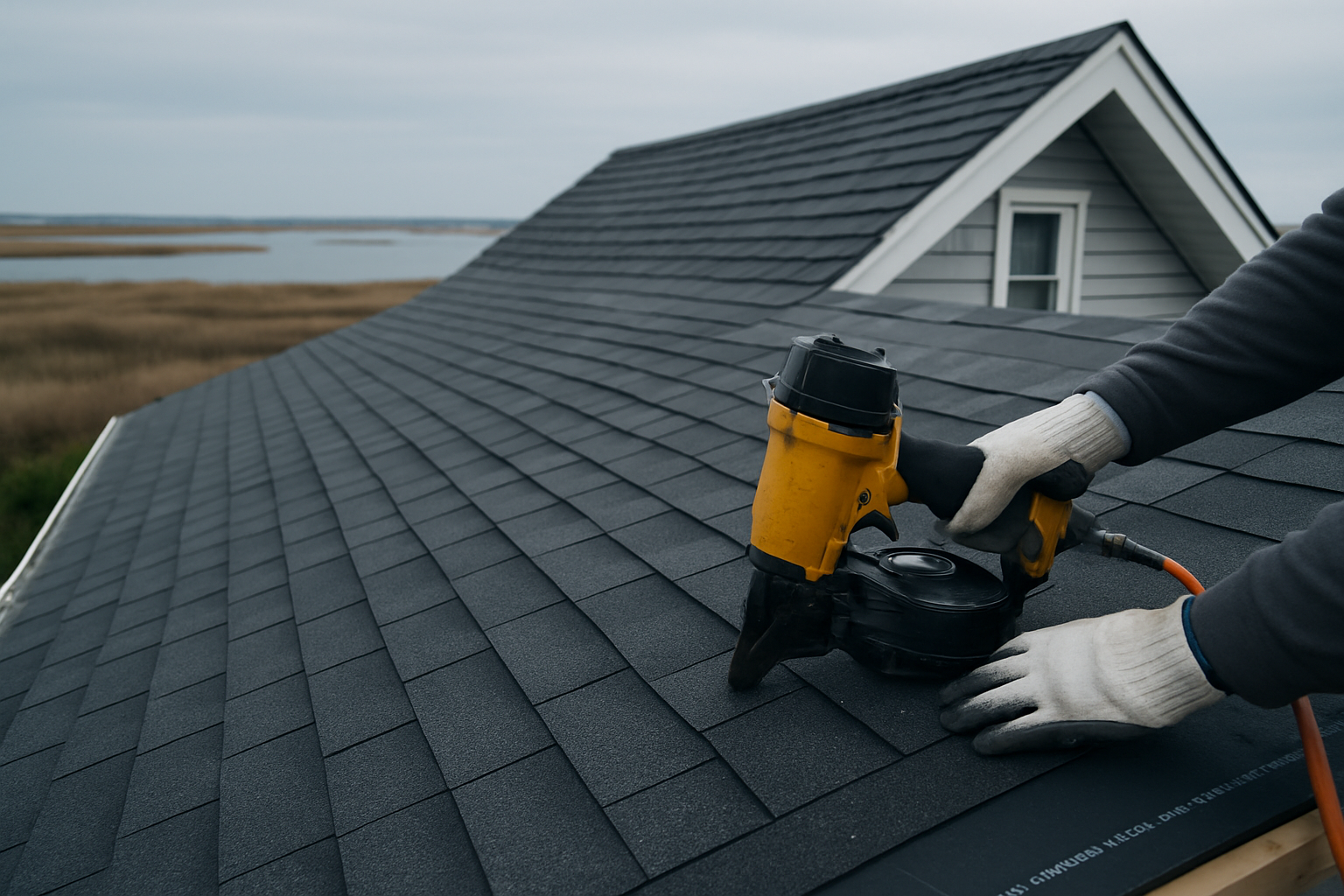
The rating is conditional. A shingle only achieves its rating when it is installed with the manufacturer's enhanced fastening pattern, driven in the specified nailing zone — not high, not low, and not overdriven through the mat. Get the nail placement wrong and the tested rating is void as a practical matter, whatever the wrapper says. That applies to a premium architectural shingle and a basic 3-tab in exactly the same way.
Duration is the variable homeowners miss. A nor'easter can drive sustained onshore wind and rain into the same elevations of the same houses for the whole storm. On the barrier islands, sustained wind is one of the governing factors, and HappyRoof's recent work includes wind-lifted shingles replaced and flashing reworked after a nor'easter. The practical rule: choose a wind-rated line matched to your street's exposure, and verify the fastening pattern in writing. The class number on the wrapper is a ceiling, not a guarantee.
What Atlantic County throws at a roof
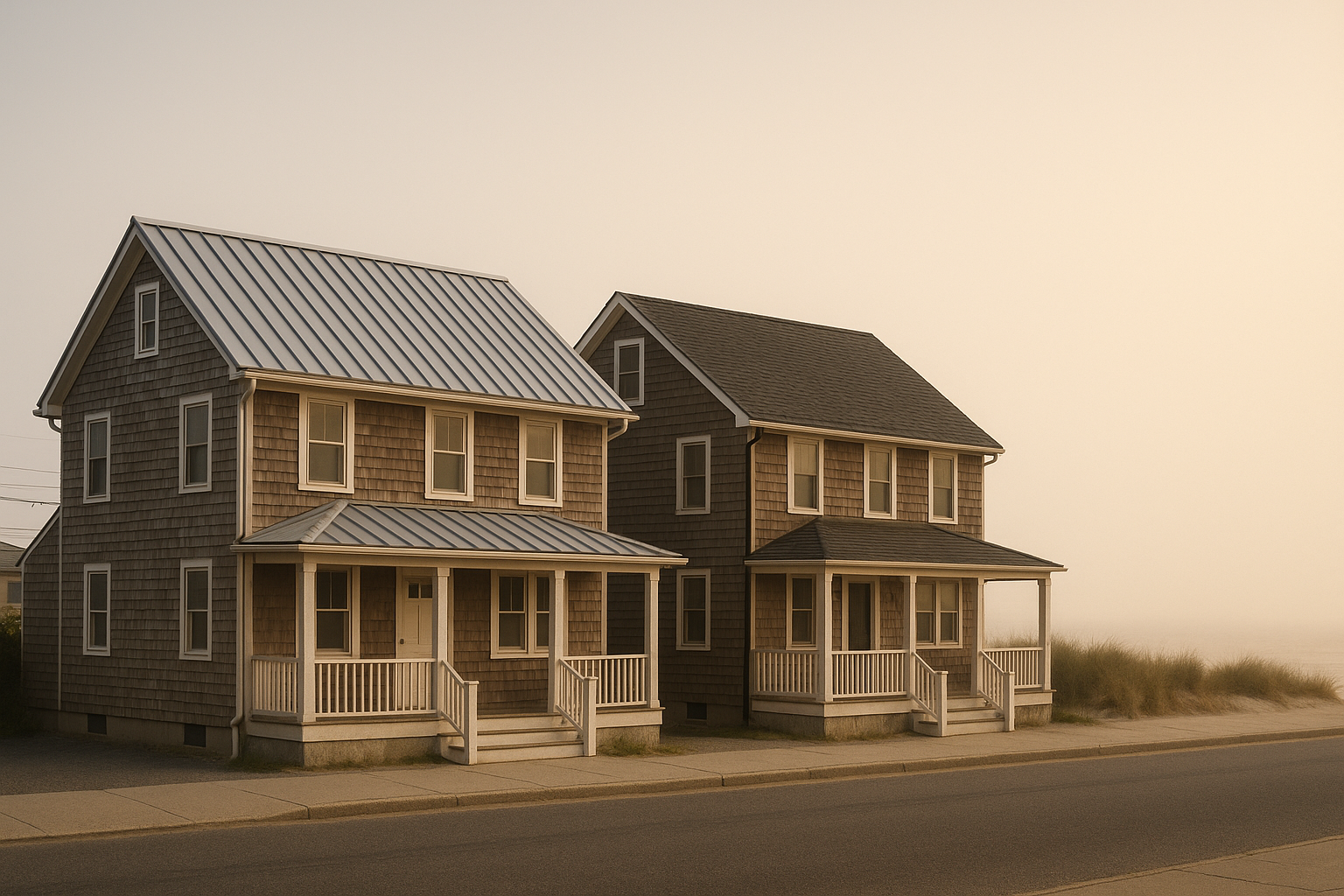
Atlantic County is three different roofing environments wearing one county name. On the barrier islands — Atlantic City, Ventnor City, Margate City, Longport, and Brigantine — the governing factors are sustained wind, salt aerosol, and a housing stock that includes a lot of narrow attached and semi-attached buildings with low-slope rear sections. Perimeter detailing, enhanced fastening, and corrosion-resistant metal earn their keep here, and access planning matters because there is often no driveway to stage from.
On the mainland, wind is less constant but still arrives with nor'easter season, and the governing concerns shift toward older housing stock, varying pitch, and the condition of the deck beneath the shingles. In the Pinelands, tree cover adds leaf and debris load that tests valley metal, drainage, and ridge ventilation.
For shingle selection, the takeaway is that "coastal" is not one condition. A roof specified for a sheltered inland subdivision is not the same specification as a bayfront house in Margate. The best shingles for coastal NJ wind are not a single brand — they are a system: a wind-rated architectural shingle matched to the street's exposure, fastened with the enhanced pattern, and detailed at the perimeter with corrosion-resistant metal. A shingle can be code-permitted on that same street and still be the wrong specification for what the street actually delivers.
Installed cost and why the per-square number hides the real price
The reference price range for Atlantic County is the honest one: most homeowners pay between $9,000 and $25,000 for a complete asphalt replacement. The spread is that wide because it tracks square footage, roof pitch, the number of stories, how many valleys and penetrations exist, how much decking needs replacing, and whether the old roof is one layer or two.
A per-square price only becomes meaningful once those variables are separated. A roofing square is 100 square feet of roof area. Two roofs of identical square count can price very differently: a steep two-story colonial with four valleys, a chimney, and rotted decking is a different job from a simple single-story ranch, even if both are "20 squares."
This is why the asphalt shingle cost per square in NJ is not a single number anyone should quote from a search result. The material tier is one line item. Tear-off and disposal, underlayment, ice-and-water shield, flashing, ventilation, and any decking replacement are separate line items. The stated practice at HappyRoof is written, itemized pricing that separates labor, materials, disposal, and the per-sheet rate for any decking replaced. That separation is the only way to compare two bids on the same terms.
Tear-off versus overlay changes the math further. An overlay means nailing new shingles directly over the existing ones; it is cheaper because nobody removes and hauls away the old roof, and some contractors push it hard for exactly that reason. New Jersey's adopted building code limits a roof to two layers of covering. Once a second layer is on, the next roof has to be a full tear-off no matter what, so an overlay does not avoid the cost of removal — it defers it and adds the weight of an extra layer to the bill.
For context, flat and low-slope sections — the porch and addition roofs common on older shore houses — often should not be shingled at all; they are specified as a separate system. When a roof has large low-slope areas, part of the shingle decision is deciding which sections should not be shingled.
Cost per year of service life: where the ranking flips
Installed price is one number. Cost per year of service life is the number that matters over a long ownership horizon. A modest difference in service life changes the arithmetic more than a modest difference in installed price — which is why you confirm the rated service life for each specific shingle before running the numbers.
| Installed cost | Serves 20 years | Serves 30 years | Serves 40 years |
|---|---|---|---|
| $9,000 | $450/yr | $300/yr | $225/yr |
| $25,000 | $1,250/yr | $833/yr | $625/yr |
The table uses the $9,000–$25,000 range Atlantic County homeowners typically pay for a complete asphalt replacement. The service-life columns are scenario markers for the arithmetic, not promises about any specific shingle. The point is the direction of the math: a lower installed price only wins if the roof reaches a comparable lifespan. When the cheaper roof fails earlier, the owner pays for two roofs instead of one — and the second roof is bought at future labor and disposal prices, not today's.
Warranty proration sharpens the same point. On a prorated warranty, the manufacturer's payout shrinks with roof age, so a failure late in life pays a fraction of the material cost and often nothing toward labor or tear-off. Transferability is the second lever: some warranties follow the house to a new owner, others end at sale. Confirm service life, proration, and transferability on the manufacturer's data sheet for the exact shingles you are comparing.
Where architectural shingles win
- Primary-home tear-offs in Atlantic County. This is the default case. The overwhelming majority of replacements here are architectural for the price-to-performance ratio and the coastal wind performance.
- Barrier-island and exposed-mainland streets. Wind-rated architectural lines matched to the street's exposure, with enhanced fastening and perimeter detailing, are the specification that handles sustained wind on the barrier islands.
- Long ownership horizons. The installed cost spreads over more years, and architectural is the default here because its wind-rated lines handle coastal exposure well.
- Resale-sensitive homes. A dimensional roof often matches buyer expectations in newer subdivisions and avoids the dated look of flat 3-tab.
Architectural shingles are not the cheapest first invoice. They are the county default for a reason: wind-rated lines handle coastal exposure well. For cost per year, run the arithmetic with the manufacturer's stated service life for the exact products you are comparing.
Where 3-tab shingles still win
- Matching an existing 3-tab roof. When a repair or a small section replacement must blend with surrounding 3-tab, a visual match can matter more than the upgrade — if the specific product's wind class meets the exposure.
- Small, low-exposure accessory structures. A shed, detached garage, or porch roof with a short expected life and low wind exposure is the classic place a basic 3-tab remains a reasonable budget choice.
- Short ownership with no resale concern. If the owner will not hold the property long enough to recoup a longer service life, the extra upfront cost buys value the next owner captures — though a buyer may discount a 3-tab roof at sale.
- A one-layer overlay to defer a full tear-off. Within the two-layer code cap, an overlay is cheaper in year one. It defers the tear-off and adds weight, so it is a cash-flow decision, not a performance decision.
The question is not whether a shingle is allowed, but whether it is specified for the exposure it will actually face.
Cost of getting it wrong
The expensive error in Atlantic County is putting a lower-specification shingle on an exposed street. The failure mode is predictable: after enough sustained onshore wind, tabs lift, the seal releases, and wind-driven rain gets under the field. The homeowner pays for a second replacement years early, plus interior repair, and the cost per year ends up far above what a wind-rated architectural roof would have cost. See the storm damage guidance on the blog for what to document first.
The smaller error runs the other way: paying for a wind-rated architectural roof on a low-exposure, short-life structure where the owner will never collect the service-life dividend. The waste is real but bounded — it is the difference between two material tiers on a small roof, not a second roof.
The silent error is the same for both shingle types: buying a wind-rated product and then having it nailed wrong. The manufacturer's enhanced fastening pattern, in the specified nailing zone — not high, not low, not overdriven through the mat — is what keeps the tested rating intact. A premium architectural shingle nailed like a budget job is a budget roof with a premium receipt.
What they have in common
- Both are asphalt shingle systems governed by the same New Jersey two-layer roof-covering limit.
- Both depend on the deck, underlayment, ice-and-water shield, flashing, and ventilation beneath them.
- Both achieve their wind rating only through correct fastening.
- Both require a municipal permit and township inspection when the job is a replacement.
- Both shed water the same way: lapped courses, sealed tabs, and gravity — which means both fail the same way when detail work is skipped.
The comparison is not good product versus bad product. It is two specifications with different margins for error, and Atlantic County's wind eats the margin.
Appearance, resale, and HOA considerations
3-tab reads as a mid-century roof. Its flat, repeating tab pattern is the look of older subdivisions and budget construction, and it does little to update a house at the curb. Architectural shingles read as current: the dimensional, contoured surface with shadow lines is what buyers expect to see on a renovated or newer home.
That perception can show up in resale. A flat 3-tab roof on an otherwise updated house can make the whole property read as dated, and a buyer pricing a near-term reroof may discount accordingly. In some newer subdivisions, an HOA may set a profile requirement; check yours before choosing, because it can remove 3-tab from the decision before cost is even discussed.
None of this means architectural wins on appearance alone. On a true mid-century house where the original 3-tab look is part of the character, or where an HOA has no architectural standard, the choice returns to wind rating and cost per year. The curb-appeal argument is strongest where the buyer pool is newest; the wind argument is strongest where the exposure is worst.
How HappyRoof approaches wind-rated installation
HappyRoof treats the shingle and the fastening as one system. The company says it selects wind-rated shingles and enhanced nailing patterns chosen for the exposure your specific street gets — not a one-size-fits-all coastal package. That matters because a shingle's wind class only survives contact with the roof if the nail pattern matches the manufacturer's specification.
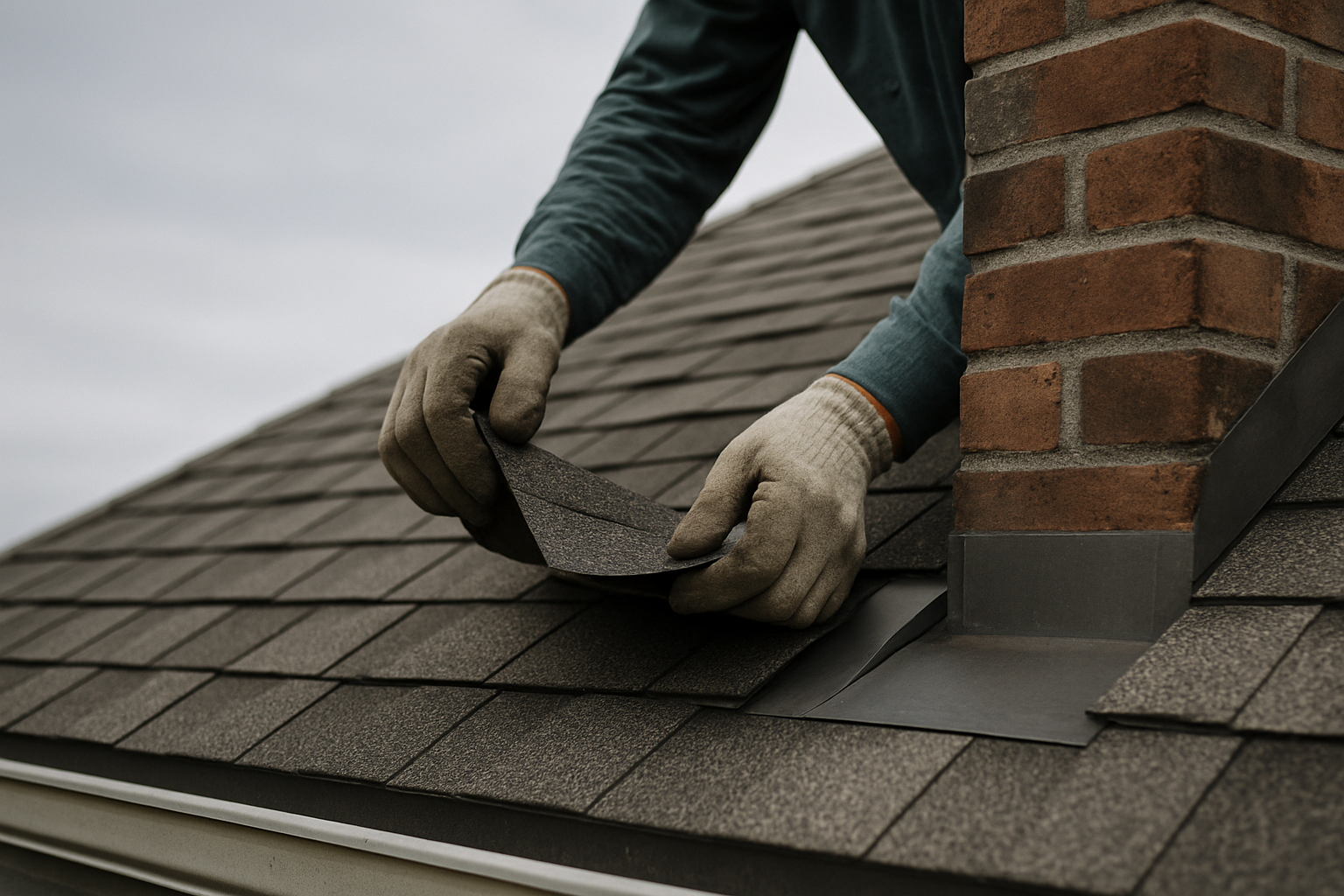
The rest of the process supports the same idea: full tear-off to the bare deck so every square foot of sheathing gets inspected before new material goes down; manufacturer-certified installation so the shingle warranty stays valid; a municipal permit pulled and the township inspection scheduled as part of the job; and full-property cleanup including a magnet sweep for stray nails.
Before any of that, HappyRoof offers a free inspection with real photos of your own roof and an honest answer on whether it needs replacing. The company's stated position is that if you have ten good years left, you will hear that too. For a homeowner deciding between architectural and 3-tab, that inspection is the point where the street's exposure gets matched to the specification. Call (609) 525-4521 to start with the inspection rather than the shingle.
Frequently asked questions
Which is the better choice in Atlantic County: architectural or 3-tab shingles?
For most primary homes, architectural. It is the default across Atlantic County, and its wind-rated lines handle coastal exposure well. 3-tab can still fit a small, low-exposure section, matching an existing 3-tab roof, or short ownership — but confirm the specific product's wind class, service life, and warranty before you choose.
What wind rating should I look for in a New Jersey coastal roof?
Chase the installation, not just the class number. A shingle only reaches its tested wind rating when fastened with the manufacturer's enhanced pattern in the specified nailing zone. On barrier-island streets, choose a wind-rated architectural line matched to your specific exposure and confirm perimeter detailing with corrosion-resistant metal.
Does New Jersey's two-layer rule affect the architectural vs 3-tab choice?
Yes. The adopted building code limits a roof to two layers of covering, so an overlay defers a full tear-off rather than avoiding it, and it adds the weight of an extra layer. That limit applies to any shingle type. The larger point is that code-permitted is not the same as correctly specified for your street's wind exposure.
How much more does architectural shingle cost than 3-tab in Atlantic County?
There is no published per-type split, because the total is driven by square footage, pitch, stories, penetrations, decking replacement, and whether the old roof is one layer or two. Most Atlantic County homeowners pay $9,000 to $25,000 for a complete asphalt replacement. An itemized quote is the only honest way to see the material delta.
Does architectural shingle actually cost less per year?
It depends on the service life each specific product achieves, and that figure comes from the manufacturer's data sheet. The arithmetic: a $9,000 replacement that serves 30 years costs $300 per year; the same roof failing at 20 years costs $450 per year. At the $25,000 top of the published range, the numbers are $833 and $1,250. Run the same math with the manufacturer's stated service life for the exact shingles you are comparing.
Do architectural shingles help with resale or HOA approval?
They usually match what buyers expect in newer subdivisions and what some HOAs specify for a dimensional look. A flat 3-tab roof can make an otherwise updated house read as dated. Warranty transferability matters too: a warranty that follows the next owner changes the resale arithmetic as much as appearance — so confirm the transfer terms before you buy.