Emergency roof tarping is temporary weatherproofing over storm-damaged roof sections to stop water entering the home until permanent repair is scheduled. In Atlantic County, NJ, it is usually the right first step after wind or impact damage: it protects the interior, preserves the damage scene for the adjuster, and meets the policyholder's duty to prevent further loss.
What emergency roof tarping is and who it is for
Emergency roof tarping is a temporary roof cover installed over the damaged section of a roof after a storm, a falling limb, or another event has opened the roof to water. The tarp is secured over the damaged slope, ridge, valley, or eave so wind-driven rain cannot reach the deck, insulation, and interior while the claim is documented and a permanent repair is scheduled. It is a temporary roof repair in the strict sense of the term: it restores weather-tightness for a defined window, not for the life of the roof.
The service is for Atlantic County homeowners who have an active leak or an open roof section after a nor'easter, a coastal squall, or a wind event. It is not for cosmetic damage. If water is coming in, if shingles are missing over a large area, or if the deck is exposed anywhere, tarping is the mitigation step that comes before permanent roof repair or roof replacement. It is also the step an insurance policy expects: the policyholder has a duty to prevent further damage once the loss is known.
Understanding the boundary matters because it changes what a homeowner asks for. A homeowner who calls for a patch when a slope is open gets the wrong tool. A homeowner who calls for tarping when a single pipe boot is torn may get more than the job requires. The rest of this page draws those lines.
When tarping is the right call — and when it is not
Tarping is appropriate when the roof plane is compromised over an area too large or too structurally exposed for a spot patch. The clearest cases:
- Wind has lifted or torn away a field of shingles and the underlayment or deck is visible.
- A falling branch has punctured the roof and water is entering.
- A ridge or eave is opened and wind-driven rain can get under the remaining roof cover.
- The claim will take days or weeks and the roof cannot be permanently repaired immediately.
- Interior water is already staining ceilings or walls and must be stopped before it spreads.
Temporary sealant is a different tool with a narrow job. A roof cement or sealant patch can be appropriate for a small, isolated opening — a torn pipe boot, a few lifted shingles that can be re-adhered, or a small puncture — where the deck is not exposed and the area can be cleaned and dried. Sealant is not a substitute for tarping when the damage covers a slope or when water is actively traveling under the roof cover. The point is to find the actual source, not to patch the stain.
Board-up is a third option, and it solves a different problem. Boarding up protects an opening through the roof or a building penetration such as a broken skylight, a vent, or a hole in the deck, where plywood keeps weather and people out. Tarping protects the roof plane itself. On many storm jobs, both are used together: a board closes the opening, and a tarp covers the surrounding damaged slope so water cannot run under the repair.
Tarping is not the right call when the damage is cosmetic with no path for water, when the roof is scheduled for immediate tear-off and a tarp would add a step rather than a benefit, or when the structure itself is compromised and needs shoring rather than a cover. A tarp will not hold up a sagging roof, and it will not repair a broken rafter.
What kinds of storm damage does a tarp actually cover?
A tarp is not one-size-fits-all, and the layout changes with the failure it is covering. The failures that send Atlantic County homeowners looking for an emergency roof cover are consistent from storm to storm.
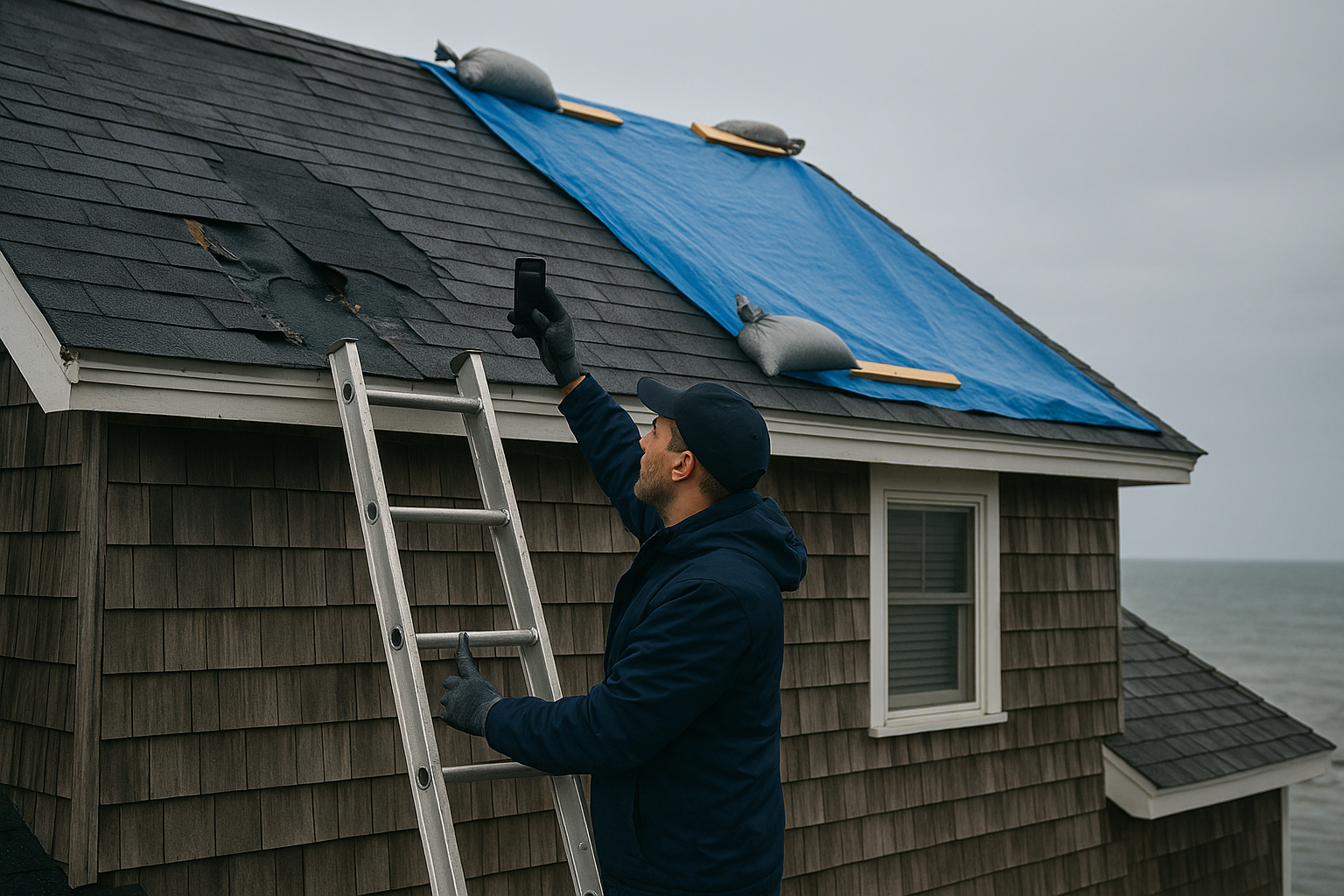
Wind-lifted shingle fields are the most common after a nor'easter. Shingles lift at the edges, the wind gets under them, and a whole slope can peel in minutes. The tarp must cover the full lifted field and lap past the intact shingles on every side, or water will run under the lifted edges that remain.
Ridge and rake blow-offs expose the roof at its most wind-prone lines. A tarp that does not cross the ridge and wrap the rake will fail at exactly the point the storm already opened. The fastening detail at those lines matters more than the size of the tarp.
Limb punctures are common inland, where Pine Barrens trees shed branches under wind. A puncture is often smaller than a lifted field but deeper, because the limb may have gone through the deck into the attic. The tarp has to cover the puncture and the surrounding broken area, and the deck below may need temporary support before anyone works over it.
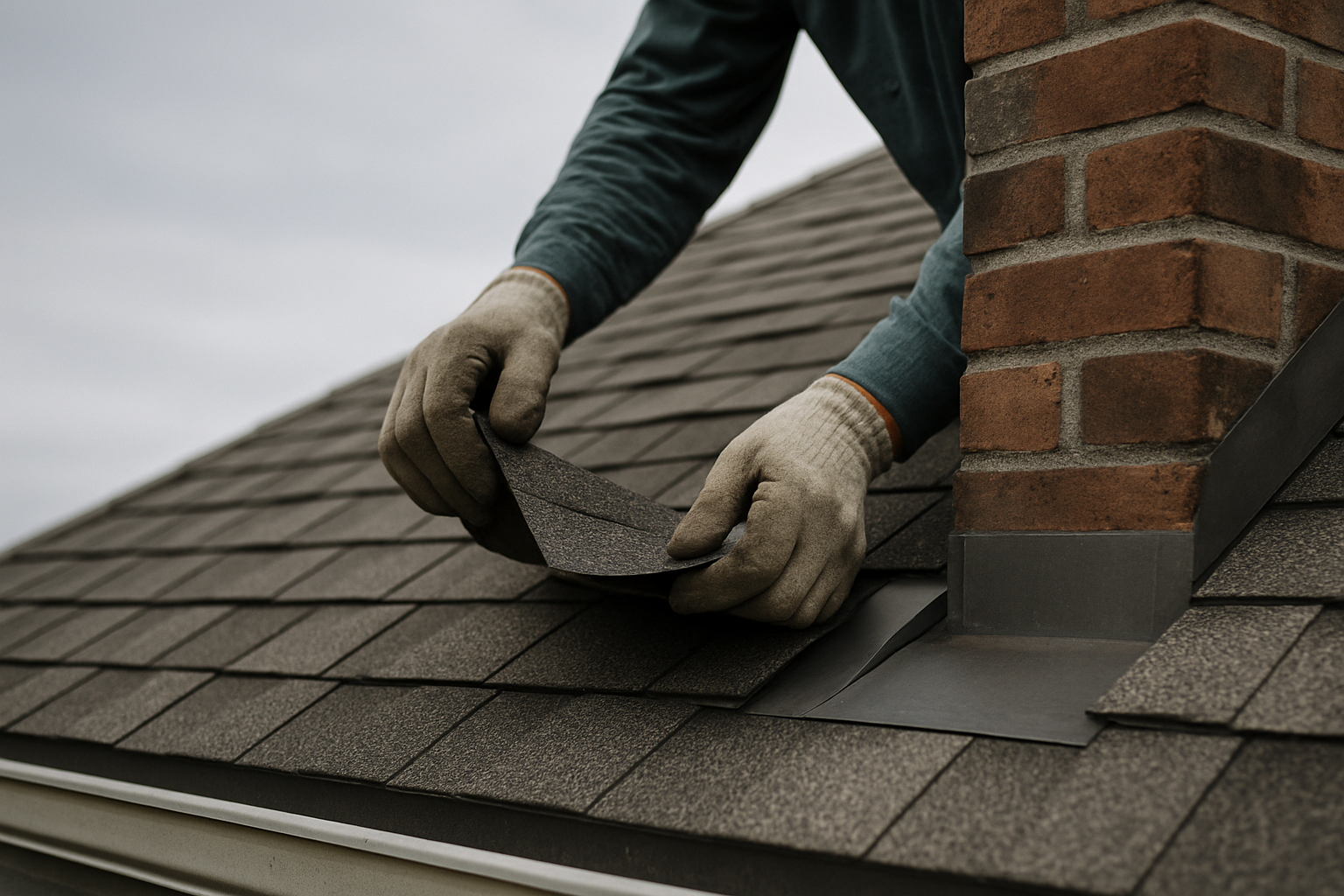
Pipe boot and penetration tears are small but persistent. Wind-driven rain entering a torn boot can run for a long time before it shows as a ceiling stain, because it travels along the rafter. A tarp over the boot area is a stopgap while the flashing is scheduled for repair.
Flat-membrane peel at eaves and penetrations shows up on shore additions and low-slope roofs. Membrane can lift at a seam or a parapet in a squall, and a tarp has to be secured so wind does not keep peeling it. The detailing is different from a shingle slope, which is why low-slope and flat roof repair is handled as its own scope.
In every case, the tarp is sized and secured to the failure, not dropped over the house. The same storm can produce a lifted field on one slope and a boot tear on another, and each gets its own coverage and its own photograph.
What an emergency tarping call includes — and what it does not
The value of a tarping call is in what happens around the tarp, not just the tarp itself.
| Included in the call | Not part of emergency tarping |
|---|---|
| Post-storm damage assessment | Permanent roof repair or replacement |
| Emergency tarping of compromised areas, with open areas addressed first | Structural shoring or broken-rafter repair |
| A written repair scope for the adjuster | Tree or limb removal |
| Availability to meet the adjuster and walk the roof | Interior water-damage dryout and restoration |
| Straight answers about storm damage vs. ordinary wear | Legal advice or acting as a public adjuster |
| Photo documentation of wind, hail, and impact damage, organized for a claim file | A promise that any tarp will survive every future wind event |
The right column is the useful half. Emergency tarping stops new water at the roof; it does not dry out what is already wet, rebuild structure, or remove the tree that caused the damage. A homeowner who understands those boundaries can plan the rest of the recovery without expecting the tarp to do a job it cannot do. It also explains why the company documents the damage as one set of evidence instead of only covering the hole and leaving.
How does tarping protect the interior?
The immediate job of an emergency roof cover in Atlantic County is to keep water out of the house. Once water is inside, it does not stay where it entered. It runs along rafters, soaks insulation, follows ceiling joists, and wicks into drywall and trim. What starts as a small stain can become a much larger interior loss within a day or two, especially during the humid coastal season when wet materials do not dry on their own and mold can become a problem quickly.
A properly installed tarp breaks that chain. It sheds rain at the point of entry, so the deck and insulation can begin drying instead of staying saturated. That matters in South Jersey, where wind-driven rain from a nor'easter can push water sideways into openings that a calm-day leak would never find, and where salt air accelerates corrosion on exposed fasteners and metal. Storm damaged roof protection in NJ is not a luxury; it is the difference between a contained roof loss and a spreading interior one.
The interior benefit is also an insurance benefit. Water damage that happens after the storm because no mitigation was done is treated differently from the original storm damage. The reference the company gives homeowners is direct: policies require you to prevent further damage once you know about it. A tarp is the documented act of prevention.
How does roof tarping before the adjuster protect your claim?
The sequence matters more than the speed. The company's storm process documents the damage first, and then addresses anything actively open to the sky. The tarp goes on after the damage is recorded, not before.
That order is what preserves evidence. An adjuster needs to see what the storm did: which shingles lifted, where the fasteners pulled, what the wind direction did to a ridge or eave. If the scene is altered before it is documented, the claim becomes harder to prove. The written repair scope and the damage documentation support the claim.
This is where roof tarping before adjuster arrival earns its place. The tarp keeps the evidence from being washed away or worsened while the adjuster is scheduled. It lets the homeowner wait without watching the ceiling spread. And it gives the adjuster a defensible picture: the damage was documented, the homeowner acted, and the loss was contained.
The company also provides a written repair scope that a homeowner can hand directly to the adjuster, and it can meet the adjuster at the property and walk the roof with them. For the fuller sequence of documentation, deductibles, and adjuster meetings, see New Jersey roof storm damage insurance claims.
One warning that belongs here because it is a repeated point on the site: walk away from any contractor who offers to "cover" a deductible. That is the deductible scam the storm claim guide tells homeowners to avoid, and it has no place in a clean claim file.
What does a proper tarp installation include at ridges, valleys, and drip edges?
A tarp that is thrown over a roof and weighted with a few bricks is not protection; it is a liability. A proper emergency roof tarping installation in Atlantic County is built to shed water for days or weeks, and it is detailed at the three places where most failures happen: ridges, valleys, and drip edges.
At the ridge
The tarp must lap over the peak and be secured on both slopes, never end short of the ridge on the windward side. If the tarp stops below the peak, wind-driven rain runs under the upslope edge and straight onto the deck. The tarp is anchored across the ridge so water sheds down both slopes, and the upper edge is lapped so water cannot enter.
At valleys
A valley is a drainage channel, and a tarp can either preserve it or defeat it. A tarp laid flat across a valley can pond water and create a new leak path exactly where the roof is supposed to drain. The tarp must be secured so water runs into and down the existing valley metal and out at the eave, not dammed behind a wrinkle or a fastener.
At the drip edge and rake
At the eave, the tarp must extend past the drip edge far enough that water falls into the gutter or off the fascia instead of wicking behind the drip edge and into the soffit. At the rake, the exposed edge is the first thing the wind catches, so it must be wrapped or secured in a way that does not leave a loose flap for uplift to grab.
Across the field, the tarp is lapped in the direction water sheds, with seams shingled so the upper course drains over the lower one. It is secured along the perimeter and across the field with fastening that holds under wind but does not add new penetrations through sound shingles without sealing them. Sandbags or weights alone are not enough for a roof slope; the edges must be mechanically secured.
A proper installation is also a documented one. The company documents the work, which matters for the claim and for the homeowner who wants to know what was done and why.
What are the limits of a tarp in wind and snow?
A tarp is a temporary shield, not a structural repair. It has real limits, and both are easiest to understand through the two weather systems that matter most in South Jersey: wind and snow.
Wind is the main enemy. A tarp on a roof is a sail. Nor'easters bring sustained wind and gusts that can lift an under-secured tarp, tear it free, and turn it into a hazard to the home, the neighbors, and power lines. Wind damage tarping in South Jersey has to be installed for uplift, not just for rain. The tarp must be fastened continuously along the edges and across the field, and it should be checked after a high-wind event because wind works fasteners loose over time. A flapping edge is not a minor cosmetic issue; it is the start of a failure.
Snow adds weight and hides problems. A tarp adds no load capacity to a roof. If a storm-damaged roof is under a tarp when snow falls, the snow sits on the tarp and the deck beneath it, and the tarp does nothing to carry that load. The tarp also makes the roof slick and hides hazards, which is one reason homeowners should not walk a tarped slope. Snow and ice can also trap water against the tarp and make a small opening behave like a much larger one.
There are other limits worth stating plainly. A tarp will not fix a broken rafter, a sagging deck, or a failed structural connection. It will not stop water that is already inside from spreading; it only stops new water at the source. It will not last through months of coastal sun and salt air — UV and wind degrade any temporary cover. And it will not do the job if it was installed over a roof that still has a loose, unsecured section flapping beneath it.
The rule is simple: treat the tarp as a bridge, not a destination. The same people who tarp the roof should be able to tell you what failed and what the permanent fix is, because a tarp that hides a problem is worse than no tarp at all.
What should you photograph, and what should you not touch before the adjuster?
Documentation is half the value of an emergency tarping call, and the order is fixed: document first, mitigate second.
Before the tarp goes on, the company documents the damage. That record ties the damage to the storm, which is the first thing an adjuster needs. Interior stains should be photographed with a date reference, because the extent of interior damage is part of the loss even though the tarp only addresses the roof.
What not to touch before the adjuster is just as important as what to photograph. Homeowners should not remove or discard damaged shingles, flashing, or metal, even if they look like debris. They should not make permanent repairs that erase the evidence of what failed. They should not "clean up" the roof or the attic before the adjuster has documented the scene. Torn shingles, pulled fasteners, and displaced flashing are evidence, and they should stay in place until they have been recorded.
The one exception is the emergency action itself. Stopping active water with a tarp is required, not optional, and it is documented as mitigation rather than treated as scene alteration. The distinction is the whole point: the homeowner's duty is to prevent further loss, not to preserve the loss by letting water run.
When should temporary protection become permanent repair?
A tarp is not the end of the job. It buys time, and the clock starts as soon as it is installed.
Temporary roof repair in Atlantic County NJ should be converted to permanent work as soon as the claim is documented, the weather allows, and the repair scope is written. The trigger is not a calendar date but a set of conditions: the adjuster has recorded the damage, the written scope is in hand, the roof is dry enough to work, and the permanent fix — repair or replacement — is scheduled.
Leaving a tarp in place too long creates its own risks. Wind and UV degrade the cover, fasteners loosen, and a tarp that was a shield becomes a leak and a hazard. On the coast, salt air and repeated nor'easter cycles shorten that window further.
The permanent fix depends on what the tarp revealed. Wind-lifted shingles may be repaired. Torn flashing at a chimney, valley, or pipe boot is a roof flashing repair issue. A low-slope addition that peeled in a squall is a flat roof repair issue. A roof that was already near the end of its life before the storm may need full replacement — see the roof replacement guide for Atlantic County specifications. The important point is that the tarp gave you the time to choose correctly instead of choosing under pressure.
How does the emergency tarping process work?
The process on a HappyRoof storm call follows a fixed order, because the order protects the claim as much as the home.
- Call and describe the damage. The homeowner reports what happened, where water is entering, and whether anything is open. The call is the trigger, and emergency tarping is available outside the posted Monday–Saturday, 7:00 AM–7:00 PM hours for active water intrusion.
- Rapid assessment and documentation. The crew documents the damage. This happens before anything is moved or covered.
- Address open areas first. If anything is actively open, that is handled before any other work. The goal is to stop active water as fast as conditions allow.
- Install the tarp and document the work. The tarp is secured at ridges, valleys, and drip edges as described above, and the work is documented for the claim file.
- Written scope for the adjuster. The homeowner receives a written repair scope that can be handed directly to the adjuster, and the company can meet the adjuster at the property and walk the roof with them.
- Permanent repair planning. Once the claim is documented and the weather allows, the temporary cover is replaced with permanent repair or replacement, itemized in writing before work starts.
What should you have ready before you call?
The faster the crew can assess and tarp, the less water gets in. A few details ready at the start of the call make the visit smoother:
- The address and the best access point — front, side, or rear, and whether a gate or fence blocks the roof.
- Where water is entering inside the home, and whether the ceiling or wall is wet or stained.
- What you saw happen: a limb, a shingle field lifted, a ridge opened, or water appearing after a specific storm.
- Whether the roof is asphalt shingle, metal, or flat membrane, if you know.
- Any hazard on or near the roof: overhead power lines, a leaning tree, a chimney that looks loose.
- Photos you have already taken from the ground, if any.
You do not need to have the policy number memorized, and you do not need to have climbed the roof. Ground-level observations and the address are enough to start. The company will document the rest.
Where is emergency roof tarping offered in Atlantic County?
Emergency roof tarping Atlantic County NJ coverage follows the company's Atlantic County service area: every town and municipality in Atlantic County. That includes the barrier-island and bayfront communities where wind and salt air are hardest on roofs — Margate City, Longport, Brigantine, Ventnor City, and Atlantic City — and the inland towns where tree and limb damage and Pine Barrens leaf load shape the roof differently: Egg Harbor Township, Galloway, Hammonton, Mays Landing, Northfield, Linwood, Somers Point, Absecon, Pleasantville, Egg Harbor City, Mullica Township, Hamilton Township, Buena, Folsom, Port Republic, Estell Manor, and Weymouth Township.
The coastal and inland conditions are not the same, and the tarping job reflects that. A bayfront roof in Margate that takes wind-driven rain off the water needs different edge and lap detailing than a roof in Hammonton that took a limb through the deck.
A storm can cover the whole county at once, and after a wide nor'easter the schedule is managed by urgency, with active water intrusion first. The address is the starting point for a real assessment, not a website form.
What drives tarping scheduling after a storm?
The contact hours are Monday through Saturday, 7:00 AM to 7:00 PM, and emergency tarping is available outside those hours for active water intrusion. The storm damage roof repair page lists same-day service.
What drives timing after a wide storm is not a fixed queue. It is the combination of urgency, safety, and access. Active water intrusion comes first. A roof that is open to the sky comes before a roof that is damaged but still shedding water. High wind can pause roof work for safety, because a tarp cannot be secured in conditions that will immediately lift it. Access — a locked gate, a blocked driveway, an unsafe ladder setup — also affects the schedule.
The honest answer to "how quickly" is that the company offers same-day service and emergency tarping outside posted hours, and the exact arrival on any given storm day depends on how many homes were hit, what the weather is doing at the time, and whether the roof can be worked safely.
Frequently asked questions
How quickly can you tarp my roof after a storm?
HappyRoof lists same-day service and provides emergency tarping outside its posted Monday–Saturday, 7:00 AM–7:00 PM hours. On any given storm day, arrival depends on how many homes were hit, current wind and safety conditions, and access. Active leaks and open areas are prioritized.
Will emergency tarping hurt my insurance claim?
No — done in the right order, it protects the claim. HappyRoof documents the damage first, installs the tarp, and provides a written repair scope the adjuster can work from. Policies require policyholders to prevent further damage once they know about it, so documented tarping supports the claim rather than weakening it.
Can I tarp the roof myself before help arrives?
You should not climb a storm-damaged roof. A damaged deck can be unstable, and a tarp makes a slope slick. If water is actively entering, document from the ground and contain water inside where it is safe to do so. Let the crew do the roof work, because an under-secured tarp can cause more damage and fly off in wind.
How long can a tarp stay on a damaged roof?
A tarp is a temporary bridge to permanent repair, not a roof. Coastal wind, sun, and salt air degrade any temporary cover, and fasteners loosen over time. It should remain only as long as the claim is being documented and the permanent repair is scheduled, then be replaced. The installer should tell you when it has to come off.
Will HappyRoof meet with my insurance adjuster?
Yes. The company can meet the adjuster at the property and walk the roof with them, and it provides a written repair scope the homeowner can hand directly to the adjuster. It documents the damage, but it does not act as a public adjuster or legal advisor.
Do you tarp flat roofs and metal roofs as well as asphalt shingles?
Yes. Emergency roof cover applies to whatever roof is on the home. The damage and the detailing differ — a low-slope membrane peeled in a squall is a flat roof repair issue, and exposed-fastener metal roofing needs different care than shingles — but the mitigation sequence is the same: document, stop active water, then plan the permanent fix.
Next step
If water is coming in or your roof is open after a storm, the next step is one call. HappyRoof documents the damage, tarps what is open, and hands you a written scope your adjuster can work from. Call (609) 525-4521 or use the contact page, and if it is outside business hours and water is actively entering, say so — emergency tarping is available outside posted hours. HappyRoof is a licensed, bonded, and insured New Jersey contractor, with a current certificate available on request.