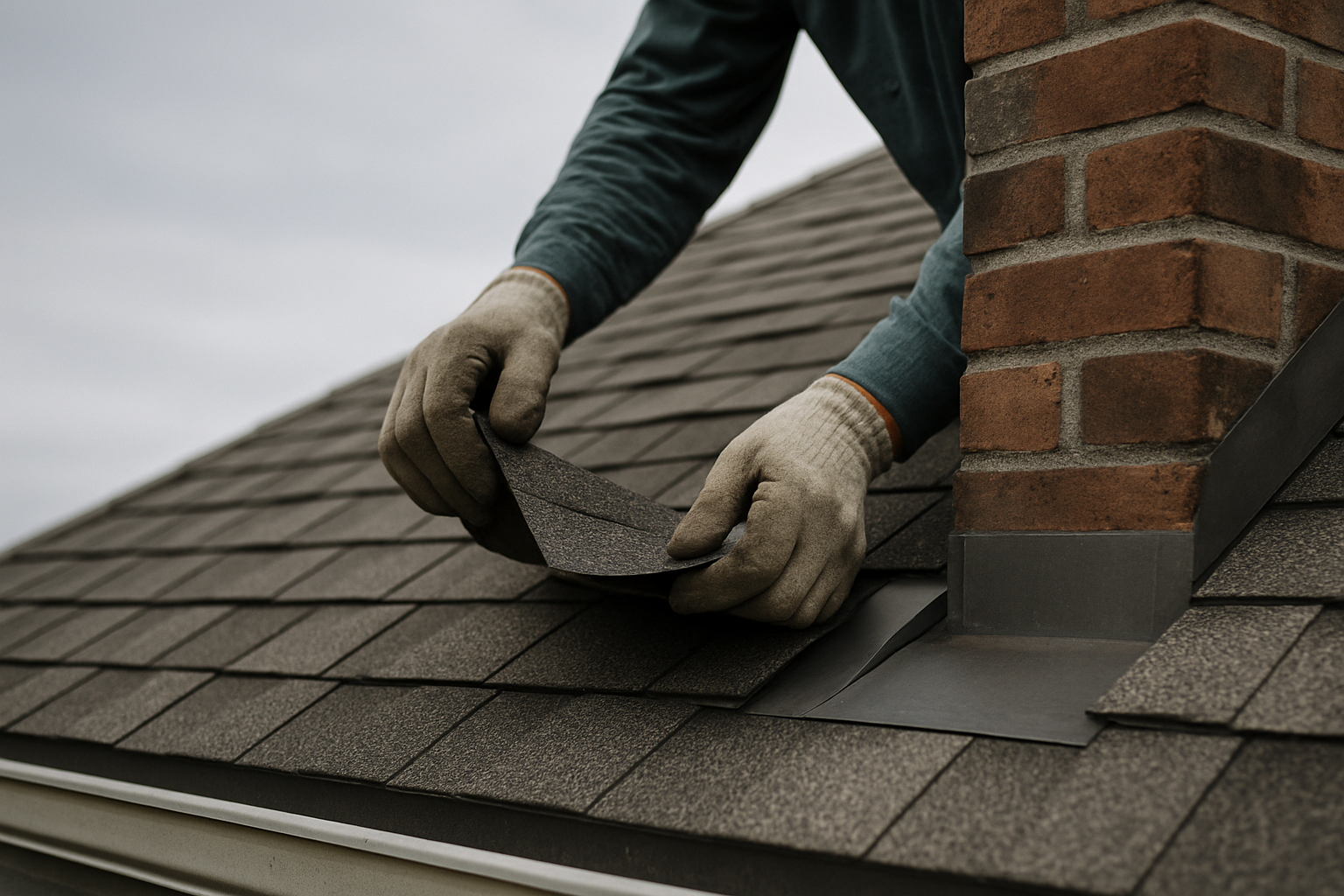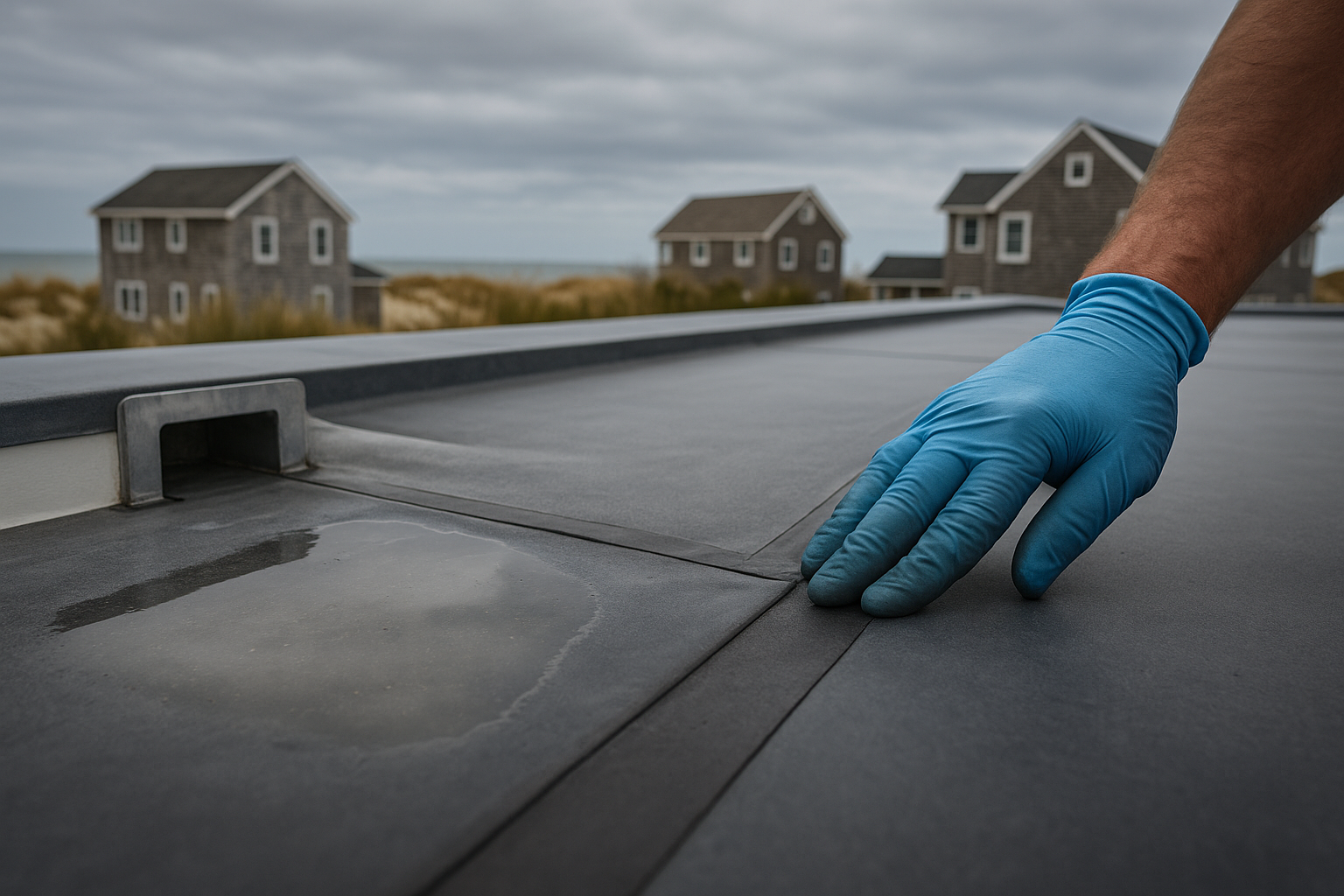
In Atlantic County, most skylight leaks are flashing failures, not broken glass. Water enters where the curb or deck flange meets the shingles, then travels along framing before it shows as a stain. Skylight flashing repair in NJ starts with finding that entry point, then deciding whether reflashing the opening or replacing the unit is the honest fix.
A skylight is a break in the roof's drainage plane
A shingle roof works because every layer overlaps the layer below it. Water moves downhill across the field, off the eave, and into the gutter. The middle of a slope almost never leaks, because the shingles there are doing the simplest job on the roof: shedding water onto more shingles. Leaks happen at transitions, interruptions, and fasteners. A skylight is all three at once.
When you cut an opening in a roof and put a raised or flush unit through it, you break the continuous drainage plane. The flashing around that opening has to rebuild the plane in miniature: every lap has to shed water down and out, never behind the shingle below it, never into the curb, never onto the sheathing. When the flashing is wrong, corroded, or simply old, the opening becomes the entry point.
Two facts shape every skylight diagnosis we do. First, the stain on your ceiling is not a map of the leak. Water that penetrates a roof deck lands on framing, and framing runs. It follows the underside of the sheathing to the nearest rafter, travels down that rafter until it hits a nail, a knot, or a joist connection, and only then falls. On a low-pitch roof over a finished space, the actual entry point is regularly 8 or 12 ft (about 2.4 or 3.7 m) uphill and to one side of the visible damage. That means a stain near a skylight is not proof the skylight is leaking, and a clean ceiling is not proof the skylight is dry.
Second, deck rot in Atlantic County clusters in predictable places: along the eaves where ice dams and wind-driven rain back water up under the shingles, around chimneys and skylights where old flashing leaked slowly for years, in valleys, and on shaded north slopes that never fully dry out. A skylight leak that has been "not that bad" for three years is often a skylight leak that has been quietly rotting the sheathing around the curb for three years. That is why the repair starts at the opening, not at the stain.
Is it a skylight leak or condensation?
This is the first question to settle, because the fixes are completely different. Condensation is an indoor air problem that shows up on the skylight. A leak is a water-intrusion problem that shows up around it.
Condensation forms when warm, humid interior air meets the cold surface of the glass and frame. The moisture in the air drops out as fog or droplets. It is most common in winter, in bathrooms and kitchens, in houses with high humidity or weak ventilation, and along uninsulated skylight shafts. It does not need rain. It tends to be uniform: fog across the glass, beads on the frame, mildew at the drywall seam of the shaft, but no water trail in the attic and no staining that tracks back to a single corner.
A flashing leak is tied to weather. It appears during or after rain, and it is usually worse in wind-driven rain, because wind pushes water uphill and sideways across laps that would otherwise drain. It leaves evidence: a stain that darkens along one side, wet insulation in the shaft, water on a rafter or top plate, peeling paint in one corner, or a drip that starts hours after the rain begins and continues after it stops.
| Sign | Condensation | Flashing leak |
|---|---|---|
| When it appears | No rain needed; worse in cold weather | During or after rain, especially wind-driven rain |
| Where it appears | Fog or droplets across glass and frame | Stain, drip, or peeling paint, often on one side |
| Attic evidence | Usually none | Wet insulation, water trail on framing |
| Weather correlation | None | Strong |
| Root cause | Interior humidity meeting cold surfaces | Water entering at the flashing or curb |
| Fix | Ventilation, insulation, humidity control | Repair or replace the flashing and opening |
The attic is usually the tiebreaker. If the shaft is dry and the framing shows no water path, condensation is the likely explanation. If there is a dark trail running down a rafter from the direction of the opening, water has been getting in. We check both before recommending anything, because resealing a skylight that is only condensing will not stop the droplets, and adding a dehumidifier will not stop a flashing leak.
Curb-mounted vs deck-mounted skylights: two different flashing problems
The repair changes depending on how the skylight sits on the roof. The two common installations fail in different ways, and a repair that works on one is wrong for the other.
Curb-mounted skylights
A curb-mounted skylight sits on a raised frame, usually a wood curb built on site and flashed like a small chimney. The curb lifts the unit above the roof plane, which is why curb-mounted units have long been common on low-pitch and flat-adjacent roofs. The flashing around a curb is built in layers: step flashing up the sides, counter-flashing over the step flashing, and head flashing across the top that laps under the shingles above and over the counter-flashing.
Curb-mounted units fail in a few predictable places. The corners are the weak point, because flashing has to be cut, folded, and lapped around a square or rectangular curb, and water concentrates at the downhill corners. The curb itself is wood, and if water has been getting behind the flashing for years, the curb rots and the fasteners lose their grip. The sealant joint between the skylight frame and the curb cracks from ultraviolet exposure and thermal movement. On wide curbs, a missing saddle or cricket behind the unit lets water pond on the uphill side and work backward under the head flashing.
Deck-mounted skylights
A deck-mounted skylight sits nearly flush with the roof plane, with an integrated flange or a manufacturer's flashing kit that ties the unit into the shingle courses. There is no raised curb, so the unit depends on the flange-to-deck seal and on the flashing pieces that lap under the shingles above and over the shingles below.
Deck-mounted units fail where the seal fails. The bottom apron has to lap over the shingle below it, not under it; if it is installed the wrong way, running water is funneled straight under the flange. The side flashing has to step with the shingle courses, and when it is butted instead of lapped, water finds the joint. The head flashing has to slide far enough under the shingles above that wind-driven rain cannot climb it. And the ice-and-water shield under the flange has to be in place before the unit goes down; if it is missing, every small gap in the metal drains onto bare sheathing.
| Attribute | Curb-mounted | Deck-mounted |
|---|---|---|
| Mounting | Raised wood or factory curb | Flush flange on the deck |
| Flashing method | Step, counter, and head flashing around the curb | Manufacturer kit plus flange seal |
| Typical failure | Curb corners, wood curb rot, sealant joint | Flange seal, wrong apron lap, missing underlayment |
| Repair approach | Rebuild or repair curb, reflash in layers | Remove and reset unit, correct kit and underlayment |
| Coastal exposure | More forgiving of standing water if flashed correctly | More dependent on wind-driven rain details |
Step flashing and head flashing on a site-built curb
When a skylight has a site-built curb, the metal around it has to be installed in a strict order. Get the order wrong, and the curb will leak no matter how much sealant goes on top.
The lap order works like this:
- The curb is framed and covered, then the lower roof area around the opening is prepared so water landing near the skylight drains downhill.
- Step flashing is installed course by course up each side of the curb. Each piece has a horizontal leg that lays on the roof and a vertical leg that turns up the curb. Each new shingle course covers the horizontal leg, and each new step piece laps over the vertical leg of the piece below it.
- Counter-flashing is set over the step flashing so water running down the vertical face of the curb stays outside the step flashing and cannot get behind it.
- Head flashing, also called a head apron, is set at the top of the curb. It slides under the shingles above and laps down over the counter-flashing, so water approaching from the uphill side is split around the curb.
- On a wide curb, a saddle or cricket is built behind the unit to divert water around it instead of letting it pile against the uphill face.
The most common site-built curb failure is a missing or undersized counter-flashing, which lets water run down the curb face and behind the step flashing. The second is a head flashing that stops at the top of the curb instead of lapping far enough under the shingle course above, which lets wind-driven rain climb the gap. The third is the corner, where the folds in the metal open up under thermal movement.
One thing we see often is a curb that has been "repaired" with a heavy smear of black roof cement over the joints. That can stop a leak for a season, but it is temporary work sold as permanent. The sealant shrinks, cracks along the seam, and the leak resumes, except now the next repair has to chisel hardened cement off the metal before doing the real job, which adds labor to the eventual proper fix. When the metal is intact and the laps are right, the curb should not need a bead of cement to stay dry.
Manufacturer flashing kits: what they do well, and where installation still goes wrong
A deck-mounted skylight is usually designed to be installed with a manufacturer flashing kit matched to the specific unit and roof pitch. The kit typically includes a bottom pan or sill flashing, side step flashing, and a head flashing. When the right kit is installed on the right pitch, the metal laps are engineered to work together and the skylight flashing kit installation is straightforward.
The problems come when the kit and the roof stop matching. A kit is designed for a specific pitch range, and installing a low-pitch kit on a steeper roof, or the reverse, changes the lap geometry. A kit is designed for a specific shingle exposure, and when the roof is re-shingled with a different course height, the side flashing no longer steps cleanly with the courses. An old skylight whose manufacturer no longer supplies the kit often gets improvised flashing made from flat stock and sealant, which is exactly where leaks start.
The other common failure is reuse. When a roof is replaced, a deck-mounted skylight is sometimes left in place and the old flashing is "worked around." The new shingles are cut to the old metal, and the old metal is now sealing against a deck that has moved. If the underlayment under the flange was not renewed, the opening is relying on a seal that may be a decade old. A proper skylight flashing kit installation means the unit is removed or lifted, the deck is inspected, the ice-and-water shield is renewed, and the kit is installed as a system, not patched into place.
For a curb-mounted unit, the "kit" question is different. Site-built curbs are flashed with fabricated step, counter, and head flashing, and the quality of the repair depends on the metalwork and the lap order more than on a packaged part number. Factory curbs, where the skylight ships with a curb and flashing, sit somewhere in between and should follow the manufacturer's installation detail.
Ice-and-water shield around the skylight opening
On the Atlantic County coast, the detail that separates a long-lasting skylight from a recurring leak is what happens under the metal, not just on top of it.
Ice-and-water shield is a self-adhered membrane that goes on the deck in the areas where water is most likely to get past the shingles and flashing. Around a skylight, it is laid so that any water that makes it past the metal lands on the membrane and drains out at the bottom of the opening instead of soaking into the sheathing. The laps matter: the membrane under the sill goes on first, the sides lap over it, and the head area laps over the sides, so water is always moving down and out, never into a seam.
This matters more near the bay than inland. Wind-driven rain and nor'easters push water sideways and uphill across laps that would shed water cleanly in a vertical downpour. Salt air accelerates corrosion on exposed metal laps and fasteners. When the ice-and-water shield is missing, torn, or lapped backward around a skylight, the failure may not show up in ordinary rain. It shows up in the storm that drives water under the head flashing and into the sheathing, and by the time the stain appears, the deck around the opening has been wet for a long time.
Deck rot around skylights is one of the most common finds when a roof is opened up, because the leak at the flashing often runs for years before the interior shows it. That is why a skylight reflash is not just a metal job. If the sheathing under the opening is soft, the repair includes cutting out and replacing the rotted deck before the new flashing goes down. The membrane, the deck, and the metal have to work as one system.
When reflashing is enough, and when the skylight should be replaced
The goal of an inspection is not to sell a new skylight. It is to tell you whether the unit you have can be made dry.
Reflashing is enough when the skylight itself is sound. That means the glass is intact, the frame is not rotted or warped, the seal between the glass and the frame has not failed, and the unit is not so old that its flashing kit is obsolete. In those cases, the repair is about the opening: rebuilding a soft curb, installing new step, counter, and head flashing, renewing the ice-and-water shield, and correcting the laps. The skylight stays, and the leak stops at the flashing where it started.
Replacement makes sense when the skylight itself is the problem or when it is not worth saving. The clearest case is a failed seal between the glass and the frame, which cannot be fixed from the roof side. A rotted or warped frame, a curb that is too far gone to rebuild, or a unit whose manufacturer flashing kit is no longer available are all cases where replacement is the honest answer. So is the situation where you are already replacing the roof, the skylight is near the end of its life, and removing it now avoids paying for a second opening repair in a few years.
HappyRoof's inspection is built around an honest remaining-life assessment. If the skylight has years left and the leak is in the flashing, you will hear that, and the repair will be scoped to the flashing. If the unit is done, you will hear that too, with a written price before any work starts.
What skylight flashing repair costs in Atlantic County
Most roof repairs in Atlantic County fall between $400 and $1,800. The low end covers straightforward, accessible work such as nail pops, a handful of wind-lifted shingles, or a drip edge repair. Skylight work sits toward the upper end because it is a detail rebuild, not a single-component swap.
The reference range covers the labor pattern: repairing a skylight curb, replacing step and counter flashing around an opening, or cutting out and replacing rotted sheathing under a long-running leak all sit in that range. What pushes a specific job higher is the physical difficulty of the roof. Steep pitches, third-story access, or difficult staging on a barrier-island lot with no driveway push labor higher. So does the amount of rotted decking found once the shingles come off, which is why every honest proposal includes a per-sheet price for decking replacement rather than pretending the number is zero.
A full skylight replacement is a separate scope on top of the repair labor. It adds the cost of the new unit, any new curb, and the flashing kit or fabricated metal. There is no single honest number for that, because the unit size, type, and the condition of the opening all change the price. The number you can rely on is the one in the itemized written proposal after the opening has been inspected.
| Cost driver | How it changes the job |
|---|---|
| Reflash only | Metal and membrane work around a sound unit |
| Curb rebuild | Adds framing and re-sheathing to the curb repair |
| Rotted decking | Per-sheet replacement once the area is opened |
| Pitch and access | Steep or third-story roofs raise labor |
| Barrier-island staging | No driveway or tight lots complicate setup |
| Full replacement | Adds the unit, curb, and flashing kit on top of labor |
If the leak followed a storm or wind event, document what happened and take photos before anything is disturbed. HappyRoof documents the condition of the opening, but coverage decisions belong to your insurer and your policy.
What happens during a skylight leak inspection
The inspection is free, and it is diagnostic before it is anything else. The order matters because the interior tells us where water has been, and the roof tells us where it is getting in.
- We start inside and document the stain, the drip, or the damp area, including when it appears and what the weather was doing.
- We trace the path in the attic or the shaft, following the framing rather than assuming the stain points to the source.
- On the roof, we inspect the opening: the curb or flange, the step and counter flashing, the head flashing, the sealant joints, and the condition of the surrounding shingles and underlayment.
- If the entry point is not obvious, we check the uphill and uphill-and-side areas, because water travels along framing before it falls.
- We give you a photo report of what we found and an honest answer on whether the fix is reflashing, deck repair, or replacement, with itemized written pricing before anything starts.
What to have ready helps the inspection move faster: roughly when you first saw the stain, whether it appears only in rain or also in cold weather, any photos of the interior damage, and access to the attic or shaft if there is one. If water is actively coming in, emergency tarping can stop the damage until the opening is repaired.
Skylight flashing repair across Atlantic County
HappyRoof serves every town in Atlantic County, and the skylight problems change with the setting. On the barrier islands and bayfront streets in Atlantic City, Margate City, Brigantine, Ventnor City, and Longport, wind-driven rain and salt air punish laps, fasteners, and sealant joints harder than inland rain does. In Egg Harbor Township, Galloway, and Pleasantville, the issues skew toward shaded north slopes that stay damp and curbs that have been wet for years before anyone looked.
The inspection is the same everywhere: find the entry point, trace the water, open enough of the opening to see the deck, and give you a written answer before work starts.
Skylight leak questions, answered
How can I tell whether water is leaking through the skylight flashing or just condensing on the glass?
Condensation forms on the interior glass or frame as fog or droplets when warm, humid air meets cold surfaces, usually without rain and worse in winter. A flashing leak appears during or after rain, often wind-driven rain, and leaves a stain, wet insulation, or a water trail in the attic. A roof-side inspection confirms which one you have.
What is the difference between a curb-mounted and a deck-mounted skylight?
A curb-mounted unit sits on a raised frame, usually site-built, and is flashed with step, counter, and head flashing around the curb. A deck-mounted unit sits nearly flush with the roof plane and relies on a manufacturer flashing kit and a flange-to-deck seal. Each fails differently, so the repair is different.
How much does skylight leak repair cost in Atlantic County?
Most roof repairs in Atlantic County fall between $400 and $1,800, and skylight curb repair sits in the upper end. Pitch, access, staging, and rotted decking push labor higher. A full replacement adds the unit and flashing kit, so the price is set after a free inspection with itemized written pricing.
Can you just reseal the skylight flashing instead of replacing it?
Sometimes, but a smear of roof cement over a flashing joint is a temporary fix that shrinks and cracks. If the metal is intact and only the sealant has failed, resealing may work. If the flashing is corroded, lapped wrong, or the curb is rotted, the opening needs proper reflashing, not more sealant.
Does a skylight leak mean the skylight has to be replaced?
No. When the glass and frame are sound and the leak is in the flashing, reflashing the opening and repairing the curb is usually enough. Replacement makes sense when the skylight's own seal has failed, the frame or curb is rotted, or the unit is obsolete and its flashing kit is no longer available.
Will homeowners insurance cover a skylight leak repair?
It depends on the cause and the policy. Storm or wind-driven rain damage may be covered, while long-term wear is often not. HappyRoof documents the condition, but coverage is a question for your insurer.
The next step is a roof-side inspection of the opening, not another season of watching the stain spread. Call (609) 525-4521 to schedule a free skylight inspection with photos and an honest answer on whether you need reflashing or replacement.
Frequently asked questions
How can I tell whether water is leaking through the skylight flashing or just condensing on the glass?
Condensation forms on the interior glass or frame as fog or droplets when warm, humid air meets cold surfaces, usually without rain and worse in winter. A flashing leak appears during or after rain, often wind-driven rain, and leaves a stain, wet insulation, or a water trail in the attic. A roof-side inspection confirms which one you have.
What is the difference between a curb-mounted and a deck-mounted skylight?
A curb-mounted unit sits on a raised frame, usually site-built, and is flashed with step, counter, and head flashing around the curb. A deck-mounted unit sits nearly flush with the roof plane and relies on a manufacturer flashing kit and a flange-to-deck seal. Each fails differently, so the repair is different.
How much does skylight leak repair cost in Atlantic County?
Most roof repairs in Atlantic County fall between $400 and $1,800, and skylight curb repair sits in the upper end. Pitch, access, staging, and rotted decking push labor higher. A full replacement adds the unit and flashing kit, so the price is set after a free inspection with itemized written pricing.
Can you just reseal the skylight flashing instead of replacing it?
Sometimes, but a smear of roof cement over a flashing joint is a temporary fix that shrinks and cracks. If the metal is intact and only the sealant has failed, resealing may work. If the flashing is corroded, lapped wrong, or the curb is rotted, the opening needs proper reflashing, not more sealant.
Does a skylight leak mean the skylight has to be replaced?
No. When the glass and frame are sound and the leak is in the flashing, reflashing the opening and repairing the curb is usually enough. Replacement makes sense when the skylight's own seal has failed, the frame or curb is rotted, or the unit is obsolete and its flashing kit is no longer available.
Will homeowners insurance cover a skylight leak repair?
It depends on the cause and the policy. Storm or wind-driven rain damage may be covered, while long-term wear is often not. HappyRoof documents the condition and can meet an adjuster, but coverage is a question for your insurer.