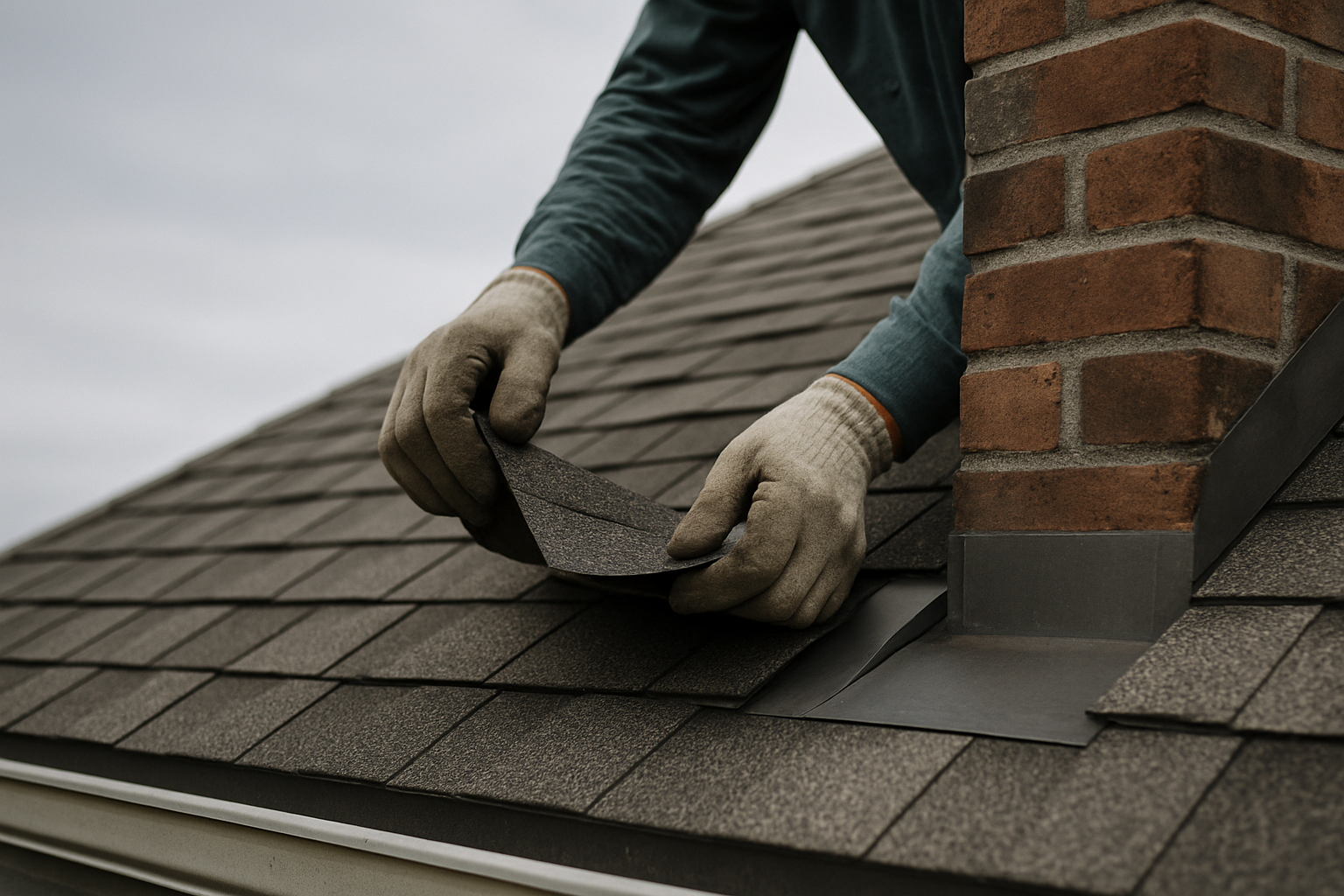
Roofing in Hammonton NJ is governed less by ocean wind than by pine-needle loading, summer humidity, and older roof structures. HappyRoof's Hammonton work prioritizes valley and gutter clearing, attic ventilation, and decking assessment, with free inspections, written pricing, and repair or replacement decisions based on what the roof actually shows.
Hammonton sits in the wooded inland half of Atlantic County, and its roofs fail differently from the barrier-island roofs a few miles east. On the shore, the recurring enemy is sustained ocean wind lifting shingle edges and salt air corroding fasteners. In Hammonton, the recurring enemies are organic and airborne: pine needles packing into valleys, limbs dropping from pitch pines and oaks, and summer humidity that condenses on the underside of the roof deck. That difference is why a homeowner should judge a roofing contractor in Hammonton NJ by how that contractor handles debris, moisture, and old decking, not only by how it handles a visible leak.
The point can be stated plainly. A roof specified for a subdivision in central Jersey is not specified for a bayfront house in Margate. The same logic runs inland: a roof specified for an open, sun-baked lot is not specified for a shaded Hammonton lot under the Pine Barrens canopy. The difference shows up in how the roof is vented, flashed, and maintained, and in what the inspection looks for first.
Pine-needle load: what it does to valleys and gutters
Pine Barrens roof leaf damage is the inland counterpart to shore wind damage, and it follows a predictable pattern. Pine needles are the perfect roofing debris: small enough to pack tightly, slow to decompose, and excellent at holding moisture against whatever they sit on. They do not blow away the way broad leaves do after a dry week. They settle into low points, mat down, and stay.
The two places needles do the most damage are valleys and gutters, and they fail in different ways.
Valleys become dams
A valley is the V-shaped channel where two roof slopes meet and water is concentrated. In a clean valley, water runs down the valley metal and off the roof. When pine needles fill a valley, they convert it from a drainage path into a dam.
Water backs up behind the needle mat, rises over the valley metal, and works under the shingles on the adjacent slopes. The needle mat stays wet long after the rain stops, so the shingles and metal beneath are held against moisture for weeks at a time. On shaded north-facing slopes, that wet mat becomes a bed where algae and moss establish. Moss is not merely cosmetic; its roots work under shingle edges and lift them. What begins as a debris problem becomes a leak problem, then a deck-rot problem, without any single dramatic storm event.
This is why Hammonton roof repair frequently starts with clearing and then reveals the damage underneath. The lifted shingle edge, the rotted deck, and the failed valley metal are often hidden under the mat until someone removes it and looks.
Gutters and downspouts pack solid
Gutters in Hammonton's tree-covered neighborhoods can fill twice a season. Pine needles are small enough to wash into the gutter on every rain, and they do not break down quickly once they are there. A gutter that is half full of needles stops doing its job.
The failure sequence is specific. Needles bury the gutter outlets, so water overflows the gutter and pours down the fascia and into the foundation. The added weight of the wet mat pulls on the gutter fasteners, which loosens the entire run. Downspout runs pack solid, so the water that should be carried away from the foundation is instead spilled at the roofline. The result is not only a roof problem but a foundation and siding problem below it.
Seamless gutters, guards, and downspout runs that move Pine Barrens leaf load and heavy shore rain away from the foundation are part of the fix, but they only work if the leaf load is actually carried off. On a Hammonton home, gutter maintenance is a structural act, not a cosmetic one.
The storm connection is wood, not wind
In the wooded inland towns, the most common storm loss is not wind on shingles. It is wood on shingles. Pitch pines and oaks drop limbs readily in ice storms and high wind, and a limb that weighs sixty pounds (about 27 kg) falling twenty feet (about 6 m) delivers enough energy to punch through sheathing, not merely scuff the surface.
After a storm, a Hammonton roof may need emergency tarping and documentation to support the insurance claim, not just a shingle patch. The homeowner's first job is to stop water from entering, and the second is to document what happened while the evidence is fresh.
Summer humidity and attic condensation in the Pine Barrens
The second inland constraint is humidity, and it operates differently from salt air. Salt air is a coastal corrosion problem: it attacks fasteners and flashing from the outside. Attic humidity in the Pine Barrens is an interior problem: warm, moist air collects inside the roof assembly and condenses on the underside of the sheathing.
The mechanism is straightforward. Warm air holds more moisture than cool air. When humid outdoor air enters a hot summer attic and the attic cools overnight, moisture condenses on the roof deck, the rafters, and the fasteners. Repeated condensation keeps the sheathing damp, which feeds rot and loosens the bond between the shingles and the deck.
The damage is invisible from the ground. The shingles can look intact while the sheathing underneath is softening. A ceiling stain may be the last stop of a moisture path that started at a soffit or a vent, which is why the attic side of the roof has to be inspected and not just the shingle side.
Why shade makes it worse
The Pine Barrens landscape holds moisture, and the tree canopy shades roofs, which slows drying. Two identical roofs can age very differently depending on whether the roof dries after a humid night or stays damp under the pines. Hammonton's wooded lots create the shaded, slow-drying condition more often than open, sun-baked lots do.
Salt air, constant wind, and high summer attic temperatures all accelerate the same chemistry, but on an inland Hammonton roof the dominant input is usually the humidity and the shade, not the wind.
The fix is air movement, not more shingle
A humid inland climate needs air moving through the attic to carry moisture out before it condenses. That is a ventilation job. It is not solved by choosing a heavier shingle or adding another layer. The entry point is rarely above the stain: the stain on the ceiling tells you moisture arrived, while the attic tells you where it came from and how it is being trapped. That is why the attic side of the roof has to be inspected, not just the shingle side.
Older farmhouse and early-20th-century roof structures
Hammonton's older housing stock changes the arithmetic of a roof replacement. A home built in the early twentieth century or earlier often has a roof structure that differs from modern construction in ways that matter to the tear-off, the nailing, and the ventilation plan.
The common differences are these:
- True dimensional lumber rafters rather than engineered framing, with actual full-size stock.
- Plank decking or spaced board sheathing instead of modern 4x8 plywood or OSB panels.
- Irregular rafter spacing, which affects where fasteners land.
- Fewer or no original roof vents, or vents that were added piecemeal over decades.
- Concentrated rot at chimneys, valleys, and pipe penetrations, where old flashing failed years before the visible leak appeared.
Each of these changes the job. Spaced sheathing can leave gaps where nails have nothing to bite, so a modern nailing pattern cannot be assumed. Old decking can sag or cup between rafters, and that movement telegraphs through the shingles. A house that never had ridge or soffit ventilation may have been trapping moisture for decades, which means the decking condition has to be evaluated before a decision is made about repair versus replacement.
The decking question
The question homeowners ask most often is what happens if the crew finds rotten wood under the old shingles. The honest answer is that the deck is inspected during the tear-off, and only what is rotten or too thin to hold fasteners is replaced. A good crew does not bury bad decking under new shingles, and it does not charge for replacing sound wood.
The written proposal is built so the scope is known before anyone picks up a nail gun. Decking condition under an older roof is one of the few things that can only be confirmed after the old shingles come off. That is not a loophole; it is the reason the proposal is written out in advance, so a rotted section of deck is handled as a defined part of the scope rather than a surprise.
Ventilation for a humid inland climate
On a Hammonton roof, ventilation is not an add-on. It is the primary defense against the climate's worst failure mode: condensation rotting the deck from underneath.
The principle is continuous low intake and high exhaust. Soffit vents let outside air in along the eaves, and ridge ventilation lets it out at the peak. The moving air carries moisture out of the attic before it can condense on the underside of the deck. In a humid Pine Barrens summer, that air movement is what keeps the deck dry.
Four details decide whether the system works:
- Intake and exhaust must be balanced. A ridge vent without enough soffit intake pulls air from the living space instead of the outside, which can draw conditioned air out of the house.
- Blocked soffit vents are common in older homes, where insulation has been pushed into the eaves and closed the intake.
- Gable vents alone do not move air across the full underside of the deck. They leave dead zones at the eaves where condensation still forms.
- Bathroom and kitchen exhaust fans must terminate outside, not into the attic. Venting a bath fan into the attic pours humid air directly onto the deck.
The difference from a shore roof is what the ventilation is fighting. On the barrier islands, the priority is wind-driven rain: keeping water that is blown horizontally from getting under the shingles. Inland, the priority is moisture that is already in the air: keeping humid air from condensing on the deck. The same ridge vent appears in both systems, but the design priority and the inspection checklist are different.
Inland priorities vs. shore-town priorities
The clearest way to see why Hammonton work is different is to put the two climates side by side.
| Constraint | Shore towns such as Margate and Brigantine | Inland towns such as Hammonton, Mullica, and Folsom |
|---|---|---|
| Primary wind and water risk | Wind-driven rain and sustained uplift | Debris loading and limb impact |
| Moisture mechanism | Salt air corrosion and horizontal rain | Summer humidity and attic condensation |
| First inspection focus | Fasteners, flashing, and shingle laps | Valleys, gutters, decking, and ventilation |
| Ventilation goal | Manage wind-driven rain entry | Remove humid attic air before condensation |
| Recurring debris | Sand and salt film | Pine needles and moss on shaded slopes |
On the shore, the emphasis lands on wind-rated fastening, ice-and-water shield at the eaves, corrosion-resistant flashing, and step and counter flashing details. Inland, the emphasis lands on valley metal and drainage, balanced ridge ventilation, attic-side moisture management, and decking assessment.
The underlayment point follows from the same logic. In a wind-driven-rain climate, the underlayment is a second line of defense against water that gets past the shingles. In a humid inland climate, the underlayment also has to protect the deck during the vulnerable period between tear-off and shingle installation, and it works with the ventilation layer to manage moisture movement. The same materials appear in both systems, but the priority is not interchangeable.
A roof specified for a subdivision in central Jersey is not specified for a bayfront house in Margate, and by the same reasoning a roof specified for an open-lot subdivision is not specified for a shaded Hammonton lot under the Pine Barrens canopy. A Hammonton roof replacement should be specified for the conditions that actually exist on the site: the tree cover, the shade, the humidity, and the age of the deck.
Roofing services for Hammonton homeowners
HappyRoof's Hammonton work falls into a few distinct jobs, and each one is shaped by the inland conditions above.
Roof replacement
A full tear-off and replacement in architectural asphalt, metal, or flat membrane, sized, vented, and flashed correctly for the climate. For a Hammonton roof replacement, the sizing includes the ventilation and decking evaluation described above, because the shingles are only one layer of a system that has to breathe and drain.
Roof repair
Leaks, missing shingles, failed flashing, valley and chimney work. The approach is diagnostic rather than cosmetic: find the actual source instead of patching the stain. In Hammonton, roof repair frequently starts with clearing debris from the valley or gutter and then reveals the damage underneath. The repair is priced from what the clearing exposes, not from a guess made from the ground.
Storm and wind damage
Nor'easter and hurricane damage, emergency tarping, and documentation to support the insurance claim. In the wooded inland towns, the most common storm loss is limb impact rather than shingle wind loss, so the documentation has to show the impact point and the resulting damage, not just a general wind report.
Gutters and downspouts
Seamless gutters, guards, and downspout runs that move Pine Barrens leaf load and heavy shore rain away from the foundation. On a Hammonton home, the leaf load is the driving factor, and the gutter system is sized and guarded to carry needles rather than to hold them.
Free roof inspections
A free, no-pressure inspection with photos of what is actually found, whether that means a repair, a replacement, or nothing at all. If the roof has ten good years left, the homeowner hears that and keeps the report. That honest-remaining-life assessment matters in Hammonton because a shaded, debris-loaded roof can look worse than it is, and a pressure-driven contractor can use that appearance to sell a replacement years early.
Siding and exteriors
Vinyl and fiber-cement siding, soffit, fascia, and trim. Fascia and soffit are directly connected to the roof's drainage and ventilation, so they are checked alongside the roof rather than treated as a separate cosmetic job.
How the inspection and work process works
The process is built around diagnosis before pricing, and it runs the same way whether the outcome is a small repair or a full Hammonton roof replacement.
- Free inspection with photos. The roof is walked, and the findings are photographed so the homeowner sees what was actually found. If the roof has years left, that is the finding, and the report says so.
- Diagnosis before pricing. The repair or replacement is scoped from the actual defect, not from a guess. The homeowner pays to solve the leak, not to reseal a guess.
- Written price before anything starts. A flat written price is provided before anything starts. The scope is written out so the decking, flashing, ventilation, and material lines are visible.
- Emergency tarping and insurance documentation. If a storm has already opened the roof, the first job is to stop water from entering and document the damage while the evidence is fresh.
What to have ready before you call
A little preparation makes the free inspection more useful and shortens the time between the visit and the written price.
- The roof's age, if known. Age matters, but it is not the whole story. It helps the inspector frame what is expected versus what is found.
- Where and when leaks appear. A leak that appears only after a heavy rain is different from one that appears after a humid night. Both details help locate the source.
- Attic access. A clear path to the attic hatch lets the inspector check the underside of the deck and the ventilation in the same visit.
- Recent storm dates. If the concern follows a nor'easter or an ice storm, the date helps tie the damage to the event for insurance documentation.
- Insurance claim information. If a claim is in progress, having the claim number and adjuster contact ready keeps the documentation moving.
- Photos you have already taken. Ground-level photos of visible damage are useful, but they are not a substitute for the roof walk and an attic-side look.
Hammonton, Atlantic County permits, and the service area
Hammonton is one of the wooded inland towns in Atlantic County where tree cover drives the work. The company serves every town in Atlantic County, and Hammonton sits squarely inside that service area alongside Folsom, Mullica Township, Egg Harbor City, Estell Manor, Weymouth Township, Buena, Port Republic, and the Hamilton Township neighborhoods around Mays Landing.
Roof replacements in Atlantic County are subject to municipal building permits and inspections. HappyRoof is a New Jersey licensed contractor and works within the municipal permitting process for roof work. The specific requirements vary by municipality, so the permit step is handled together with the written proposal rather than as an afterthought. A homeowner should confirm the current Hammonton permit requirements with the municipality, and the contractor's proposal should reflect the scope that will be inspected.
The company's credentials are printed simply: licensed and insured, and manufacturer-certified installers. The workmanship is put in writing.
Scheduling and lead times
HappyRoof does not publish a fixed lead time for Hammonton roof work, because the scope depends on what the inspection finds. A valley repair and a full tear-off have different schedules, and the decking condition under an older roof cannot be confirmed until the old shingles come off.
What is fixed is the sequence. The inspection is free. The price is written down before anyone touches the roof. Emergency tarping is available to stop water from entering after a storm. The free inspection is the first scheduling step, and the written proposal follows it. Call (609) 525-4521 to schedule.
Frequently asked questions about roofing Hammonton NJ
Does a Hammonton roof really need different ventilation than a shore roof?
Yes. The inland failure mode is humid attic air condensing on the underside of the deck, while the shore failure mode is wind-driven rain getting under the shingles. Hammonton work emphasizes balanced intake and exhaust so humid air is carried out before it condenses, and a useful inspection looks at the attic side because the moisture entry point is rarely above the visible stain.
How often should I clear pine needles from my Hammonton roof and gutters?
In Hammonton's tree-covered neighborhoods, gutters can pack solid with pine needles twice a season. Valleys hold needles against the shingles and keep them wet, so they should be cleared whenever they accumulate rather than on a fixed calendar. Gutter guards help where the Pine Barrens leaf load is heaviest.
Can pine needles actually damage a roof, or are they just a mess?
They cause real damage. Pine needles pack tightly, decompose slowly, and hold moisture against whatever they sit on. They fill valleys, bury gutter outlets, and create damp beds on shaded slopes where moss grows. Moss roots work under shingle edges and lift them, turning a debris problem into a leak and deck-rot problem.
My Hammonton house is older. Will a roof replacement require replacing all of the decking?
Not necessarily. The decking is inspected during the tear-off, and only wood that is rotten or too thin to hold fasteners is replaced. Older homes often have plank or spaced sheathing, so the crew checks fastener hold before underlayment goes down. The written proposal covers the scope, but hidden deck condition is confirmed after the old shingles come off.
How do I know if my Hammonton roof needs repair or replacement?
The decision comes from what the inspection actually finds. Isolated damage — a single leak, a failed flashing, a few missing shingles — usually means a repair is the honest call. When damage is widespread across multiple slopes, patching individual spots stops being economical and replacement becomes the better investment. HappyRoof's free inspection provides photos and an honest remaining-life answer either way.
Does HappyRoof handle Hammonton permits and inspections for roof work?
HappyRoof is a New Jersey licensed contractor and works within Atlantic County municipal permitting for roof replacements and repairs. Hammonton roof work is subject to municipal permits and inspections, and the scope is documented in the written proposal.
Get the free Hammonton roof inspection
The first step is the free inspection: photos of what is actually up there and an honest answer on whether the roof needs a repair, a replacement, or nothing at all. If the roof has ten good years left, that is what the report says.
Call (609) 525-4521 to schedule. The price is written down before anything starts.