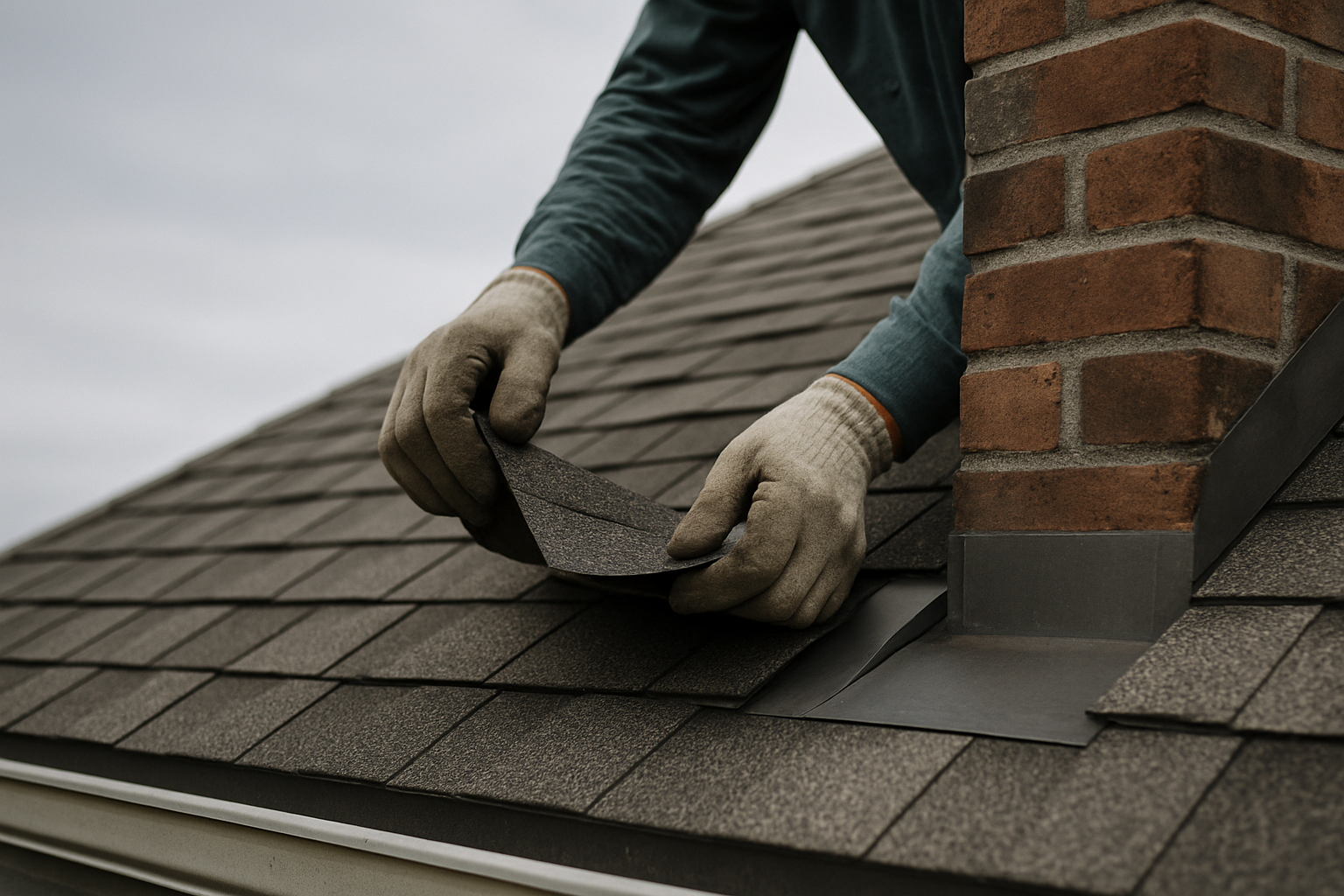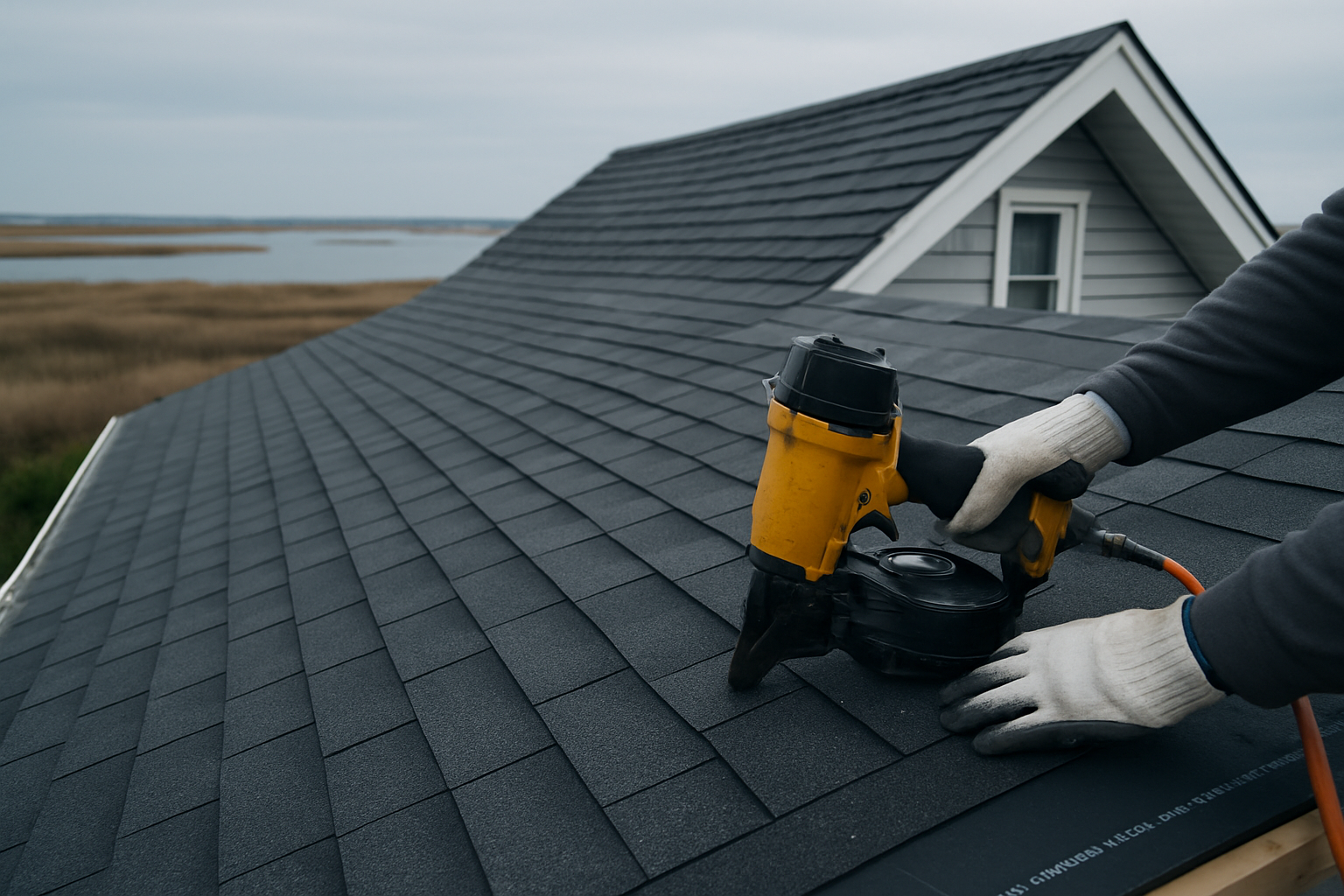
For most Atlantic County homes, the best time to replace an asphalt shingle roof is a dry stretch in spring or early fall, when the shingles can warm up and seal before nor'easter season. Fall is the strongest window because it puts a sealed roof in place before the coastal storms; winter cold and summer heat each force installation compromises.
Why shingle sealing controls the schedule
An asphalt shingle roof is not finished when the last nail goes in; it is finished when the courses seal to one another. Laminated architectural shingles carry a heat-activated adhesive strip along the exposure. Once the shingle surface reaches the temperature the manufacturer specifies for that product, the strip softens and bonds the course above to the course below. That bond is what turns thousands of individual shingles into a single, wind-resistant surface.
Note the careful wording: the temperature the manufacturer specifies. There is no one sealing number that applies to every shingle on the market. The asphalt shingle sealing temperature is a product-specific number, not an industry constant. The required temperature is printed on the bundle wrapper and in the installation instructions for the specific product, and it can differ between lines from the same mill. Before you schedule around a number you found on a forum, check the wrapper for the shingle your roofer is actually proposing.
Below that window, the adhesive can stay stiff. The shingles remain attached by the nails alone. A nailed-but-unsealed roof is not a finished roof, and the difference shows up exactly where Atlantic County punishes roofs: in wind. Unsealed shingle tabs can be lifted by sustained ocean wind on the barrier islands or by the gust fronts that arrive with a coastal low. Once a tab lifts, wind-driven rain finds the underlayment, and the damage compounds.
Think of the seal as the difference between a stack of shingles and a roof. The nails hold each shingle to the deck. The seal bonds each course to the one below it, so wind that gets under one tab cannot peel back the whole slope. Without the seal, every tab is a separate point of failure, and the failure mode — wind-driven rain under the shingles — is exactly the damage a coastal county should be most careful about.
Cold weather does not make an asphalt roof impossible. Manufacturers publish cold-weather installation procedures for this situation. Depending on the product, those procedures may call for warming the adhesive, hand-sealing each tab with a compatible adhesive, or both. The work can be done correctly in winter. What changes is the process, the labor, and the margin for error. If your roof is going on below the manufacturer's sealing temperature, get the cold-weather method in writing before the crew starts.
That is the scheduling question in one sentence: you want the shingles installed while the sealant can activate on its own, and sealed before the season that punishes unsealed shingles. In New Jersey, those two goals point to the same two windows — spring and fall — with fall the stronger of the two.
The four New Jersey weather windows at a glance
The table below is the short version of the page. It ranks the four windows by how well they line up with sealing, storm timing, and Atlantic County's coastal conditions. The month ranges are approximate; New Jersey weather does not respect the calendar.
| Window | Sealing behavior | Main weather risk | Atlantic County factor | Best use |
|---|---|---|---|---|
| Fall | Reliable on sunny days; roof seals before winter | Nor'easter and coastal lows; leaf load | Busiest season; Pine Barrens needles pack gutters | Planned replacement before winter |
| Spring | Reliable once days warm; late cold snaps need cold-weather handling | Spring wind events; wet weather | Wind finishes roofs weakened over winter | Replacement before hurricane season |
| Summer | Seals fastest, but heat softens the shingles | High heat and humidity; hurricane season | Crews start early to beat afternoon heat | Emergency or unavoidable work |
| Winter | Unreliable below the manufacturer's window | Cold sealant; ice and snow; brittle shingles | Cold-weather procedure required | Storm or leak emergency only |
Read the table as a ranking, not a guarantee. Fall and spring are the windows where a planned replacement makes sense. Summer and winter are the windows you end up in when a roof fails or a claim forces the schedule. The rest of this page explains what sits behind each cell.
Fall: the best time to replace a roof in NJ
For most Atlantic County homeowners, fall is the best time to replace a roof in NJ. The worst of the summer heat has passed, so the crew is not walking on shingles softened by a hot deck, and a clear autumn day still delivers enough sun to activate the sealant. You finish the job, the roof seals, and it goes into winter as a continuous, wind-resistant surface instead of a field of nailed tabs waiting for spring.
The timing also lines up with the local calendar. On the barrier islands, sustained ocean wind lifts shingle edges and salt air works on fasteners ahead of schedule. Inland toward the Pinelands, autumn brings tree cover, limb strikes, and gutters that pack with pine needles. A fall roof replacement in Atlantic County is the default answer because a roof replaced and sealed in fall is ready for that leaf load and the first coastal lows; it meets the season as a finished system rather than an unsealed one.
Fall also pairs naturally with the rest of the exterior. The same autumn that drops Pine Barrens needles into every gutter is the moment to have seamless gutters and guards working with the new roof, so the leaf load is carried away instead of sitting at the eave and backing water up under the drip edge.
Fall is not risk-free, and no honest roofer will tell you it is. Nor'easter season overlaps the autumn, and the fall and winter coastal lows that stall offshore are one of the three storm peaks in Atlantic County. A fall project can still be interrupted by weather, and a torn-off roof is exposed until the new one is dried in. The advantage is that you are scheduling ahead of the season rather than reacting to it — and a one-to-two-day replacement on a typical Atlantic County home gives you a short enough exposure window to work between systems.
The practical cost of fall is competition. It is the busiest window for exactly the reason this section exists: every homeowner arrives at the same conclusion. If you want a fall roof, start the process in late summer, and get the permit conversation moving early.
Spring roof replacement in NJ: the second window, with wind risk
Spring is the second practical window for a roof replacement in NJ. By late spring, daytime temperatures are generally back in the range where shingles seal on their own, the ground has firmed up enough for dump trailers and ladders, and the job finishes before the peak of summer heat. A spring replacement also puts a sealed roof in place before hurricane season, which officially runs from June through November.
Spring's problem is wind and backlog. Spring wind events are one of the three Atlantic County storm peaks — they finish off shingles already weakened over winter. A March or April roof can be interrupted by those same events, and a late cold snap can push the job back below the manufacturer's sealing temperature and into cold-weather handling. Early spring, in particular, behaves more like winter than most homeowners expect: a cold deck, stiff adhesive, and shorter working days.
The practical rule for spring is the same as fall, applied in the other direction. If you want a spring roof, call before the spring wind events start, not after they have filled every crew's schedule with emergency repairs. And when you book, ask the same question you would ask in winter: if a cold snap hits mid-job, how will the crew meet the sealing temperature?
One more spring consideration is the previous season. Roofs that were marginal in May are the ones that fail in September — and the reverse is also true. A roof that limped through winter is most visible in spring, when the snow is gone and the wind has done its work. Spring is a good time to find out whether you need a replacement, even if you schedule the work itself for fall.
Summer: heat, humidity, and hurricane exposure
Summer seals shingles fastest, which sounds like a point in its favor. The catch is that the same heat that activates the adhesive also softens the asphalt itself. Walking on a hot, sun-softened roof can scuff granules and mark shingles, so crews have to work differently — and carefully. That is why replacement day starts early: tear-off is the loud, dusty part, and everyone wants it finished before the afternoon heat.
Humidity makes the same job harder on the crew and can slow the cure of the sealants used around flashing, pipe boots, and penetrations. Then there is the season itself. Hurricane season runs through November, so a roof torn off in August is exposed if a tropical system tracks toward the coast. You do not want your deck opened to the sky in the middle of the most active part of the storm calendar.
Summer replacement is defensible when the roof is already failing or when an insurance timeline forces it. It is rarely the window a homeowner chooses voluntarily. If summer is your only option, the scheduling moves are simple: book the earliest start of the day you can, expect the crew to protect landscaping, siding, windows, and any pool or deck below the work area, and watch the forecast for the next named system before the tear-off begins.
Winter roof replacement in NJ: when cold weather forces an exception
Winter is the window to avoid for an asphalt roof, and the reason is the sealing step, not the cold on the crew's hands. Once the shingle surface stays below the manufacturer's sealing temperature, the adhesive may not activate on its own. The roof goes on nailed but unsealed, and it can stay that way until a warm day arrives — which in New Jersey can be months.
A winter roof replacement in NJ is not automatically wrong. Manufacturers publish cold-weather installation procedures, and a careful crew can follow them: warming the sealant, hand-sealing tabs, or both. What changes is the process, the labor, and the margin for error. Ice and snow make tear-off more dangerous. Shingles are more brittle in cold and can crack during handling. Underlayment and flashing sealants behave differently at low temperatures. And the correction window is shorter: a problem that would be caught and fixed on a mild day can be hidden until the first thaw.
Reserve winter for the cases where waiting is worse than a cold-weather install: a leaking roof, storm damage, a failed deck, or a closing date that will not move. Those are real, and a competent crew handles them every winter. The discipline is the same as any other season: before the job starts, get the cold-weather procedure in writing. Ask which shingle is specified, what the manufacturer's sealing temperature is, and exactly how the crew will meet it on the days the forecast will not.
How nor'easter and hurricane season change the schedule
Hurricane season officially runs from June through November, and nor'easter season overlaps and extends well past it. Atlantic County sees three storm peaks: late-summer tropical systems, the fall and winter coastal lows that stall offshore, and the spring wind events that finish off shingles already weakened over winter.
Storm season changes the schedule in two directions. First, it creates emergency work. A roof torn or lifted by wind cannot wait for the ideal sealing window; the job becomes stopping water entry now, tarping the exposed area, and then scheduling the replacement around the insurance claim and the next available dry stretch. Second, it creates backlog. After a nor'easter, crews are doing emergency repairs and tarping, and planned replacements get pushed back. A homeowner who scheduled for the shoulder is in far better shape than one who waited until the storm exposed the roof.
Emergency tarping is the bridge between the storm and the replacement. It is not the fix; it is what buys the time to file a claim, get the adjuster out, and schedule the rebuild in the next real weather window. A roof that is tarped promptly loses less to water, and a claim with a tarp-and-photo record is easier to present than one where the damage sat open for a week.
It is a plain fact of the local season: roofs that were marginal in May are the ones that fail in September. That is the argument for a free estimate before the season rather than after. A photo report showing a roof with good years left lets you wait; a report showing wind-lifted shingles tells you to schedule now, while you still control the calendar.
For a planned replacement, the storm calendar sets the deadline. You want the new roof sealed before the peaks that are most likely to test it. That means finishing before late summer if you are worried about tropical systems, and before winter if you are worried about the coastal lows and spring wind events that follow.
How a storm-damage insurance claim moves the calendar
Storm damage changes the scheduling logic. The ideal window stops being about sealing temperature alone and becomes about the claim timeline: document the damage, file the claim, meet the adjuster, get approval, and only then schedule the replacement. Each of those steps has its own clock, and none of them waits for a clear autumn day.
The first 48 hours after a nor'easter are the documentation window. Photograph the damage before repairs, note the date and cause of the loss, and record any emergency work. That record is what the adjuster is looking for, and it is what keeps a fall claim from sliding into spring. See the storm damage claims guide for the full first-48-hours sequence.
That sequence can push a September storm claim into a winter replacement. You do not control the adjuster's calendar or the insurer's approval. What you do control is the documentation that keeps the claim from stalling. A roofing contractor is not a public adjuster and does not give legal advice.
There is one trap to walk away from, and it is specific to New Jersey: no contractor may lawfully absorb or waive your deductible. Any bid that offers to "cover the deductible" is asking you to participate in fraud, and it will not make the calendar any shorter. The claim timeline is hard enough without starting from a false premise.
The scheduling takeaway is to separate two questions. The first is emergency: what has to happen now to stop water coming in. The second is replacement: when the roof will actually be rebuilt. Tarping answers the first and buys time. The claim answers the second and sets the real date. If the claim lands you in winter, the winter rules from earlier in this page apply — cold-weather procedure, sealing temperature in writing, and a crew that has done it before.
When to schedule a roof replacement in New Jersey: contractor, permit, and material
There is no magic season where every Atlantic County roofer is idle. Fall is the busiest, because homeowners arrive at the same obvious conclusion: seal the roof before winter. Spring is close behind, fed by the damage that winter wind and ice leave behind. If you want a fall roof, call in late summer; if you want a spring roof, call before the spring wind events start. The shoulder before your chosen window is where you actually buy the schedule.
Permits add their own lead time, and they are not optional. New Jersey requires a construction permit for a roof replacement, and each Atlantic County municipality runs its own construction office. Filing details and lead times vary between, say, Egg Harbor Township and Atlantic City, but the shape of the process is the same: application, permit issued, work performed, municipal inspection, permit closed. Build that into the schedule, because the permit has to be pulled before work starts — a township that is slow to issue the permit delays the tear-off no matter how perfect the weather is.
Material availability follows the same pattern as labor. A major storm can pull shingles, underlayment, and flashing toward emergency work and create short waits on planned jobs. Scheduling in the shoulder reduces the chance that your roof is the one waiting on material while the dry window passes.
Where you live in the county also shapes the schedule. On the barrier islands, wind and salt air age a roof faster, so the inspection-driven runway tends to be shorter. Inland toward the Pinelands, tree cover and shaded slopes create their own timing pressure — moss and leaf load are a fall problem, not a spring one. Neither location changes the basic windows; both change how much runway you have.
The scheduling decision is therefore a three-part check: contractor availability, permit lead time, and material. Weather gets the most attention, but in practice a homeowner who handles the other three early is the one who gets the good weather window when it arrives.
Metal and flat-membrane roofs: the temperature exceptions
Everything above is written for architectural asphalt shingles, which are what most Atlantic County homes carry. Metal and flat-membrane systems do not depend on the same heat-activated self-sealing step, so the schedule opens up.
A metal roof is mechanically fastened, and its panels do not need a warm day to bond to one another the way shingle courses do. That makes metal far less temperature-sensitive than asphalt, which is useful if a project lands in late fall or early spring. Metal is not temperature-proof: the sealants used at laps, penetrations, and flashings still have their own application-temperature ranges, and the installer must follow them. Metal also brings its own trade-offs — weight, cost, and a different sound profile — but sealing is not one of its scheduling constraints.
Flat-membrane roofs are governed by their own installation requirements. Some membranes are adhered, some are mechanically attached, and some use heat-welded seams; each method has its own temperature range for adhesives or welding. The point is not that flat roofs can be installed in any weather. The point is that the governing number comes from the membrane system, not from an asphalt sealing strip.
If your home has a flat or low-slope section, or you are considering metal, do not assume the asphalt calendar applies. Ask which system is specified and what its temperature limits are. The answer may widen your window — or narrow it in a way that surprises you, which is exactly why you ask before you book.
Before you pick a window: know whether the roof can wait
The best time to replace a roof is partly a question of whether you need to replace it yet at all. A free estimate that comes with photos of what is actually up there changes the decision. If the roof has ten good years left, the answer is to keep the report and wait; if it genuinely needs replacing, the same photos tell you how much runway you have.
That runway is what determines how choosy you can be about the window. A roof with a season or two of life left lets you wait for fall. A roof with lifted shingles and a leak does not — it schedules you. Roofs that were marginal in May are the ones that fail in September, which is the case for getting the estimate before the season rather than after.
The estimate also settles the sealing question before it becomes an argument on the roof. Knowing the roof's condition, the material being proposed, and the manufacturer's sealing temperature lets you have the cold-weather conversation in advance instead of discovering it in January. The more you know before you pick a window, the more the window is a choice rather than a scramble.
What the weather actually has to cooperate on during the job
Most single-family asphalt replacements in Atlantic County are one- to two-day jobs. That is short enough to thread between systems, but only if you understand what each phase needs from the weather.
Tear-off is the loud, dusty part, and it needs a dry deck. Crews start early because they want the old roof off and the underlayment down before afternoon heat or an afternoon shower. Before anything comes off, a careful crew sets dump trailers, lays tarps over landscaping and against the foundation, and protects siding, windows, and any pool or deck below the work area. Cars should come out of the driveway and off the apron near the trailers.
Underlayment and ice-and-water shield need a dry surface to bond properly. Flashing, valley metal, pipe boots, and drip edge need sealant that can cure. The shingle courses need enough warmth to activate the adhesive — or a documented cold-weather procedure. Each phase has its own weather sensitivity, which is why a forecast that looks fine for the week can still contain a day that is wrong for one phase.
The practical result is that you are not really choosing a week; you are choosing a window and then working with the crew to place the phases inside it. A roofer who explains which phase needs what — rather than promising the whole job on a single nice day — is the one you want managing your calendar.
Common mistakes when scheduling a roof replacement
These are the mistakes that turn a well-timed roof into a rushed one.
- Treating the "best time" as a single month and refusing everything else. The honest answer is a window, not a date. Choose the season that lines up with sealing and storm timing, then take the first reliable dry stretch inside it.
- Scheduling a winter asphalt job without asking about the cold-weather procedure. The shingle has a manufacturer's sealing temperature, and the crew either meets it or the roof stays unsealed. Get the temperature and the method in writing before the job starts.
- Waiting until the roof is leaking to call. By then the schedule is dictated by emergency backlog, and the sealing window is whatever the calendar offers. A free estimate before the season tells you whether you have time to be choosy.
- Forgetting the permit lead time. New Jersey requires a permit for a roof replacement, and each municipality runs its own construction office. Confirm timing with the township before you book the crew's dates, not after.
- Assuming a storm claim means you can schedule immediately. The claim has its own sequence — document, file, adjuster, approval — and it does not wait for clear weather. Plan the replacement around that timeline, and never sign a bid that offers to absorb your deductible.
Frequently asked questions
What is the best time of year to replace a roof in New Jersey?
For an asphalt shingle roof, spring and fall are the practical windows, with fall the stronger of the two. Both give you dry-enough weather and enough warmth for the shingles to seal, and both put a sealed roof in place before a punishing season. Winter cold and summer heat each force installation compromises that a planned schedule should avoid.
Can a roof be replaced in winter in New Jersey?
Yes, but it becomes a different job. Once temperatures stay below the manufacturer's sealing temperature, the shingles may not seal on their own, and the installer must follow the manufacturer's cold-weather procedure — warming the adhesive, hand-sealing tabs, or both. Winter is best reserved for emergencies where waiting would let water do more damage.
What temperature do asphalt shingles need to seal?
There is no single industry-wide number. Each shingle manufacturer prints the required sealing temperature on the bundle wrapper and in its installation instructions, and it can differ between product lines. Below that temperature the adhesive may not activate on its own. Confirm the number for your specific shingle and get the cold-weather method in writing.
Should I wait until after hurricane season to replace my roof?
Not necessarily. Hurricane season runs from June through November, and nor'easter season overlaps and extends past it, so waiting for "after the season" can mean waiting until winter. A fall replacement puts a sealed roof in place before the worst of the coastal lows, which is usually better than leaving a marginal roof up through the season.
Does a storm-damage insurance claim change when I can schedule a replacement?
Yes. The claim adds its own sequence — document the damage, file, meet the adjuster, get approval — before the replacement can be scheduled. A September storm claim can land in a winter replacement. Document everything early, keep records of emergency work, and plan the replacement around the claim timeline.
Are metal or flat roofs less dependent on warm weather than asphalt shingles?
Generally yes. Metal panels are mechanically fastened and do not rely on a heat-activated seal to bond, and flat-membrane systems are governed by their own installation methods rather than an asphalt sealing strip. Neither is weather-proof: sealants and adhesives still have temperature ranges, so ask which system is specified and what its limits are.
The schedule starts with knowing whether you need a roof at all. HappyRoof offers a free estimate with photos of what is actually up there, so you can decide with evidence instead of a sales pitch. Call (609) 525-4521 to book the estimate before the season you are trying to schedule for.