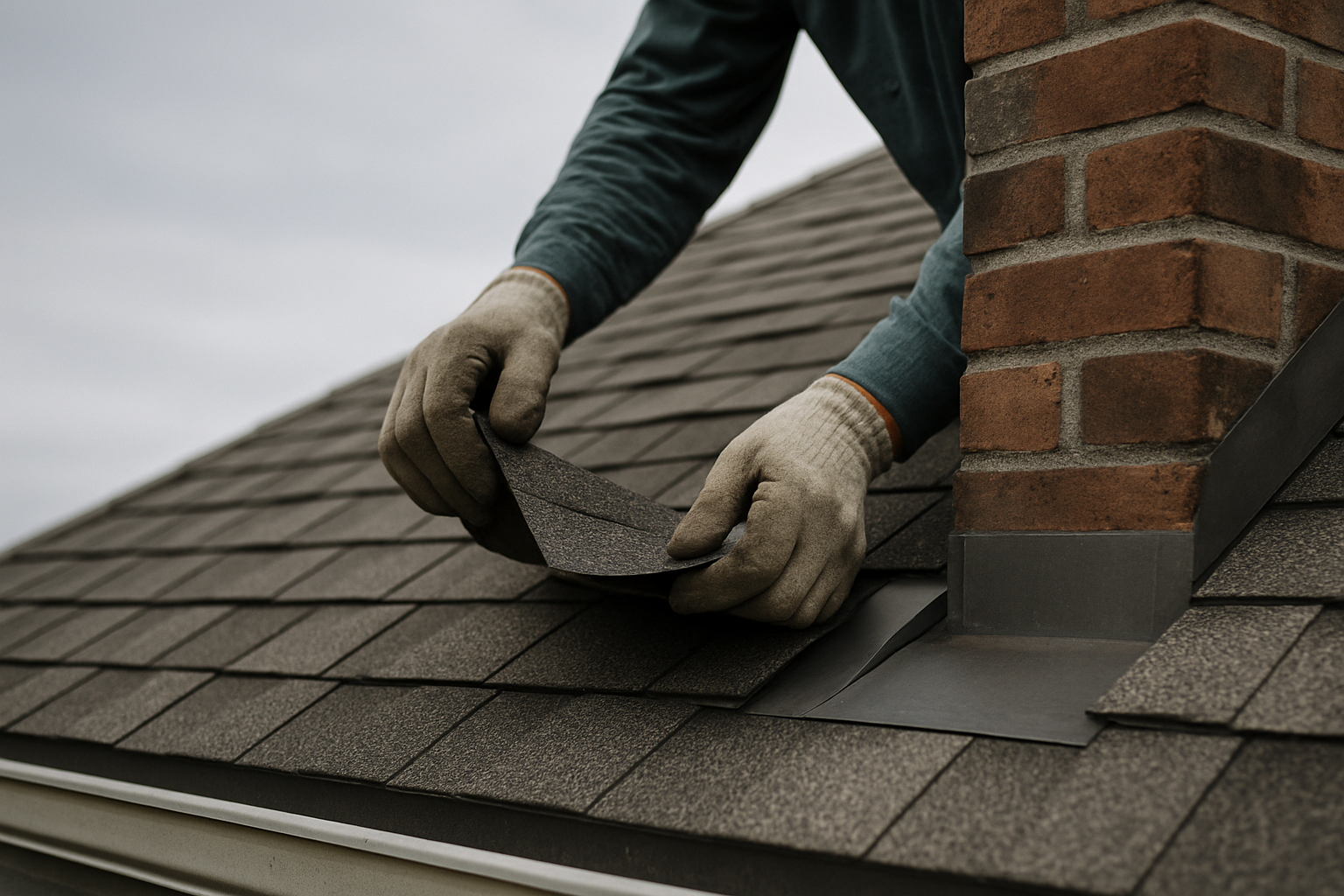
When you buy a house with an old roof in NJ, the roof becomes three problems at once: an inspection question, an insurance-binder question, and a negotiation question. Before closing, get a photo-documented roof inspection that estimates remaining life, confirm your insurer will bind coverage on the aged roof, and resolve whether the seller replaces, credits, or reprices.
An old roof does not have to kill the deal, but it has to change how the deal is priced and scheduled. Most buyers treat the roof as one yes-or-no item on the inspection report. It is actually three separate questions with three different decision-makers: the roofer who tells you what remains, the insurance underwriter who decides whether the house can be covered as it stands, and the seller who has to absorb or credit the cost. Handle them in that order and the roof stops being a surprise; handle them out of order and a five-year roof can quietly become a closing-day problem.
What buying a house with an old roof in NJ actually commits you to
When a listing says "roof is original" or the disclosure lists an age that is past two decades, you are not buying a roof. You are buying the remaining service life of a roof, and in Atlantic County that life is consumed faster than it would be inland. Coastal exposure, nor'easters, and high summer attic heat all accelerate the same chemistry that eventually sends granules into the gutters and lets wind-driven rain under the shingles.
That means the purchase has to answer three questions before you are bound:
- Condition. How many useful years are left, and what does it cost to repair or replace now?
- Insurance. Will a carrier bind hazard coverage on the roof as it sits, and on what valuation basis?
- Money. Who pays for the roof the day after closing — you, the seller, or a negotiated split?
A standard home inspection answers only part of the first question, and even then only as a trigger. The insurance question is answered by an underwriter, not by the seller's agent. The money question is answered in the contract, and it is almost always better to answer it with a written roofing proposal in hand than with a round number someone made up at the kitchen table.
What a standard home inspection can and cannot tell you about the roof
A general home inspector's job is breadth, not depth. The inspector will look at the roof from the ground, from a ladder, or with a drone, note the visible condition, flag obvious problems, and estimate age if the material and disclosure allow it. That is genuinely useful. The report is usually what lets you invoke the inspection contingency and demand a closer look.
What a standard home inspection cannot reliably tell you is the number you actually need: remaining life in years. A general inspector is not a roofing contractor. He or she typically will not pull a shingle, may not walk a steep or fragile roof, and will not give you a repair-versus-replacement cost or a written remaining-life assessment. The report will tell you the roof is "near the end of its useful life" or "showing granule loss" — both true and both useless for pricing a negotiation.
There is also a practical limit on access. A steep two-story roof, a wet or icy surface, or a fragile roof that should not be walked can all keep a general inspector on the ground, where the report becomes a set of binocular observations and drone photos. That is a reason to get a roofer on the roof, not a reason to skip the closer look.
The gap between a general report and a roofing diagnosis is why the second step exists. When the general inspection flags age or damage, the buyer should order a roofing contractor's inspection before the contingency deadline passes. Treat the general inspection as the alarm, not the diagnosis. The diagnosis comes from someone who inspects roofs every day and can put a number of years and a written price on what they see.
Why a photo-documented roof inspection is worth doing before you sign
You cannot negotiate with adjectives. "The roof looks old" buys you nothing. "The roof has an estimated three to five years of remaining life, granule loss across both slopes, curling shingle corners, and a patched valley that is already lifting, and a full replacement is priced in the attached written proposal" is a different conversation entirely.
A photo-documented roof inspection gives you three things a general inspection does not:
- Evidence. Photographs of the actual defects, so the seller and the seller's agent are arguing with pictures rather than with your opinion.
- A remaining-life estimate. A roofer who will tell you the roof has ten good years left when it does, and who will tell you when it has three, is the only kind of inspection worth paying attention to.
- A written, itemized proposal. A flat number for repair or replacement, before you agree to a credit amount, so the negotiation is anchored to a real scope of work.
In Atlantic County, a free inspection with real photos of your own roof and an honest answer on whether it needs replacing is exactly the service to ask for, and a written price should come before anything starts. The attic side matters as much as the roof side: the entry point for a leak is rarely directly above the stain on the ceiling, so an inspection that skips the attic is guessing. For more on how remaining life is actually assessed here, see the roof lifespan and inspection questions for Atlantic County.
The distinction between a roofing inspection and a sales estimate also matters in a purchase. An estimate built to sell a roof will find a reason to replace it. An inspection built to document condition will tell you when the roof has life left and when it does not. When you are about to buy a house, the second kind is the only kind that helps you negotiate.
Red flags to look for on the roof and in the attic
Some roof problems announce themselves. Others only show up when you know where to look. When you are walking the property with the inspector or reviewing a roofer's photos, these are the signals that separate a roof with life left from one that is already failing.
| What you see | Where you look | What it means for the purchase |
|---|---|---|
| Granules collecting in gutters and at downspout outlets | After rain, along gutter runs and at downspout mouths | The shingle surface is shedding; protection is thinning and will not recover |
| Shingle corners curling upward or cupping into a bowl | Sun-exposed slopes, especially south and west | The shingle is past its flexible life and is lifting in wind |
| Bald spots where the black fiberglass mat is visible | From the ground and from the roof edge | The granule layer is gone and the mat is exposed to UV |
| Patches, tar, or sealant smeared on flashing | Chimneys, valleys, pipe boots, and wall intersections | A prior leak was sealed rather than repaired, and the repair is often the next leak |
| Water stains on attic decking or rafters | Underside of the sheathing, around penetrations | Water has moved through the deck at some point; an active leak has to be ruled out |
| Daylight visible through the roof deck | The attic, with the lights off | There are openings in the roof system, which is a replacement signal, not a caulk job |
| A sagging or wavy roof line, or decking that flexes | The exterior sight line and underfoot when walked | The deck or structure is fatigued, not just the shingle surface |
| Multiple leaks in different areas of the house | Ceilings, walls, and attic in separate rooms | The failure is distributed across the roof, not confined to one defect |
Two of these deserve special attention in a purchase, because sellers and listing agents routinely minimize them.
Sealant on flashing. A bead of sealant around a chimney, valley, or pipe boot usually means someone found a leak and reached for a tube instead of fixing the entry point. Sealant fails, shrinks, and separates, and the leak returns. The proper repair is to correct the flashing detail, not to reseal a guess. If the photos show sealant, ask when it was applied and whether the underlying flashing was ever corrected.
Attic decking stains. A stain on the underside of the sheathing is evidence that water has traveled through the deck, even if the ceiling below is clean. The entry point is rarely directly above the stain, which is why the attic side of the inspection matters. A roofer who finds the actual source instead of patching the stain is the difference between a real fix and a recurring leak. For the specific ways flashing leaks are diagnosed, see roof flashing repair in Atlantic County.
One finding is rarely enough to condemn a roof. Granule loss on a shaded north slope means something different from granule loss across every slope plus curling corners plus a patched valley plus leaks in two rooms. When two or three of these signals show up together, patching individual spots stops being economical, and the purchase negotiation should shift from "repair" to "replacement."
How an old roof affects your insurance binder in New Jersey
The insurance binder is where old-roof purchases most often stall, and it is the part buyers are least prepared for. A mortgage lender will not close without evidence that hazard coverage is in force. The carrier has to underwrite the property before it issues that evidence, and the roof is one of the first things an underwriter asks about.
When the roof is aged, underwriting becomes the bottleneck. The carrier may ask the roof's age, material, and condition; may request photographs or a recent roof inspection; and may decline the property, exclude the roof, or change the valuation basis depending on what it sees. None of that is a single New Jersey rule. It is carrier-by-carrier underwriting, and two carriers can read the same roof two different ways.
The practical consequences for a buyer are threefold:
- Start early. Begin the insurance conversation the moment the general inspection flags the roof, not the week of closing. A binder that stalls on the roof can push closing past the contract date and expose a rate lock or a financing contingency.
- Disclose honestly. Tell your agent the roof's age and condition up front. An application that understates the roof's age tends to fall apart later, when the carrier's own inspection or the claims record contradicts it.
- Get the valuation basis in writing. Ask the agent to confirm whether the roof would be covered on an actual cash value or replacement cost basis, because the two are not the same thing.
The valuation question matters most for a roof with only a few years left. Actual cash value, or ACV, pays the cost to repair or replace minus depreciation for age and condition. A roof near the end of its life can depreciate down to very little, which means a covered loss can leave the buyer funding most of a replacement out of pocket. Replacement cost coverage pays to repair or replace with similar materials, minus the deductible and within the policy's terms, but the carrier has to be willing to write it on the roof's current condition.
| Coverage basis | What it pays after a covered loss | What it means for an aged roof |
|---|---|---|
| Actual cash value (ACV) | Replacement cost minus depreciation for age and condition | A roof with little remaining life can yield a small payout after a loss |
| Replacement cost | Cost to repair or replace with similar materials, minus the deductible, within policy terms | Pays better, but the carrier must be willing to write it on the roof as it sits |
Coastal underwriting adds a second layer in Atlantic County. Wind coverage, named-storm deductibles, and the risk of wind-driven rain all factor into how a carrier prices and conditions a policy near the shore. That is an agent question, and the answer can vary from one block to the next. The buyer's job is to ask it early enough that the answer can be folded into the negotiation rather than discovered at the closing table.
A roofer is not your insurance advisor, and HappyRoof does not act as a public adjuster. What a roofer can do for a claim is document what the roof actually shows and meet an adjuster on site, which is the kind of help that matters after a nor'easter. The underwriting decision — whether to bind, at what valuation basis, and with what wind or named-storm deductible — is between you and your agent. For the documentation side of a claim, see New Jersey roof storm damage claims.
One more caution belongs here because it comes up during old-roof negotiations: in New Jersey, a contractor may not lawfully absorb or waive a policy deductible. If a repair pitch includes the deductible being "handled," walk away from that part of the pitch and confirm the rest with your agent.
Repair credit, seller replacement, or price reduction: what each means for you
Once you know the roof's condition and your insurance situation, the negotiation is about who carries the risk. There are three standard ways to resolve an old roof in a New Jersey purchase, and they are not interchangeable.
| Option | Who performs the work | Who controls scope and contractor | The buyer's actual risk | Usually best when |
|---|---|---|---|---|
| Repair credit at closing | The buyer, after closing | The buyer | The buyer carries the disruption and must fund the work; the credit amount may be limited by lender rules | The buyer wants to choose the contractor and control the scope, and can manage the project after moving in |
| Seller replaces before closing | The seller, before closing | The seller, who often chooses the lowest bid | The buyer inherits whatever scope and workmanship the seller purchased, and closing can slip if the work or inspection is not done in time | The roof is clearly at the end of life and the buyer wants a new roof at move-in without managing the project |
| Price reduction | The buyer, after closing | The buyer | The mortgage basis drops slightly, but no money is set aside for the roof itself | The buyer has cash reserved and wants to finance or pay for the roof on their own terms |
A repair credit is not a roofing invoice, and it is not financing. It is a real-estate term in the contract: the seller contributes a set amount toward the buyer's closing costs or prepaids, which frees up the buyer's cash to pay for the roof after closing. Lenders cap seller concessions as a percentage of the purchase price, and the current limit depends on the loan program and down payment. Your loan officer, not the roofer, can tell you the number for your file.
A price reduction works differently from a credit, and the difference shows up in the loan. Reducing the purchase price lowers the mortgage amount and the down payment only slightly, and it does not put a roof-sized sum into your hand at closing. A credit, by contrast, reduces the cash you need to bring to the table, which can be the difference between being able to fund the roof right away and putting it off. Both leave you responsible for actually doing the work after closing, so the credit amount should be based on a real written proposal, not on a guess.
The strategic difference between the three is control. A seller who replaces the roof before closing controls the contractor, the material tier, and the scope, and a seller under contract to move has an incentive to buy the cheapest roof that satisfies the contingency. If you take the credit or the price reduction instead, you control all three, but you also carry the scheduling and the disruption.
If you do accept a seller-replaced roof, do not accept a verbal promise. Put the scope in writing: full tear-off where the layer count requires it, permit pulled, municipal inspection performed and closed, and a written confirmation that the work is complete before closing. New Jersey requires a construction permit for a roof replacement, and the requirement is not optional. Each Atlantic County municipality runs its own construction office, so the permit and inspection timeline has to be verified against the closing date, not assumed.
The layer count also belongs in the negotiation. New Jersey's adopted building code limits a roof to two layers of covering. If the existing roof already has two layers, the next roof is a full tear-off no matter what, and an overlay is not a legitimate way to make the seller's number look smaller. A buyer who understands this will not accept a two-layer roof being papered over with a third.
If the roof is being replaced after closing, the buyer faces the same material decision any homeowner does: architectural asphalt, metal, or membrane depending on the slope. For a buyer planning a replacement on a coastal home, the trade-offs between standing seam metal and architectural asphalt shingles for South Jersey are worth reading before the credit amount is finalized, and the scope questions in an asphalt shingle roof replacement in Atlantic County will show up again when you write the actual contract.
Inspection-contingency timing, quotes, and the closing schedule
The contingency clock runs faster than most buyers expect. The inspection window is set by the contract, and every follow-up — the roofer's visit, the written proposal, the negotiation, the amended agreement — has to happen inside it. If the window passes, the leverage passes with it.
The sequence that keeps the roof from derailing the closing looks like this:
- General inspection. This is the trigger, not the answer. It establishes that the roof needs a closer look and starts the clock.
- Roofing inspection and photos. Book it as soon as the general inspection flags the roof. The roofer documents defects, checks the attic side, and estimates remaining life.
- Written proposal. Get an itemized number for repair or replacement, in writing, so the negotiation is anchored to a real scope rather than a guess.
- Insurance conversation. Confirm with your agent, in writing, that the carrier will bind on the roof as it sits or on the agreed repair.
- Negotiation and amendment. Convert the roofer's number and the insurer's answer into a credit, a seller repair, or a price change in the contract.
- Closing verification. If the seller is doing the work, confirm the permit is closed and the municipal inspection is done before you sign.
Steps two through four can happen in parallel. The roofer and the insurance agent are answering different questions, and neither has to wait for the other. What cannot be compressed is the permitting. Each Atlantic County municipality runs its own construction office, and filing details and lead times vary between towns. If the seller's repair is going to involve a permit and a municipal inspection, that work has to be scheduled against the closing date early, not discovered the week before.
Quotes also take longer than buyers assume, because a real quote is not a rough number. A real quote is an itemized written proposal covering tear-off, materials, permits, disposal, and cleanup, and it comes from someone who has looked at the actual roof. A round number from a listing conversation is not a quote, and it should not be the number the credit is based on.
For buyers on the island towns, one more scheduling note applies. Staging is the challenge on narrow lots and shared driveways, and summer parking restrictions can delay access. That affects how early the inspection has to be booked and how much slack the closing schedule needs. The logistics are part of the timeline, not a detail to discover after the contract is signed.
There is also a storm risk specific to a coastal transaction. If a nor'easter hits between inspection and closing, the roof can change condition in a weekend. The purchase should account for that possibility: know who is responsible for interim damage under the contract, and know that emergency tarping exists to keep a damaged roof from turning into an interior loss while the deal is still being negotiated.
Questions to ask before you accept an old roof
You are allowed to ask for information that is not in the listing, and the answers change the price.
For the seller's disclosure and the listing agent:
- What is the roof's actual age, and what documents support it — a permit record, an invoice, or an estimate?
- Has the roof ever leaked, and where? What was repaired, and by whom?
- Has a homeowner's insurance claim ever been filed for the roof, and what was the outcome?
- Is the current roof a single layer or a second layer over an earlier roof?
- Has the roof been patched or resealed, and can the seller produce the repair records or photos?
For the roofing contractor's remaining-life assessment:
- How many years of useful life do you estimate remain, and what specifically are you basing that on?
- Is the roof a candidate for repair, or is replacement the only honest answer?
- What does the repair or replacement price include in writing — tear-off, materials, permits, disposal, cleanup?
- Is the decking sound, or will it need sheathing work once the shingles come off?
- What is the layer count, and does New Jersey's two-layer limit force a tear-off?
- Will the written proposal itemize the scope so the seller's credit is based on the same work I will actually authorize?
The layer-count question is not a formality. A roof that already carries two layers has no room for another, and the next roof is a full tear-off regardless of how the seller prices it. Asking the question before you negotiate keeps the credit from being based on an overlay that New Jersey will not allow.
Atlantic County roofs age differently, and the purchase should account for that
Roof age is a number, but remaining life is a local condition. A roof that was specified for an inland subdivision is not specified for a bayfront house on an island town, and the difference shows up in the purchase.
Three Atlantic County conditions accelerate the same failure chemistry:
- Coastal wind and exposure. Coastal conditions work the shingle surface and the fasteners harder than an inland lot, and wind-driven rain finds openings that a calm inland roof would never test.
- Summer attic heat. High attic temperatures cook the shingles from below, shortening the flexible life that keeps them sealed in wind.
- Nor'easters. Storm-driven rain and uplift arrive together, and a roof with marginal remaining life is exactly the roof that fails during the next one.
The housing stock also varies by town in ways that change the roof question. The older neighborhoods of Atlantic City and Pleasantville frequently have low-slope rear and porch roofs that need membrane work rather than shingle work, which is a different repair and a different material. A buyer looking at one of those homes should understand that the rear roof may be a flat-roof question, not a shingle question. See low-slope and flat roof repair for shore and addition roofs for how those are diagnosed.
None of this means an old roof should automatically kill the purchase. It means the purchase price and the closing schedule should be built around the roof's actual remaining life, not around a generic expectation of how long roofs last. A roof with three years left is a known, quantifiable cost. The only version of that cost that should surprise you is the one you never had inspected.
Frequently asked questions
Can I still get homeowners insurance if the house has an old roof?
Usually yes, but the terms depend on the carrier's underwriting. The insurer may ask the roof's age, material, and condition, may request photos or an inspection, and may write the roof on an actual cash value basis rather than replacement cost. Start the insurance conversation as soon as the inspection flags the roof, and confirm the valuation basis in writing before you rely on it.
Should I ask the seller to replace the roof or give me a credit?
It depends on whether you want control or convenience. A credit lets you choose the contractor and scope after closing, but you carry the disruption and must fund the work. A seller replacement puts a new roof on before closing, but the seller controls the scope and often chooses the lowest bid. If the seller replaces, require a written scope, a permit, and a closed municipal inspection.
What does a standard home inspection tell me about the roof?
A general inspection flags visible condition and obvious problems, which is enough to invoke the contingency and justify a closer look. It will not reliably tell you remaining life in years or a repair-versus-replacement cost. For that, order a roofing contractor's inspection with photos and a written proposal before the contingency window closes.
Can an old roof be used to negotiate the price?
Yes, but only with evidence. A photo-documented inspection and an itemized written proposal turn "the roof looks old" into a number the seller has to answer. The negotiation can resolve as a credit, a seller replacement, or a price reduction, and the choice changes who controls the work and who carries the risk after closing.
How much remaining roof life is too little when buying?
There is no single cutoff, but the practical line is when the roof will need replacement during your planned ownership and the seller is not pricing for it. If the assessment says three to five years and you plan to stay longer, the purchase should resolve that cost now, either through a credit, a price adjustment, or a seller replacement before closing.