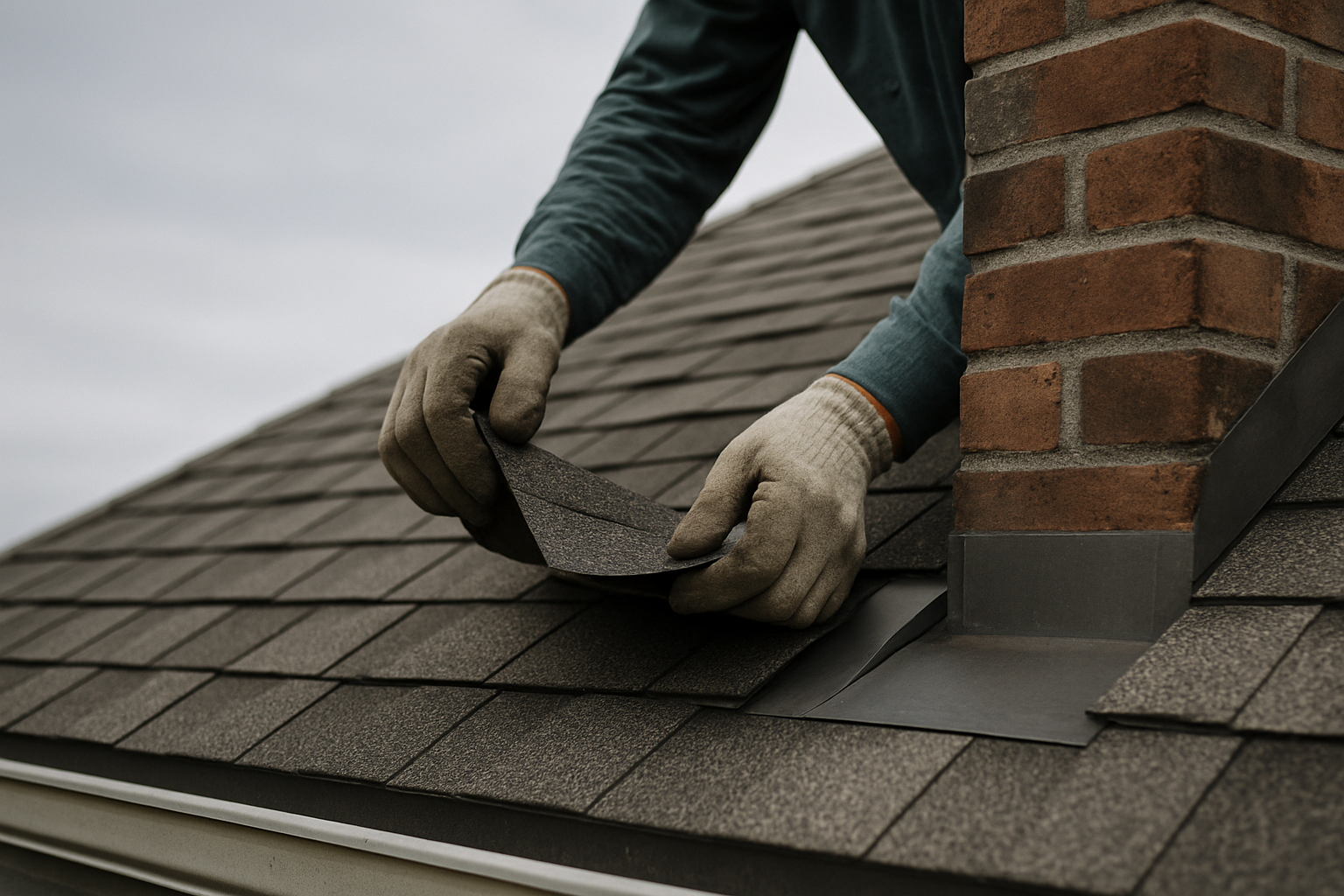
Selling a house with an old roof in NJ does not have to mean a last-minute credit. The decision is repair, replace, or disclose with documentation. A free pre-listing inspection with dated photos and an honest remaining-life assessment lets you choose before the buyer's inspector chooses for you.
In Atlantic County, a roof is never a neutral detail in a sale. On the barrier islands, sustained ocean wind lifts shingle edges and salt air corrodes fasteners ahead of the inland schedule. Inland toward the Pinelands, tree cover means limb strikes, shaded slopes that grow moss, and gutters that pack with pine needles every autumn. A roof that was specified for a subdivision in central Jersey is not specified for a bayfront house in Margate, and buyers, home inspectors, and insurance underwriters in this market have learned to look for the difference.
A complete asphalt roof replacement on a typical Atlantic County home usually runs $9,000 to $25,000 and takes one to three working days. When a house goes on the market, the same roof that kept the house dry becomes three things at once: a disclosure item, an inspection target, and an insurance condition. This guide works through each one so a seller can choose repair, replacement, or documented disclosure instead of reacting to a buyer's objection at the eleventh hour.
What does New Jersey require a seller to disclose about a roof?
Roof history belongs in the seller's written disclosures for the transaction, and the exact form and its current requirements should be reviewed by the listing agent and a New Jersey real estate attorney. HappyRoof is a roofing contractor, not a legal advisor, so this section describes how roof condition intersects with a sale rather than what any specific form requires.
The practical starting point is the same for every Atlantic County seller: if water has come through the ceiling, if a roofer has told you the decking is soft or the flashing is failing, or if you have patched the same leak twice, that is a known roof condition and it belongs in the written record you share with a buyer. A seller who documents that history with photos and repair records puts the buyer in the same position as the seller before the offer.
An old roof is not, by itself, a failure to be fixed before sale; it is a condition to be priced. Documenting the known facts is not a promise that the roof will never leak again. What causes trouble is usually the condition that was never written down. A buyer who finds a patched stain after closing is in a very different position than one who read "recurring chimney leak, repaired and documented" before making an offer.
The practical rule for an Atlantic County seller is straightforward: disclose what you know, and support it with the same dated photos and repair records you would want to see if you were buying. In Atlantic County's older housing stock, where low-slope rear roofs and porch membranes are common, the quiet path of saying nothing tends to be the most expensive one.
How do buyers and home inspectors read roof age and remaining life?
A buyer's home inspector does not issue a pass or fail on a roof. The inspector walks the roof where safe, looks at the decking from the attic, and reports what they see: approximate age, condition of the shingles or membrane, evidence of past or active leakage, and whether the roof is at the beginning, middle, or end of its useful life. What the buyer does with that report is where the sale is won or lost.
The phrase that changes a negotiation is "at or near the end of its useful life." A buyer hears that as "this roof is a future bill," and the future bill gets turned into a price adjustment or a repair request. The inspector does not have to say the roof is leaking today. An honest statement about remaining life is enough, because the buyer knows the next replacement is a full tear-off down to the deck.
What an inspector actually looks at in a roof section is concrete: granule loss at the gutter, curling or lifting shingles, cracked or missing flashing at chimneys and valleys, deteriorated pipe boots, soft or stained decking visible from the attic, and daylight through the roof deck. None of these is subtle, and a buyer's inspector will photograph every one of them. A seller who has already seen the same photos, with a roofer's explanation of what they mean, is in a very different negotiation than a seller who meets those photos for the first time in the inspection report.
That is why remaining life matters more than calendar age in Atlantic County. Two roofs of the same age can be in very different condition: the barrier-island roof has spent years taking wind-driven rain and salt air, while an inland roof under tree cover has been fighting moss and leaf-loaded gutters. A buyer's inspector in this market is not grading the roof against a central Jersey subdivision; they are grading it against Atlantic County exposure. For the factors that actually shorten or extend a roof's life here, see the Atlantic County roof lifespan guide.
Sellers get ahead of this by obtaining their own assessment before the buyer's inspector arrives. HappyRoof's free inspection is built around an honest remaining-life answer: if a roof has ten good years left, the owner hears that instead of a sales pitch. The same assessment, in writing with photos, lets a seller answer the buyer's inspector with facts rather than with a defensive explanation.
How Atlantic County's weather changes what "old" means
Roof age is not a single number in this part of New Jersey. The same roof can be mid-life or end-of-life depending on where the house sits and which direction it faces.
On the barrier islands, sustained ocean wind lifts shingle edges and wind-driven rain finds every opening at the rake and eave. Salt air corrodes fasteners ahead of schedule, and a roof that looks fine from the curb can be failing at the fasteners that hold it down. A bayfront house in Margate needs a different specification than a subdivision roof built for a calmer inland site, and buyers who shop those towns know it.
Inland toward the Pinelands, the load is different. Tree cover means limb strikes and debris that sits on the roof. Shaded slopes grow moss, which holds moisture against the shingles. Gutters pack solid with pine needles every autumn, and a clogged gutter sends water back under the eave instead of away from the foundation. A seller in Galloway or Egg Harbor Township may be selling a roof whose enemy was leaf load and shade, not wind.
Nor'easter season adds a timing variable for sellers. A roof that passed a summer inspection can be lifted by a March storm between contract and closing, which is why storm documentation and emergency tarping exist. A seller who has a dated post-storm photo record can show whether a wind-lifted slope was repaired properly or left open.
The practical point for a seller is that "old" is a local judgment. The buyer's inspector will read the roof against Atlantic County conditions, not against a generic lifespan table. That is the same reason a pre-listing inspection should be done by someone who works these towns and knows the difference between wind damage on a barrier island and moss damage under a Pine Barrens canopy.
Repair or replace before listing: the three tests
The same three tests that settle any roof question settle the pre-listing question: age, damage spread, and cost.
The age test asks where the roof is in its useful life. If the roof is in the first half of its life and the defect is isolated, repair is usually the right call. If the roof is at or beyond its expected life and the buyer's inspector will say so anyway, a repair can read as a bandage on a roof that still needs replacement, and the seller ends up paying for both the repair and the buyer's future credit.
The damage-spread test separates a localized defect from a systemic one. A failing pipe boot, a chimney flashing leak, or a few wind-lifted shingles is a repair. Widespread granule loss, curling shingles across multiple slopes, soft decking, or a sagging roof line is a replacement signal. On the low-slope and flat roof repair roofs common in older Atlantic City and Pleasantville neighborhoods, the question is often membrane condition rather than shingle condition, which is a different repair entirely and a different material.
The cost test compares the price of the work against the cost of leaving it. A repair that removes the buyer's single biggest objection is often the cheapest way to keep a deal together. A replacement should be made because the roof needs it, not because a well-meaning neighbor says every buyer demands a new roof.
A seller should also read a pre-sale proposal the way a buyer's lender will: itemized, permitted, and complete. An itemized written proposal covering tear-off, materials, permits, disposal, and cleanup removes the day-of surprises that turn a pre-sale job into a closing delay. A patch job with no permit and no paper trail saves a little now and becomes a question mark later.
| Option | When it fits | What you gain | Risk if you choose wrong |
|---|---|---|---|
| Repair before listing | Localized defect on an otherwise sound roof | Removes the buyer's biggest objection; supports the disclosure | Spending money on a roof that still reads as old |
| Replace before listing | Roof at or near end of life | Clean inspection; insurable closing; no last-minute credit | Large outlay not fully recovered at closing |
| Disclose and price in | Documented remaining life; seller wants speed | No pre-sale outlay; honest negotiation | Buyer asks for a credit anyway |
For a localized leak at a chimney, valley, or pipe boot, the right next step is often a focused roof flashing repair rather than a full roof. For a roof that is genuinely at end of life, the same analysis applies to asphalt shingle roof replacement as it would to any pre-sale improvement.
One caution: do not let a buyer's repair request drive a roofing decision the roof itself does not justify. Buyers routinely ask for a new roof because the inspector used the word "older." The response is not automatic surrender; it is the documentation from a pre-listing assessment showing the roof's actual remaining life.
Why a pre-listing roof inspection is a seller tool in Atlantic County
Most sellers wait for the buyer's inspector to tell them about their own roof. The smarter sequence is to inspect before the listing goes live. A pre-listing roof inspection turns the roof from a surprise into a number the seller already controls.
HappyRoof's inspection is free and comes with photos of the actual roof, an honest answer on whether it needs replacing, and, if work is needed, an itemized written proposal before anything starts. For a seller, that package does three jobs at once. It supplies the facts for the written disclosures. It tells you whether the house should be listed as "sound roof" or "roof priced in." And it gives the listing agent dated documentation to hand a serious buyer.
Documentation is the underrated half of the tool. A buyer who sees dated photos of sound decking and intact flashing, with a written remaining-life assessment, has less room to ask for a speculative credit. A buyer who sees dated photos of a specific defect, disclosed and not hidden, can be told exactly what the seller did about it and what remains. Either way, the seller sets the story before the buyer's inspector writes a competing one.
The alternative is the inspection that happens after the offer, when the buyer's inspector is the first person to stand on the roof in years and every finding becomes a renegotiation. A pre-listing inspection moves that conversation earlier, while the seller still has time, leverage, and choice of contractor.
For sellers watching the calendar, the free inspection is the fastest way to learn whether the house needs a focused repair or a full replacement before the listing photos are even taken. It also prevents the worst outcome: discovering a soft deck or a failed flashing two weeks before closing, when every option is expensive and every option is rushed.
How roof age and condition affect insurance underwriting and closing
Roof age and condition routinely come up when a buyer's lender requires insurance before closing. The insurer is not being difficult for sport; it is pricing the same exposure the home inspector just described: wind-driven rain, uplift, and the cost of a future claim.
The exact underwriting thresholds vary by carrier, so a seller should not guess at them. What matters for the sale is the sequence: the buyer applies for coverage, the insurer reviews the roof's age and condition, and the policy is issued, priced up, conditioned on repair, or declined. A roof the buyer's inspector has already flagged is likely to get the insurer's attention next, and a closing can stall while a repair is scheduled under deadline pressure.
This is the strongest practical argument for resolving known defects before listing. A seller who repairs a failing pipe boot or replaces a storm-damaged slope before the sign goes up removes the condition that would otherwise surface twice: once in the inspection report and again in the underwriting file.
A seller's pre-listing documentation can also help on the insurance side, even though the buyer's policy is the buyer's responsibility. When the buyer's agent or underwriter has questions about roof age, a dated photo report and a written remaining-life assessment are concrete answers. An insurer that can see the roof's condition is more likely to underwrite it than an insurer that can only see an age in a form field.
If the roof condition stems from storm damage, there may be a claim path worth documenting before the sale. New Jersey roof storm damage claims have their own documentation rhythm, and the same dated photos that support a claim can support a disclosure. Walk away from any offer that involves someone absorbing or waiving a deductible.
Will you recover the cost of a new roof in the sale price?
Plan for honesty, not a dollar-for-dollar refund. A replacement roof rarely returns its full cost at the closing table, because most buyers treat a sound roof as the baseline condition of a house rather than an upgrade they will pay extra for. The return on a pre-sale roof usually shows up as a cleaner inspection, an insurable closing, and a negotiation where the seller is not defending a known defect.
That does not make the roof decision purely about money in versus money out. A house with an older, disclosed roof can still sell, often at a price that reflects the roof's remaining life. A house with an undisclosed failing roof sells into a dispute. The question is not "will the buyer pay me back for shingles?" The question is "which version of this transaction costs me less: fixing it now on my schedule, or negotiating it later under the buyer's deadline?"
The most expensive roof is frequently the one replaced in the final weeks before closing, when the buyer has already asked for a credit, the mortgage commitment carries a repair condition, and the seller is negotiating from a fixed closing date. That duress scenario is exactly what a pre-listing inspection is designed to prevent.
There is also a timing case for disclosure over replacement. If the roof has five or six good years left, a full replacement before listing may not move the sale price at all. The seller's better move may be to disclose the condition, document the remaining life, and let the next owner plan the replacement on their own calendar. The free inspection exists precisely to give a seller that honest answer.
An appraiser is unlikely to treat a new roof as a line-item bonus. Condition factors into the appraisal, but a roof that simply does its job is expected, not exceptional. Sellers who spend before listing should do it because the roof needs the work or the work removes a closing risk, not because they expect the appraiser to add the invoice back to the value.
What a seller should document before the listing goes live
A seller's roof file should contain four things:
- Dated photos of the roof surface, flashing, and attic decking from the pre-listing inspection.
- A written remaining-life assessment and an itemized proposal if work was recommended.
- Receipts or invoices for any past repairs, with the date and the specific defect addressed.
- Closed permit records for any prior roof replacement or structural repair.
In New Jersey, a roof replacement requires a construction permit, and the requirement is not optional based on how busy the township is. Each Atlantic County municipality runs its own construction office, so filing details and lead times vary between, say, Egg Harbor Township and Atlantic City, but the shape of the process is the same: application, permit, work, municipal inspection, permit closed. A seller who can produce a closed permit for past work removes a question before the buyer's attorney asks it.
A magnet-swept yard is not part of a listing file, but the standard is worth knowing. When HappyRoof replaces a roof, landscaping is tarped, a magnet is run over the yard and driveway for nails, and every scrap is hauled away before the crew leaves. A seller doing pre-sale work should expect that same cleanup standard, because a buyer walking the yard after closing should not find the seller's old roof nails.
What happens when the buyer's home inspection flags the roof
If the buyer's inspector flags the roof, the seller has four basic choices: repair the specific defect before closing, replace the roof if it is genuinely at end of life, offer a credit or price adjustment, or stand on the current price with documentation showing the condition was disclosed and priced in.
Documentation determines which choice is credible. A seller who can produce dated photos and a written assessment from before listing can argue that the condition was known and reflected in the asking price. A seller who is learning about the roof for the first time from the buyer's inspector is negotiating without information, which is the expensive place to be.
Any repair or replacement done as part of the sale should be permitted, inspected, and closed on the record. A buyer's lender will ask about it, and a future buyer will ask about it again. Work done quietly to close a sale becomes the next seller's disclosure problem.
If the finding is a localized defect rather than end-of-life, a targeted repair, whether chimney flashing, a valley, or a pipe boot, is often enough to satisfy both the buyer and the buyer's insurer. That is the scenario where an honest pre-listing assessment pays for itself: it distinguishes the roof that needs a full replacement from the roof that needs a focused repair.
When to inspect, repair, and decide in the sale timeline
The sequence matters almost as much as the decision.
- Before listing: get the free inspection, take dated photos, and decide whether to repair, replace, or disclose. This is when the seller has the most leverage.
- Before showings: finish any repair or replacement you are going to do, close the permit, and assemble the roof file. A house with a documented, freshly resolved roof item shows better than a house with a question mark.
- After an offer: expect the buyer's inspection, and expect the roof to appear in it if it has not been addressed. Answer with documentation, not defensiveness.
- Before closing: if the buyer's insurer conditions coverage on a repair, schedule it immediately and keep the permit on the record. The last two weeks before closing are the worst time to begin a roof project.
At every stage, the seller's goal is the same: be the first person with accurate information about the roof.
Frequently asked questions about selling a house with an old roof in NJ
Do I have to replace my roof before selling my house in New Jersey?
Not automatically. The decision is repair, replace, or disclose with documentation, and an older roof can be sold as-is if its condition is documented and the price reflects it. What a seller should not do is hide a known leak or failure. Confirm the exact disclosure form and its current requirements with your listing agent and a New Jersey real estate attorney.
What roof conditions should I document when selling in New Jersey?
Document known leaks, active or past water intrusion, failed flashing, soft or stained decking, storm damage, and any roof work you know is incomplete or unpermitted. The test is knowledge: if you know it, write it down and share it through the proper disclosure process. Confirm what the form requires with your listing agent and a New Jersey real estate attorney.
Is it better to repair or replace a roof before listing?
It depends on age, damage spread, and cost. Repair wins when the roof is otherwise sound and the defect is localized — flashing, a pipe boot, a few shingles. Replacement wins when the roof is at or near end of life and the buyer's inspector will say so anyway. A roof replacement also requires a construction permit in New Jersey, so factor that into the timeline.
Can a buyer's home inspection kill a sale over an old roof?
It can stall one, not automatically kill it. Inspectors report condition and remaining life; buyers then ask for repair, replacement, or a credit. A seller with a pre-listing assessment and dated photos can answer with facts. A seller hearing about the roof for the first time from the buyer's inspector negotiates without information, which is the expensive position.
Will a new roof increase my sale price?
Do not count on a dollar-for-dollar return. Buyers typically treat a sound roof as baseline condition, not a premium feature. The return usually arrives as fewer inspection objections, an insurable closing, and a faster negotiation. The honest question is which costs less: fixing on your schedule now, or negotiating later under a closing deadline.
How do I document my roof's condition before listing?
Start with a free pre-listing roof inspection that includes dated photos of the surface, flashing, and attic decking, plus a written remaining-life assessment. Add repair invoices and closed permit records for any past roof work. That file supports the written disclosures and gives the listing agent dated documentation to answer buyer objections.